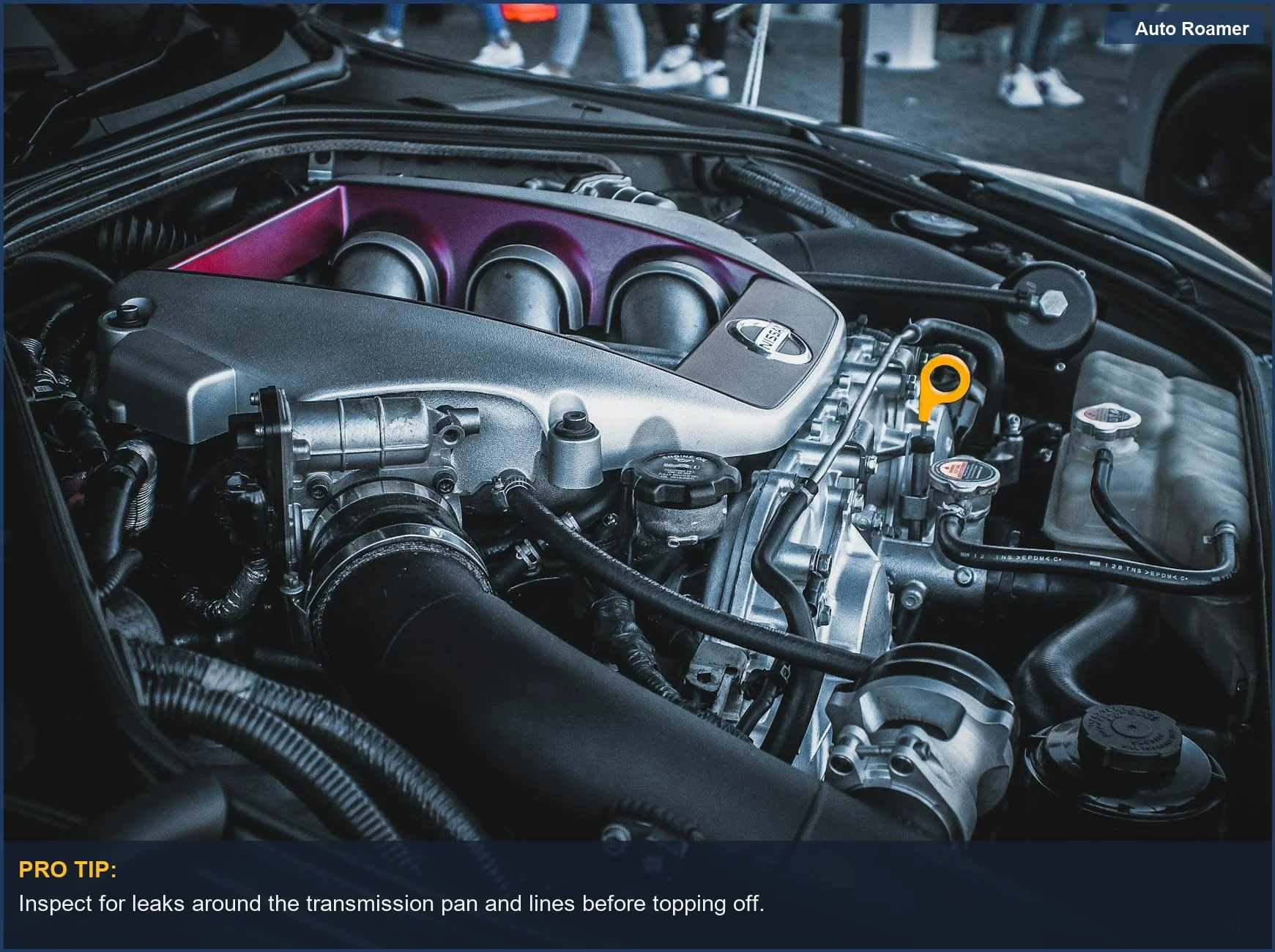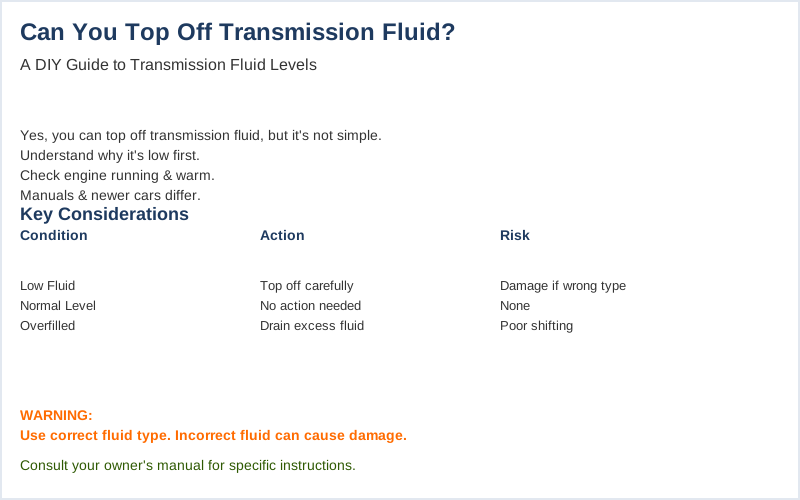
The Short Answer: Level vs. Condition
Topping off transmission fluid only restores the level — it is a stopgap for a low level or a slow leak. A full change or flush restores the fluid's condition: its additives, detergents, and protective properties. Top off to get home safely and to buy time while you find the leak; change the fluid when it is old, dark, or smells burnt.
The reason "should I top off or change my transmission fluid?" trips so many people up is that the two jobs sound similar but fix completely different problems. One is about how much fluid is in the transmission. The other is about how good that fluid still is. Confusing the two is how a car ends up with the right amount of worn-out fluid — full on the dipstick, and still shifting badly.
Topping off means adding fluid to bring a low level back up to the marked range. It does nothing for the fluid already in there. If that fluid is fresh and you simply lost a little to a minor weep, topping off is a perfectly reasonable fix. If the fluid is five years and 60,000 miles old, topping off just dilutes tired fluid with a splash of new — the transmission is still running on mostly degraded oil.
Changing the fluid replaces the old fluid with new. That restores the additive package that protects clutches, seals, and gears, and it removes the heat-damaged, oxidized fluid that has lost its ability to do that job. A change is maintenance; a top-off is a correction. The rest of this guide walks through exactly when each one is the right call, the difference between a drain-and-fill and a flush, the "lifetime fluid" myth, and the real risk of topping off fluid that should have been changed.
What Topping Off Actually Does (and Doesn't)
Topping off is purely a level correction. Automatic transmissions rely on fluid for three things at once: lubrication of moving parts, hydraulic pressure to engage clutches and shift gears, and cooling. All three depend on the transmission being filled to the correct level. Drop below that level and the pump can start drawing in air, pressure becomes erratic, shifts get harsh or slip, and the fluid that remains overheats because there is less of it to carry the heat away.
Adding fluid fixes that immediate problem. What it does not do is improve the quality of the fluid already in the system. Transmission fluid is a carefully formulated oil with a package of additives — friction modifiers, anti-wear agents, detergents, and anti-oxidants. Those additives are consumed and broken down by heat over time. Pouring a quart of fresh fluid on top of several quarts of exhausted fluid raises the level but barely moves the overall condition.
There are also two hard rules that make topping off less casual than topping off windshield washer fluid:
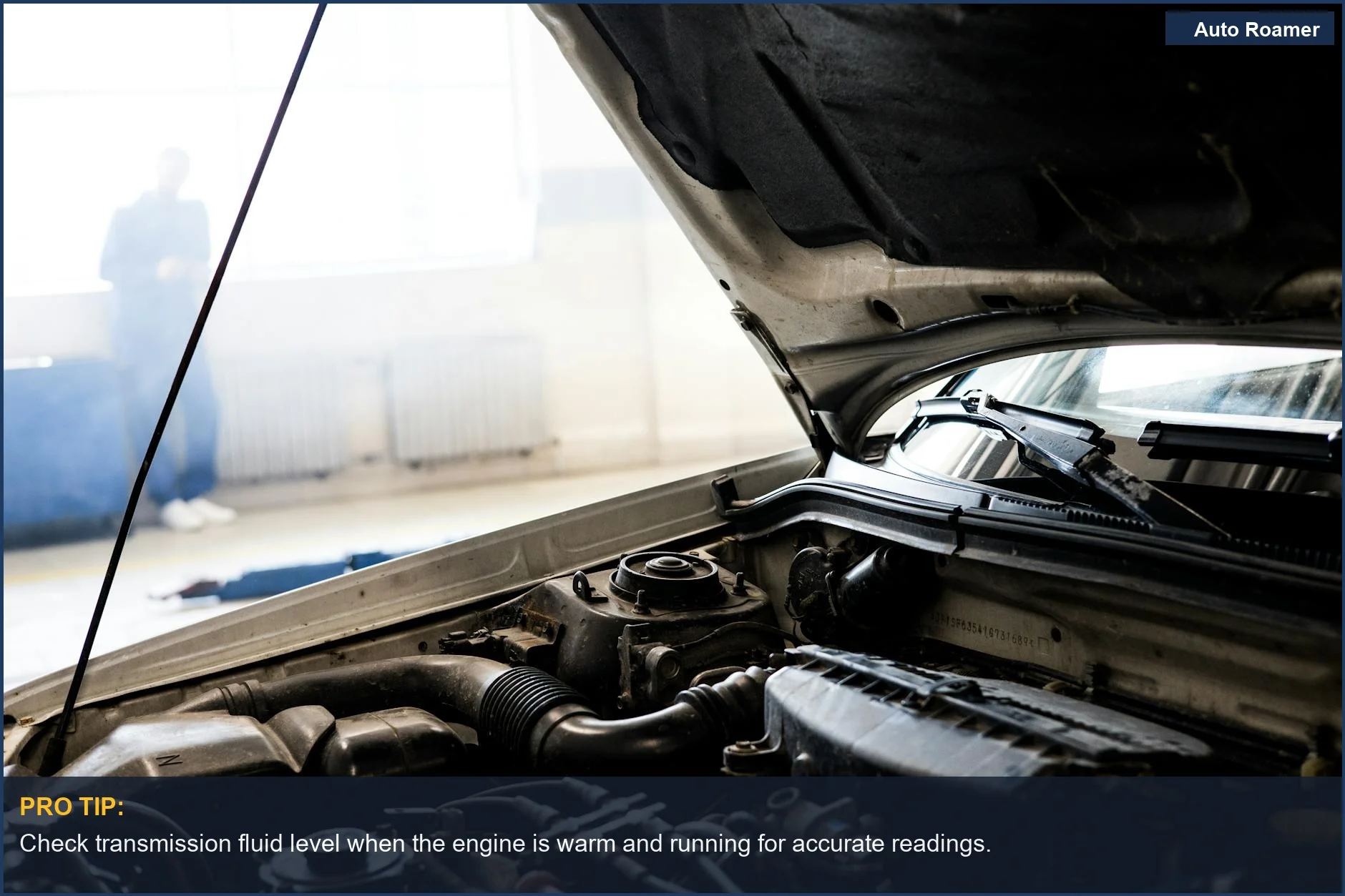
- Check the level the way the manufacturer specifies. Most automatics with a dipstick must be checked with the engine running, at operating temperature, on level ground, after cycling through the gears. Checked cold or with the engine off, the fluid has drained back into the pan and reads falsely low — which is how people overfill.
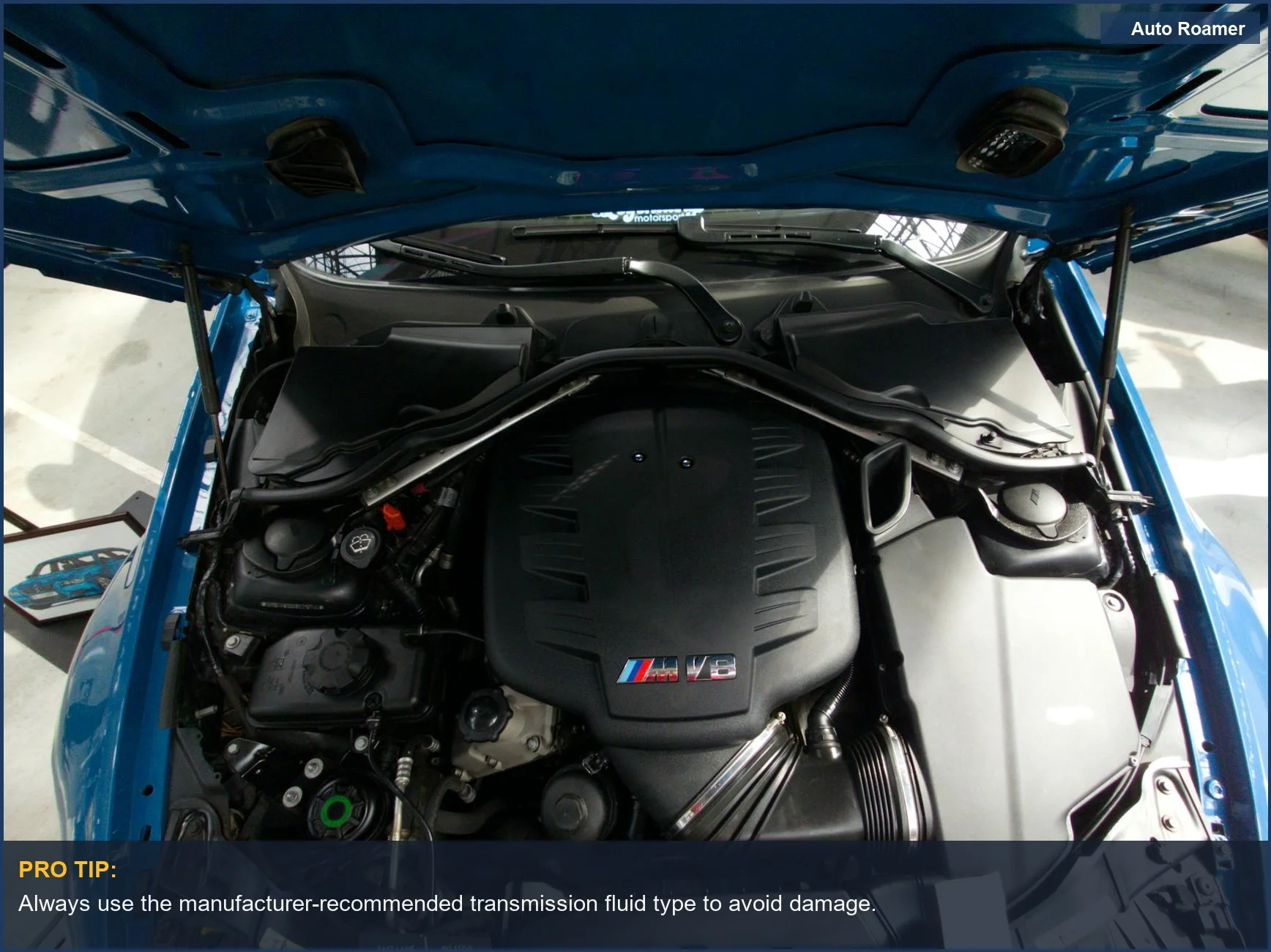
- Use the exact fluid the car calls for. Dexron, Mercon, ATF+4, and the various proprietary low-viscosity fluids are not interchangeable. The owner's manual specifies the correct type. Using the wrong fluid can degrade seals and friction material and turn a simple top-off into an expensive repair.
Overfilling is its own hazard. Too much fluid can foam and aerate as the rotating parts whip through it, and aerated fluid can't hold steady hydraulic pressure — causing the same erratic shifting that being too low causes. Add fluid in small increments, a few ounces at a time, and recheck after each addition.
It also helps to be realistic about how much a top-off should ever involve. A correctly operating automatic that simply reads a touch low usually needs only a fraction of a quart to come back into range — not a full bottle. If you find yourself needing a quart or more to reach the full mark, that's not a routine top-off; it means the transmission was running well below its proper level, and the question shifts from "how much do I add" to "where did all that fluid go." The amount you have to add is itself a diagnostic clue.
When to Top Off: Low Level or a Leak You Haven't Fixed Yet
Topping off is the right move in a narrow but real set of situations. The common thread is that the problem is the level, not the fluid.
The level reads low but the fluid still looks and smells good. If the dipstick shows below the full mark, but the fluid on it is still a clean, translucent red or light brown and smells faintly oily rather than burnt, the fluid itself is fine. Bringing the level back up restores correct operation. This is the textbook case for topping off.
You have a slow leak and need to keep driving safely. Transmissions can develop slow leaks at the pan gasket, the cooler lines, seals, or the dipstick tube. While you arrange a proper repair, keeping the fluid topped up protects the transmission from running dangerously low. Here, topping off is explicitly a stopgap — a way to get home or to the shop without starving the transmission, not a fix for the leak.
If you find yourself topping off every week or two, you do not have a maintenance task — you have a leak. Topping off is buying time to diagnose and repair it, not a substitute for doing so. Persistent fluid loss always traces back to a leak that needs to be found and sealed.
The key honesty here is that topping off is a treatment for a symptom. A healthy transmission with no leak does not steadily lose fluid; the level should be stable between services. So if you are reaching for the funnel regularly, the next step is not more fluid — it is finding where the fluid is going. Common culprits are a leaking pan gasket, a loose drain plug, worn cooler lines, or a failing seal, and a shop can usually pinpoint the source with a dye test.
When to Change: Mileage, Burnt Smell, Dark Color, Severe Use
Changing the fluid is about condition, and there are clear signals that the fluid has reached the end of its useful life. Any one of these points toward a change rather than a top-off:
- You've hit the service interval. Many manufacturers specify a transmission-fluid service somewhere between roughly 30,000 and 100,000 miles depending on the vehicle and driving conditions. The owner's manual is the authority for your specific car. If you're at or past that interval, the fluid is due regardless of how it looks. It's worth knowing how often to change your transmission fluid for your specific vehicle.
- The fluid is dark or cloudy. Fresh ATF is typically a clear red or amber. As it ages and oxidizes it darkens toward brown and eventually a murky near-black. A noticeably dark color is a sign the fluid has been heat-stressed and its additives are spent.
- It smells burnt. A sharp, acrid, burnt odor on the dipstick is the clearest warning sign of all. It usually means the fluid has overheated and the clutch friction material may have started to break down. Burnt-smelling fluid should be changed, not topped off — adding fresh fluid to burnt fluid does not undo the damage already done.
- You drive in severe conditions. Towing, hauling, frequent stop-and-go traffic, mountain driving, and hot climates all run the transmission hotter, and heat is what kills ATF. Vehicles used this way often have a shorter "severe service" interval in the manual, and the fluid genuinely wears out faster.
The underlying principle is simple: heat degrades transmission fluid, and degraded fluid stops protecting the transmission. A change restores that protection; topping off cannot. When the evidence on the dipstick — color, smell, mileage — says the fluid is worn, the correct response is to replace it, not to add to it.
It's also worth understanding why heat matters so much, because it explains every one of those warning signs. ATF spends its life being sheared between gears and clutches and squeezed through tiny hydraulic passages, all of which generate heat. Up to a point the fluid handles it, but each rise in operating temperature roughly accelerates oxidation — the chemical aging that turns the fluid dark and consumes its additives. Towing on a hot day, crawling through summer traffic, or climbing a long grade can push transmission temperatures far above the gentle highway cruise the "100,000-mile" intervals often assume. That's the whole reason severe-service intervals exist, and why two identical cars can need a fluid change at very different mileages: it's the heat history of the fluid, not just the odometer, that determines when a change is due.
Drain-and-Fill vs. Flush: Two Ways to Change the Fluid
"Changing" the fluid isn't a single procedure — there are two common methods, and they replace different amounts of fluid.
A drain-and-fill drains the fluid from the transmission pan (and often replaces the filter and pan gasket) and refills with fresh fluid. The catch is that a large share of the fluid lives in the torque converter and cooler lines and does not drain out with the pan. A single drain-and-fill typically replaces only about a third to half of the total fluid. Because of that, some people do a series of drain-and-fills over a few short intervals to gradually swap out most of the old fluid without ever disturbing the whole system at once.
A flush uses a machine that connects to the transmission's cooler lines and pushes new fluid through while the old fluid is forced out, exchanging nearly all of the fluid in one service — including what's in the torque converter. A flush is more thorough, but it is also more debated. On very high-mileage transmissions that have never been serviced, some technicians caution that a full flush can dislodge accumulated debris and occasionally surface problems in a worn unit. On a reasonably maintained transmission, a flush is a clean, complete fluid exchange.
Which to choose comes down to mileage, history, and your own comfort level:
- Regularly serviced or moderate-mileage car: either method works; a drain-and-fill with a new filter is a safe, common default, and a flush gives a more complete exchange.
- Very high mileage, never serviced: many mechanics lean toward a conservative drain-and-fill (or a couple of them) rather than an aggressive flush.
- Following the manual: some manufacturers specify a particular procedure and fluid; that guidance should win over any general rule of thumb.
Either way, the point that matters for this comparison is that both a drain-and-fill and a flush change the fluid — they restore condition. Topping off does neither.
The "Sealed" or "Lifetime" Fluid Myth
A growing number of vehicles are sold with transmissions described as having "lifetime" or "sealed" fluid, often without a dipstick at all. It is one of the more misleading labels in modern car ownership, and it deserves a clear-eyed look.
"Lifetime" does not mean the fluid never degrades. It is generally understood within the industry to mean the fluid is rated for the design life of the transmission under the manufacturer's assumptions — not that the fluid is immortal. The chemistry still breaks down with heat exactly as any ATF does. Many independent mechanics and long-term owners report that "lifetime" transmissions still benefit from a fluid change well before the vehicle is worn out, particularly if it has been driven in severe conditions.
"Sealed" mainly means the manufacturer didn't fit a dipstick — checking and changing the fluid requires a specific procedure, often involving a fill plug and a precise fluid temperature, rather than a simple roadside top-off. It does not mean the fluid is inaccessible or that it never needs attention. It means the service is more involved and, on these vehicles, is usually best left to someone with the right equipment and the manufacturer's procedure.
The practical takeaway: if your car has a sealed or "lifetime" transmission, don't assume the fluid is a fit-and-forget item. Check what the manual actually says, and treat claims of zero maintenance with healthy skepticism. The fluid is still doing the same hard job, and it still ages.
DIY vs. Shop, and the Risk of Topping Off Degraded Fluid
Whether you handle this yourself or hand it to a shop depends on the job and on your car.
Topping off is the most DIY-friendly of the two — on a car that still has a dipstick and fill tube. The whole cost can be a quart of the correct fluid and a transmission funnel. The discipline is in the procedure: correct fluid, engine warm and running, level ground, add slowly, recheck often. On a sealed transmission with no dipstick, even a top-off is genuinely a shop job because there's no simple way to check the level.
Changing the fluid is more involved. A drain-and-fill with a filter and gasket is within reach of a confident home mechanic with a jack, stands, and a catch pan, but it's messier and requires disposing of the old fluid properly. A machine flush is a shop service by definition. For many owners, letting a shop change the fluid is the sensible call, especially on sealed units that need a fill-plug-and-temperature procedure.
The most important risk to understand sits right at the intersection of these two jobs: topping off fluid that should have been changed. If the fluid is already dark or burnt and the level is low, the instinct to just add a quart is exactly the wrong move. You raise the level, the symptoms ease briefly, and you keep driving on fluid that has lost its ability to protect the clutches and gears. Heat continues to do damage you can no longer see on the dipstick, and what would have been a routine fluid change can progress toward a far more expensive repair. Topping off a degraded fluid doesn't solve anything — it hides the problem while it gets worse.
The honest rule of thumb: if the fluid is good and the level is low, top off. If the fluid is bad, change it — no matter what the level reads. Never use a top-off to postpone a change the fluid's condition is telling you it needs.
There's a cost angle worth being honest about, too, because it's usually what drives the temptation to top off instead of change. A quart of fluid is cheap; a full fluid service at a shop costs meaningfully more; a rebuilt or replaced transmission costs many times that. Topping off degraded fluid feels like the frugal choice in the moment, but it often turns out to be the most expensive one, because it lets the cheapest fix (a timely fluid change) lapse into the most costly outcome (transmission failure). Spending a little on the right service at the right time is almost always cheaper than saving on the wrong one. When you're genuinely unsure what the fluid is telling you, having a shop read it is a small price for avoiding that trap.
How to Check Your Transmission Fluid Level and Condition
Everything above depends on one skill: reading the fluid correctly. The same dipstick check tells you both whether the level is low (top off) and whether the condition is poor (change), so it's worth doing right.
For a typical automatic with a dipstick, the general procedure looks like this (your owner's manual is always the final word, since some cars differ):
- Park on level ground and apply the parking brake. An uneven surface throws off the reading the same way it does with engine oil.
- Start the engine and let it reach operating temperature. Most automatics are checked warm, with the engine running.
- With your foot on the brake, cycle slowly through every gear position, pausing in each, then return to Park (or Neutral if the manual specifies). This fills the passages so the dipstick reads true.
- Pull the dipstick, wipe it clean, reinsert it fully, and pull it again to read the level against the marked range.
Now read both things at once:
- Level — where the fluid sits relative to the full and add marks tells you whether you need to top off, and roughly how much.
- Color — fresh ATF is clear red or amber. Brown, cloudy, or near-black fluid is a condition warning that points to a change.
- Smell — a faint oily smell is normal; a sharp burnt smell means change, not top-off.
- Texture — rub a drop between your fingers. Smooth is good; gritty fluid suggests internal wear and warrants a shop's attention.
That single check resolves the whole question. Low level with good fluid means top off. Bad fluid — by color, smell, or mileage — means change, whatever the level. And if you keep losing fluid, the real job is finding the leak. For a deeper look at service timing and related upkeep, the broader maintenance picture ties together with the rest of your car's fluids and intervals — the same condition-versus-interval thinking applies when you extend the life of your engine oil.