
It Cools Relative to Ambient, Not to a Number
The first thing to understand about a thermoelectric cooler is that it does not chill to a setting - it chills relative to the air around it. A 12V thermoelectric (Peltier) cooler only cools to about 36-40F (roughly 20-22C) below the surrounding ambient temperature. It cannot reach a fixed cold setpoint the way a compressor fridge can, because it has no thermostat driving toward a target - it just pumps a fixed temperature difference below whatever the ambient happens to be.
That single fact explains most disappointment with these coolers. Owners expect a cold box and instead get a box that is a certain amount cooler than the room, which in a warm space is not very cold at all. The cooler is not broken; it is doing exactly what a Peltier device does, which is move heat across a fixed gradient rather than pull down to a number.
Once you accept that the reference point is ambient, the whole troubleshooting picture changes. The question stops being 'why won't it hit 38F' and becomes 'is it achieving its rated difference below the current ambient, and if not, why.' A cooler falling well short of 36-40F below ambient has a real, fixable problem worth chasing; one that is achieving that difference is working correctly and simply cannot do more. Getting this straight before you diagnose saves a lot of wasted frustration, because half the 'not cold enough' complaints are really 'the room is too warm for the physics.'
Do the Ambient Math
Run the numbers on your actual conditions and the cooler's behavior stops being a mystery. Because cooling is relative to ambient, in an 80F (27C) cabin the best a Peltier cooler reaches is roughly 40-44F (4-7C). That is genuinely useful - cold drinks, cool food. But move the same cooler into a hot 100F+ (38C+) car and it may only manage the 60s F, because it is still only pulling its fixed difference below a much hotter starting point.
This is why the same cooler feels great in spring and useless in a summer parking lot. Nothing about the unit changed; the ambient did, and the output tracks it directly. A cooler sitting in a sun-baked car interior is fighting a losing battle, not failing - the physics simply cannot deliver a cold box when the surrounding air is that hot.
Set expectations honestly on what it can and cannot do. Peltier coolers cannot make ice, and they cannot hold true freezer temperatures or reliable food-safe fridge temperatures below about 40F (4C) in warm conditions. For anything that must stay below 40F for food safety on a hot day, a thermoelectric cooler is the wrong tool - that is a compressor fridge's job. Judge the cooler against what it is: a device that keeps contents cool relative to the air, not a refrigerator with a temperature dial.

Get It Out of the Heat
If ambient is the reference point, then lowering ambient is your single most powerful lever - more than any other fix in this guide. Performance is entirely ambient-dependent: as the hot side gets hotter, the available cooling on the cold side drops, so a hot car sets a hard ceiling on how cold the box gets. Everything you do to reduce the heat around the cooler directly improves what it can achieve inside.
The practical moves are simple and free. Keep the cooler out of direct sun and off hot surfaces, because sunlight beating on the lid and heat soaking up through a hot floor both raise the effective ambient the cooler is fighting. Lowering the surrounding temperature is the single biggest lever for a colder interior - a cooler moved from a sun-blasted seat into a shaded footwell, or run with a window cracked and a fan moving cabin air, gains real degrees inside with no hardware change at all.
Think about placement the way you would for any heat-sensitive gear on a long trip. Shade it, ventilate around it, and never bury it against the transmission tunnel, a heater duct, or a black dashboard. In camp, bring it into shade rather than leaving it on a sun-heated tailgate. These are not marginal tweaks; because the cooler's output is locked to ambient, controlling the ambient is the difference between a cooler that holds drinks cold and one that just holds them lukewarm.
Both Fans Have to Work
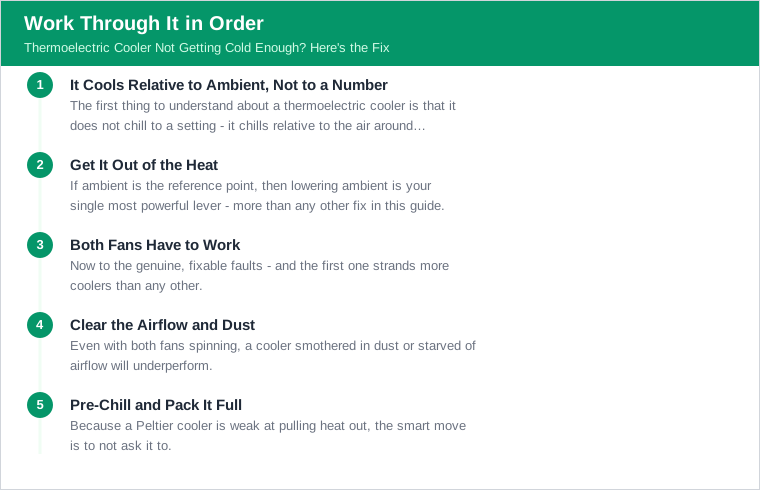
Now to the genuine, fixable faults - and the first one strands more coolers than any other. Both fans are essential. The hot-side fan and heatsink must shed heat continuously; if the hot-side fan fails or is blocked, the cold side warms up and cooling collapses entirely. A Peltier module is a heat pump, and if it cannot dump heat out the hot side, it cannot pull heat off the cold side either. The two are linked.
This is the failure that actually looks like a dead cooler. When the hot-side fan quits, the heatsink saturates with heat, the temperature difference across the module collapses, and the interior warms up even though the cooler is powered and humming. People assume the Peltier module died, when in truth a stalled or unplugged fan choked it. The module is often fine; its heat has nowhere to go.
Diagnose it directly. With the cooler running, feel or look for airflow at both the hot exterior side and the cold interior side, and confirm both fans are actually spinning. A seized bearing, a jammed blade, an unplugged connector, or a fan clogged with debris will stop one of them. The hot-side fan is the critical one - if it is not moving air, fix or replace it before anything else, because no amount of ambient control or repacking will rescue a cooler whose heat cannot escape.
Clear the Airflow and Dust
Even with both fans spinning, a cooler smothered in dust or starved of airflow will underperform. Blocked airflow or dust on either the hot-side or cold-side heatsink drastically cuts performance - keep the vents clear. The fins on each heatsink work by exposing maximum surface area to moving air; coat them in dust or block the vents and their ability to transfer heat plummets, throttling the whole system.
Road-trip and overland use makes this worse than most people expect. A cooler that lives in a dusty cargo area, rides with the windows down, or spends time on gravel roads pulls fine grit straight into its fans and across its fins. Over a season the hot-side heatsink can clog into a felted mat of dust that insulates instead of radiating, and the cooling quietly fades until the box barely feels cool.
The fix is maintenance, not replacement. Blow out both heatsinks with compressed air, clear any debris from the fan blades and vent openings, and make sure nothing - a bag, a jacket, the wall of a packed trunk - is pressed against the exterior vents blocking the exhaust. Give the hot side open air to breathe into. A cooler that has slowly gotten worse over months is very often just dirty, and a five-minute cleaning restores cooling that no amount of fiddling with settings would.

The Thermal Paste Nobody Checks
Here is the hidden fault that even careful owners miss: the thermal interface inside the cooler can dry out. Dried-out or missing thermal paste between the Peltier module and the heatsink raises the thermal resistance and kills cooling, and re-pasting can restore it. That thin layer of paste is what carries heat from the module into the heatsink, and when it degrades, the heat stops moving and the cold side warms up.
It is an easy failure to overlook because it is buried. Everything on the outside can look and sound perfect - fans spinning, vents clear, cooler humming - while a dried, cracked, or never-adequate layer of paste chokes the heat transfer where you cannot see it. Vibration and heat cycling over time can pump the paste out or bake it dry, and cheaper coolers sometimes ship with barely any to begin with.
For anyone comfortable opening the unit, this is a cheap, high-payoff repair. Access the Peltier module, clean off the old crusty paste from both mating surfaces, and apply a fresh thin, even layer of thermal paste before reassembling with the module clamped firmly to the heatsink. Getting good contact back can bring a tired cooler's performance right back to where it started. It is the same principle as re-pasting a computer's processor - and for a cooler that has slowly lost its bite, it is often the missing piece.
Why It's So Different From a Fridge
Understanding why a Peltier cooler is so limited helps you stop expecting fridge behavior from it. A thermoelectric cooler works about 4-5x less efficiently than a vapor-compression (compressor) fridge, which is why it draws similar power but cools far less. The same watts that let a compressor fridge hold a freezer setpoint only buy a Peltier cooler a modest difference below ambient.
The self-heat problem is at the core of it. A Peltier module generates large amounts of its own heat: while absorbing about 25W from inside the box, it can dump 50W or more of heat out the hot side, so the heatsink and fans have to remove roughly double the cooling wattage just to keep up. That is why the hot-side cooling matters so much and why a small blockage tips the whole balance - the device is always fighting a mountain of its own waste heat.
The spec sheets can be misleading, too. A single-stage Peltier module's theoretical maximum temperature difference is around 70C, but that maximum only occurs at zero heat load - meaning with nothing to actually cool. Put real contents and real ambient against it and the achievable difference collapses to the 36-40F range these coolers are known for. So the honest ceiling is set by physics, not by a defect: a thermoelectric cooler is a fundamentally different, far weaker device than a compressor fridge, and no repair will close that gap.

Pre-Chill and Pack It Full
Because a Peltier cooler is weak at pulling heat out, the smart move is to not ask it to. Pre-chill the contents and pack the cooler full, because Peltier units maintain cold far better than they pull down warm items. Loading a warm cooler with room-temperature food and expecting it to get everything cold is asking the device to do the one thing it is worst at - and it will crawl, or never get there in the heat.
The winning technique is to do the cooling with something else first. Chill drinks and food in a real refrigerator or with ice before the trip, then load them into the pre-cooled thermoelectric box so its modest capacity is spent holding cold rather than creating it. A cooler that starts with cold contents and cold walls stays cool for hours; one asked to pull down a warm load from scratch struggles the entire time.
Packing it full helps for the same reason. A full cooler has thermal mass - all that already-cold content resists warming, so the Peltier module only has to fight the slow leak of heat through the walls rather than a big air gap and warm items. Fill empty space with more cold items or even chilled water bottles. Treat the cooler as a cold-holder you top up, not a chiller you start from warm, and it performs far closer to its real potential.
Watch the Battery
One more thing separates a thermoelectric cooler from a fridge, and it matters on any trip that runs off the vehicle: these coolers rarely stop drawing. Typical power draw is about 4-4.5A at 12V, roughly 48-54W, running continuously - many models have no thermostat cycling, so the Peltier module is on whenever the cooler is powered. Unlike a compressor fridge that cycles off once it hits temperature, a Peltier cooler just keeps pulling.
That constant draw adds up fast on a parked battery. Many Peltier coolers run at 100% duty with no cycling, so leaving one on the car battery with the engine off can flatten it - about 4.5A adds up to roughly 54Ah over 12 hours. That is enough to leave a starter battery unable to crank in the morning after a single overnight, which is a rough surprise a long way from help.
Plan the power like you would any continuous load. Run the cooler from a dedicated house battery or a portable power station rather than the starter battery, or accept that it should only run with the engine on. If it must run off the vehicle overnight, size the battery for that 54Ah-per-12-hours reality and keep enough reserve to start the engine. The cooler's non-stop draw is not a fault - it is how Peltier devices work - but it will drain a battery that a cycling fridge would have spared.

The Verdict: Right Expectations, Then Right Habits
A thermoelectric cooler that seems too warm is usually two things at once: a device being judged against the wrong standard, and maybe a small fixable fault on top. Start with the expectation. A Peltier cooler only reaches about 36-40F (20-22C) below ambient, cannot make ice, and cannot hold food-safe fridge temperatures in a hot car. A 20C (36F) difference below ambient is actually a respectable result for one of these coolers - if it is achieving that, it is working.
Then check the genuine faults in order. Confirm both fans spin, especially the critical hot-side fan. Clear dust and debris from both heatsinks and keep the vents unblocked. Inspect and, if needed, renew the thermal paste between the module and heatsink. Get the whole unit out of direct sun and off hot surfaces to lower the ambient it fights. And pre-chill and pack it full so it only has to hold cold, not create it.
There is one more honest question worth asking at the end of the list: whether a thermoelectric cooler is simply the wrong tool for how you camp. If you routinely need food-safe cold in hot weather, no amount of fan-cleaning or re-pasting will get you there, and the money is better spent on a compressor fridge. But if you want a light, cheap, silent box to keep drinks and snacks cool on moderate days, a healthy Peltier cooler does that job well. Do those and a thermoelectric cooler delivers everything it realistically can - cool drinks and food a set amount below ambient, on modest power. What it will never do is behave like a compressor fridge, and chasing that is chasing physics. Right expectations first, right habits second, and the handful of real repairs in between: that is the whole fix for a Peltier cooler that is not as cold as you hoped.