
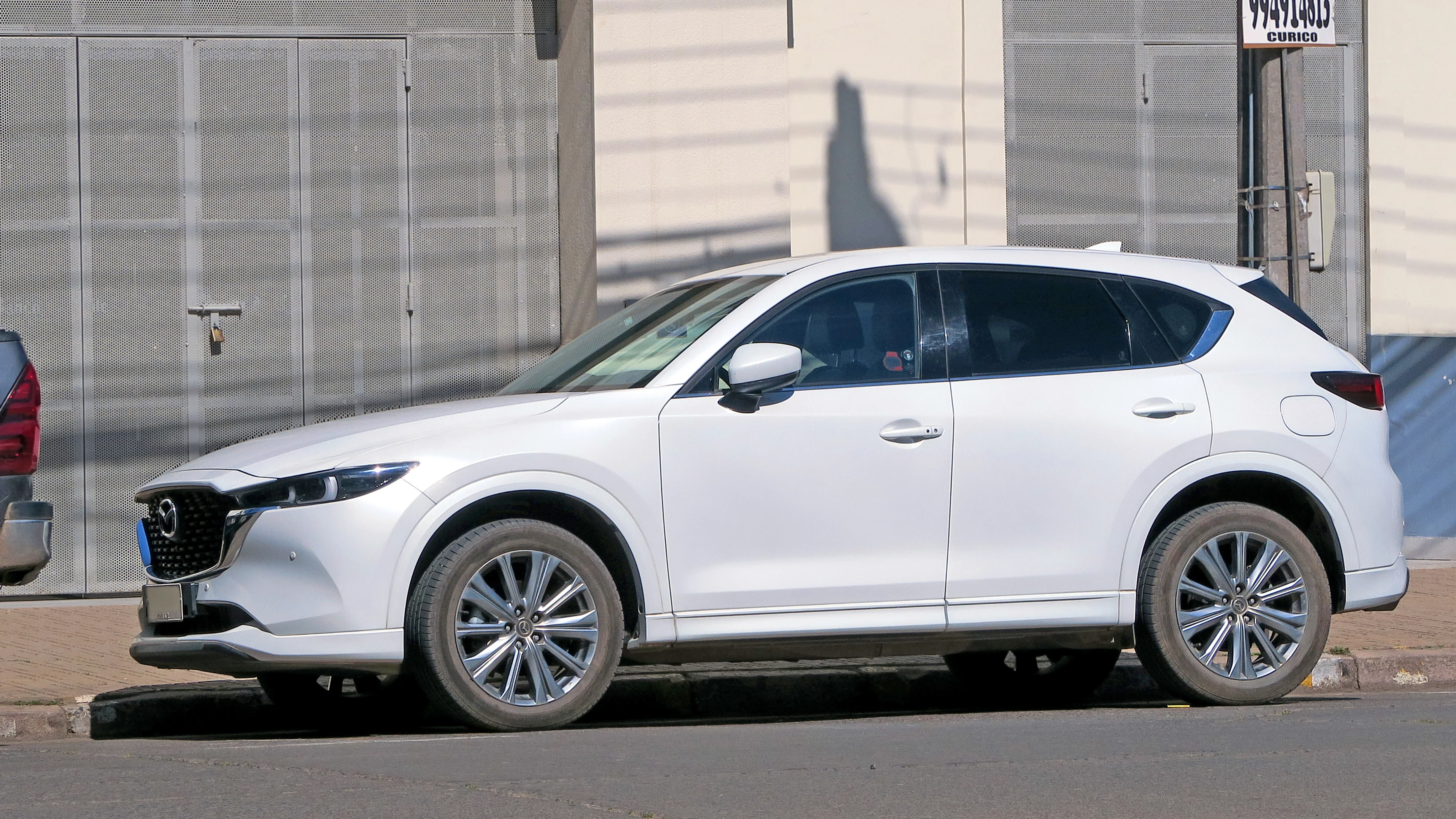
Mazda actually prints the numbers - so let's read them honestly
Give Mazda credit: while Honda and Toyota make you guess a cargo floor length in inches, Mazda's official spec sheet publishes the CX-5's cargo dimensions outright. That's rare, and it's good, because it means we don't argue about the numbers - we just read them and check what the marketing implies against what they actually say.
Here's what the CX-5 gives you, straight from Mazda USA: 59.3 cubic feet of cargo space with the seats folded, a cargo floor that runs 75.8 inches to the front seats, 41.3 inches of width at its narrowest, and 30.6 to 32.4 inches of height. Marketing calls that roomy. Reality: it's a modest, honest box - smaller in volume than a RAV4 or CR-V - that sleeps one person well if you respect two catches. The first is that 75.8-inch length figure, which is measured to the front seatbacks, not across a flat floor. The second is a reversible cargo board that decides whether your floor is level. Read those two right and the CX-5 is a genuinely comfortable solo bed. Miss them and you'll wonder why the 'roomy' SUV feels short.
Length: 75.8 inches to the front seats, about 67 truly flat
The brochure claim is bold; the spec sheet is quieter. Mazda lists the folded CX-5 cargo length at 75.8 inches - which sounds like plenty, since that's over 6 feet 3. Here's the catch every honest measurement finds: that 75.8 inches is measured all the way to the front seatbacks, up and over the folded rear seats. The genuinely flat section, from the tailgate to where the folded seatbacks start rising, is closer to 67 inches - about 5 feet 7.
What that means for real bodies:
- Up to about 5 foot 7: you lie flat on the level section with room to spare.
- 5 foot 7 to 6 foot 3: you use the full 75.8 inches only by bridging the seatback step so your legs don't ride uphill.
- Over 6 foot 3: you're sleeping diagonally or building a platform that spans the whole bay.
Does the 75.8-inch number matter? Yes - but only if you level the step. Take it at face value and a six-footer wakes up with their hips on the slope and their feet on the seatbacks. The number is real; the flat part is the number you sleep on.
Credit where it's due, though: the fact that we can even have this argument precisely is because Mazda published both the length and the seats-up figure (37.4 inches), so you can do the subtraction yourself instead of trusting a forum. Compare that to a Honda or Toyota, where the 'is it long enough' question has no official answer at all and you're measuring in a dealer lot. The CX-5's length has a catch, but at least the catch is documented - which, for a skeptic, is worth more than a bigger number you can't verify.
Width: 41.3 inches at the pinch, 57 at the floor
Width is where the CX-5 answers one sleeper or two, and Mazda prints both ends of the taper. Cargo width runs 41.3 inches at the narrowest - between the wheel wells - out to 57.0 inches at the widest point on the floor. The number that decides your night is the pinch, because your shoulders and hips sit in the narrow zone.
Two adults side by side want roughly 48 inches of usable width. The CX-5's 41.3-inch pinch falls well short, which makes it a fine one-person bed and a genuine squeeze for two average adults.
Working with the width you have:
- Solo: 41.3 inches still beats any single sleeping pad, so one sleeper has margin.
- Two people: plan narrow pads, no gear beside you, and accept touching shoulders.
- Use the 57-inch zone: put your torso back toward the tailgate where the floor opens up to buy a little shoulder room.
The 15.7-inch spread between the 41.3-inch pinch and the 57-inch floor width is bigger than most compacts, and it's the one place the CX-5's shape actually helps a sleeper. Angle your body slightly - head toward one rear corner, feet toward the opposite front - and you borrow width from the wide zone without losing length. It won't turn a one-person bed into a two-person one, but for a solo camper it's the difference between 'snug' and 'genuinely comfortable,' and it costs nothing but a few degrees of diagonal.
Is the CX-5 cargo floor actually flat?
This is the question the spec sheet half-answers, so let's finish it. The CX-5 has a two-level reversible cargo board, per Mazda - you can set it at a lower or higher position. Set low, the folded rear seatbacks sit close to level with the cargo floor, leaving a mild step rather than a clean flat plane. It is near-flat, not dead flat.
That mild step is the difference between a good night and a lumpy one, and it's easy to beat:
- Set the board to its low position before you add anything - it closes most of the gap for free.
- Fill the remaining seatback step with a rolled blanket or foam so your hips don't drop into it.
Ten minutes with the board and a fill turns the CX-5's near-flat floor into a genuine bed. Skip it and you'll blame the car for a step you could have leveled yourself.
Worth being precise about what 'reversible' buys you, since Mazda markets it as a feature and a skeptic should check the claim. One side of the board is carpeted to match the cabin; the other is a wipe-clean hard-wearing surface for muddy or wet gear. For sleeping that second surface is genuinely useful - you flip it dirty-side-up under a fridge or a cooler and don't fret about spills soaking into carpet you also lie on. It's a small, honest bit of thoughtfulness, and it's more than the brochure's 'versatile cargo' language actually promises. The board's real value to a camper isn't the flatness marketing implies - it's the flip-side you can hose off.
Height: 30.6 to 32.4 inches, and the tailgate you crawl through
Height is where the CX-5's sporty roofline costs you, and Mazda's own numbers say so. Cargo-area height runs 30.6 to 32.4 inches floor to ceiling - a couple inches lower than a boxier RAV4 or CR-V. The tailgate opening is 44.3 inches wide by 30.8 inches tall, so you crawl in, you don't step in.
What roughly 31 inches of height means:
- Sitting up: you can prop on an elbow and change a shirt lying down, but not kneel upright - it's low.
- Pad math is tighter here: a 3-inch pad turns 32 into 29, so pick a thinner pad than you would in a taller SUV.
- Getting dressed happens seated or reclined; practice once in the driveway so it isn't a cold-morning surprise.
The tailgate opening height of 30.8 inches is worth a skeptical second look too, because it's the dimension that decides how gracefully you get in and out. At just over two and a half feet, you duck and slide rather than step through - fine for an able adult, genuinely awkward for anyone with a bad back or a bad knee. Mazda's coupe-like roofline earns its good reviews on the road and charges you for them at the campsite. It's not a dealbreaker, but it's the honest cost of the styling, and no one selling you the car is going to mention you'll be crawling in feet-first every night.
The low roofline is the price of the CX-5's looks. If sitting fully upright matters to you, that's a real strike against this one - the numbers won't argue you out of it. The honest move here is to change and organize on the open tailgate, where the sky is your headroom, and keep the low 31 inches inside strictly for lying down. Do that and the roofline stops mattering; ignore it and you'll bang your head every morning and blame a car that told you its height up front.
Power: 12 volts only, and the outlet Mazda sells abroad but not here
Here's one where you should not trust a forum screenshot: the US-market CX-5 has no 120-volt household outlet. All eight trims carry 12-volt sockets front and rear, and that's it. You may see a 120V/150W outlet mentioned in some CX-5 owner's manuals - those are non-US markets, not the car in your driveway.
So plan camp power the honest way:
- Don't run gear off the 12V socket parked-and-off - it needs accessory mode, which drains the battery you need at dawn.
- Ignore the abroad-only 150W outlet - it's not on the US car, so don't build a plan around it.
It's a small omission, but pretending otherwise strands you. A portable station is the reliable answer, and it goes to the picnic table too.
Run the math on the 12V sockets while we're here, because they do have a job. At the usual 120-watt ceiling they'll pre-chill a fridge and top off a power station while you drive - useful, real, and exactly what they're for. What they won't do is run anything overnight without the car in accessory, which drains the battery you need in the morning. So the honest division of labor is simple: the CX-5's sockets handle driving-hours power, and a separate battery handles the night. Treat them as a charging tool rather than a camp power source and they earn their keep without ever leaving you with a dead start.
The condensation the 'roomy' reviews never mention
Here's a spec no brochure prints and no glossy review measures: the water two people breathe out overnight, which lands as condensation on the CX-5's cold glass by morning. The car's sleek, heavily-raked windshield and big side glass look great and add to that condensing surface, so the 'roomy and refined' cabin becomes a damp one if you seal it up.
What actually controls it - the part reviews skip:
- Crack two windows about an inch on opposite sides for cross-flow. This is the single biggest fix and it's free.
- Keep damp gear up front - wet boots and jackets in the sleeping bay dump moisture all night.
- No combustion heater inside - it adds water and carbon monoxide; a warmer bag is the safer, drier answer.
Does the CX-5 handle cold well? For a compact, reasonably - it holds heat about as well as its rivals and no worse. But the low, glassy greenhouse that reviewers praise for visibility is the same surface your breath condenses on, and no amount of 'premium cabin' language changes the physics. Plan the airflow and you wake up dry; trust the marketing and you wake up wiping the headliner. It's the most predictable problem in car camping and the one the shopping guides never put a number on.
How the CX-5's smaller numbers really compare
Let's put the CX-5's honesty in context, because the numbers are smaller than the segment's headliners and you deserve to know why. On volume, 59.3 cubic feet trails the RAV4's roughly 69.8 and the CR-V's 76.5 by a real margin - the CX-5 is the more compact box. On flat length, its ~67 truly-flat inches is mid-pack.
The honest positioning:
- Versus the RAV4: the Toyota carries more volume and a bit more height; the CX-5 answers with nicer materials, not more space. Our CX-5 vs RAV4 for car camping weighs it directly.
- Versus the Corolla Cross: the CX-5 is longer and wider inside; our CX-5 vs Corolla Cross matchup runs that pair.
- Versus a mid-size SUV: you give up real two-person width to keep the CX-5's size and economy.
The CX-5's case isn't space; it's that Mazda tells you the truth about the space it has. It's a well-built one-person bed, and it never pretends to be more.
Worth naming the trade plainly: you're choosing the CX-5 for how it drives and how it's built, and accepting a smaller bed as the cost. That's a perfectly rational call for a solo camper who also wants a sharp daily driver - just go in knowing you bought the nicer cabin, not the bigger one. A buyer whose top priority is sleeping space should be looking at the RAV4 or CR-V and reading the CX-5's honest numbers as the reason to keep shopping.
The verdict: a smaller, honest bed for one
The Mazda CX-5's cargo dimensions make it a comfortable solo sleeper and an honest one, because Mazda publishes the numbers instead of letting you guess. You get 59.3 cubic feet folded, a floor 75.8 inches to the front seats with about 67 truly flat, 41.3 to 57 inches of width, and 30.6 to 32.4 inches of height - all from Mazda's own spec sheet. Those are one-person-bed numbers with a known length catch and a low roof.
The CX-5 sleeps one person flat and well once you set the reversible board low and bridge the seatback step. For two adults, the 41.3-inch pinch and the low ceiling are the walls the numbers won't move.
Set the board low, level the step, pick a thinner pad for the roofline, and bring your own power, and the CX-5 turns modest, honest numbers into a genuinely good night. If the small volume or low height rules it out, that's the spec sheet doing you a favor - at the driveway, not the trailhead. The full build lives in our sleeping in a CX-5 guide, and the rules side is in our guide to sleeping in your car safely and legally.