
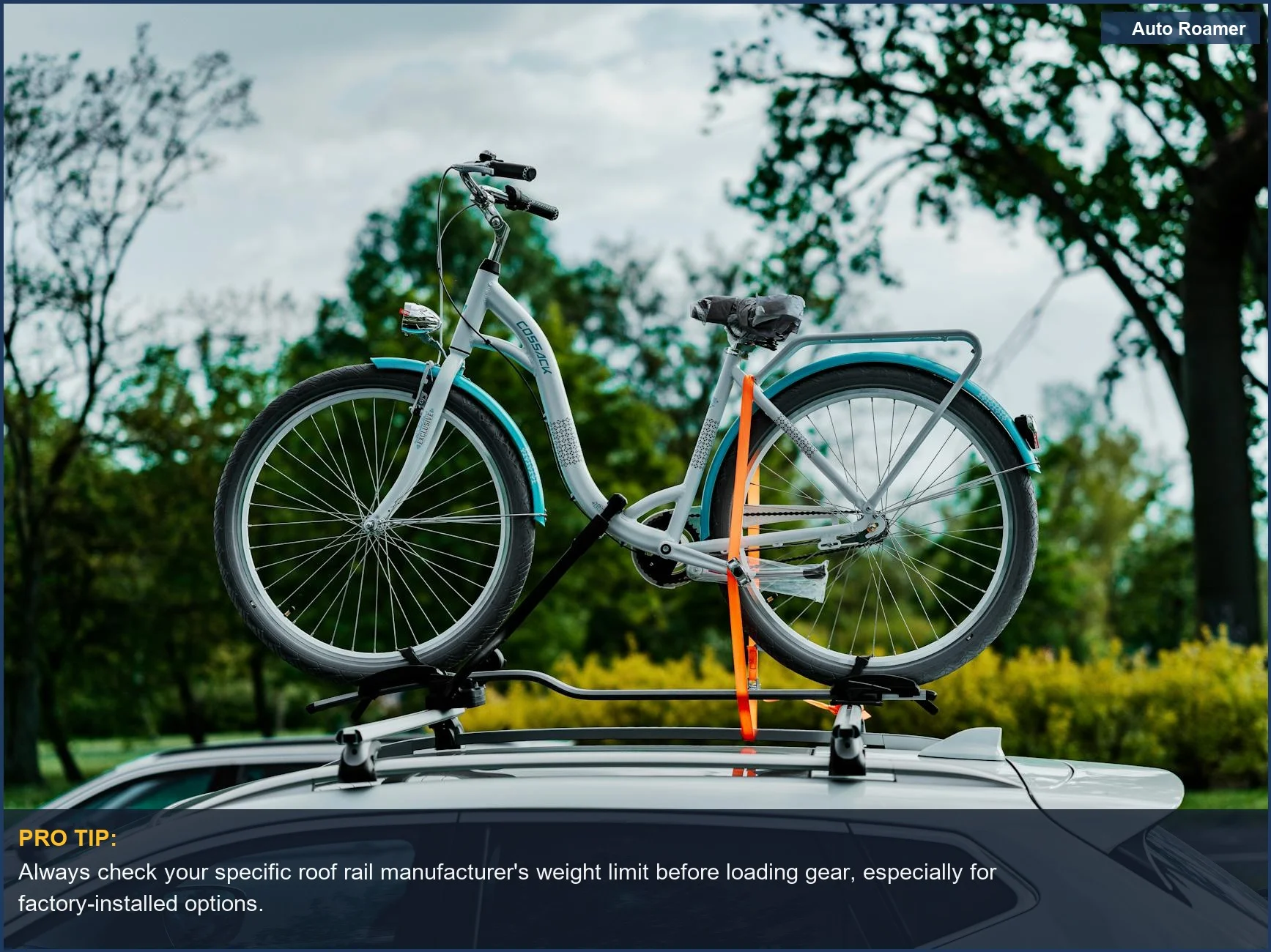
Santa Fe Roof Rack Weight Capacity: The Direct Answer
For most model years, a Hyundai Santa Fe's factory roof carries a published dynamic roof load of roughly 100 kg (about 220 pounds) while driving — and the static load, when the vehicle is parked, is substantially higher. That single distinction between dynamic and static is the most important thing to understand about your roof rack's capacity, and it is the number most people get wrong. The figures here come from Hyundai's published roof-load specifications and how automotive roof ratings are defined, as published by the manufacturer rather than from independent load testing.
Two ratings govern what you can safely put on the roof, and they are not interchangeable:
- Dynamic load (driving): the maximum weight the roof can carry while the vehicle is in motion. For the Santa Fe this is commonly published at around 100 kg / 220 lb, and it is the number that matters for cargo boxes, kayaks, bikes, and anything you drive with on the roof.
- Static load (parked): the maximum weight the roof can support when stationary — typically several times the dynamic figure. This is the rating that makes rooftop tents possible, because a tent plus sleeping occupants is parked weight, not driving weight.
The short version: think roughly 220 lb on the roof while you drive, and a much higher limit (often around three times that) once you are parked. Your real usable cargo number is always the lower of the vehicle's dynamic rating and your crossbars' rating — and the rack's own weight counts against it.
The rest of this guide explains exactly why dynamic and static differ, gives the published numbers by generation and where to confirm yours, walks through the rooftop-tent math, and shows how to calculate the real load your gear can be — all so you can pack the Santa Fe's roof with confidence instead of guesswork.
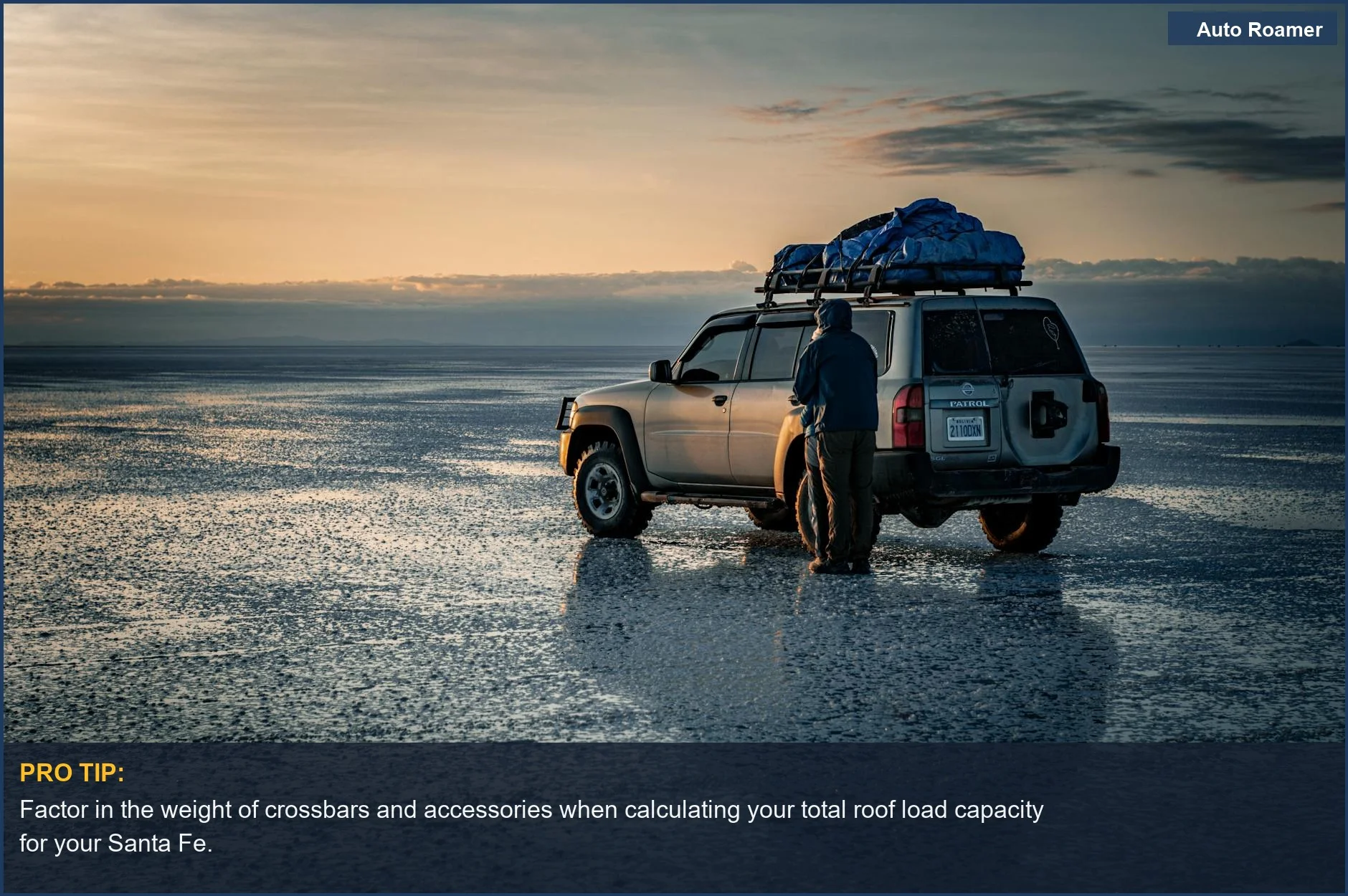
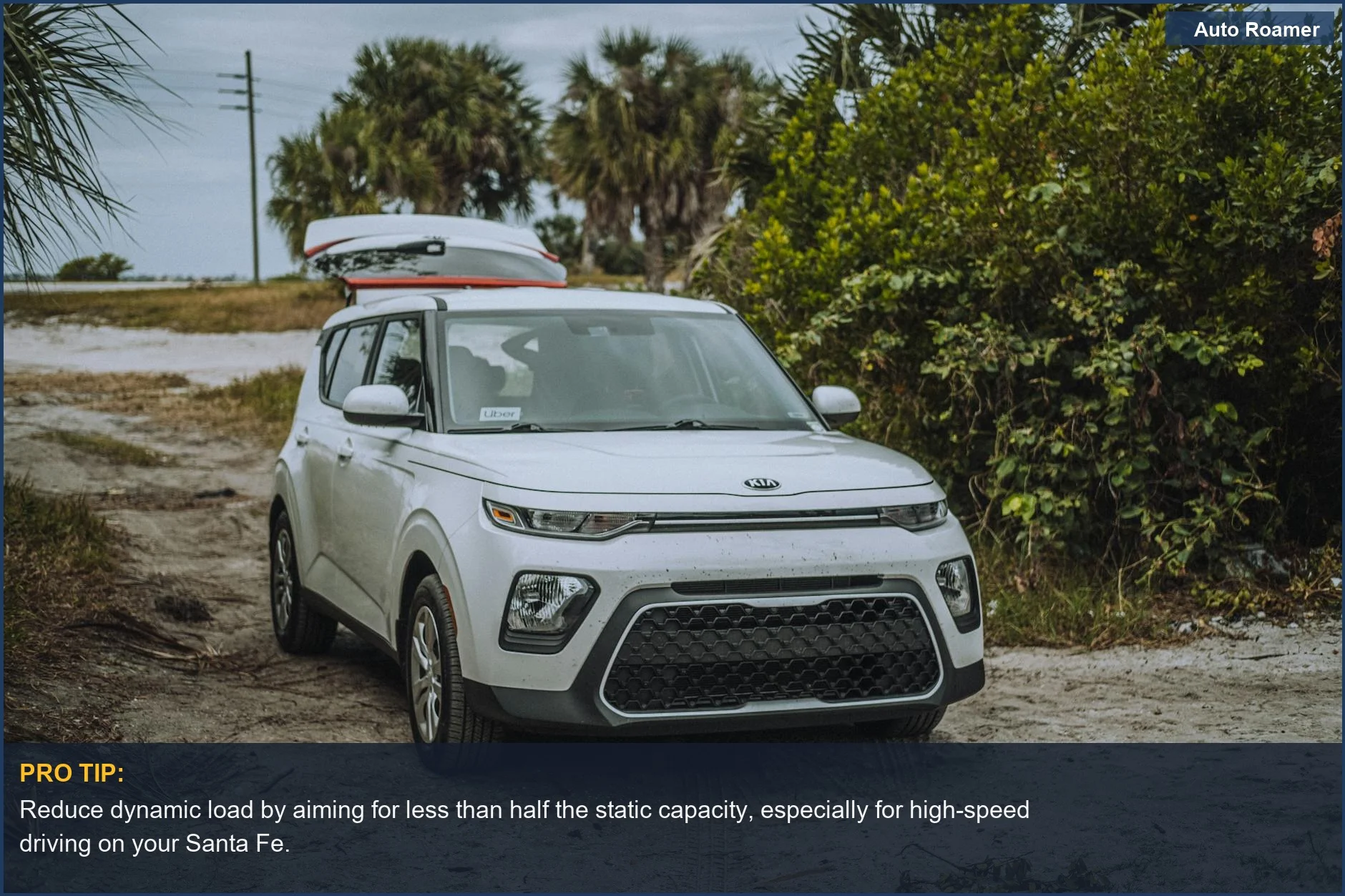
Dynamic vs Static Load: Why the Two Numbers Differ
Almost every mistake people make with roof loads traces back to confusing these two ratings, so it is worth understanding why they are different rather than just memorizing numbers. The gap is not a marketing quirk — it is physics.
When the vehicle is parked, the roof only has to support the static, downward weight of whatever sits on it. When you are driving, that same load is multiplied by forces the roof never sees while stationary:
- Vertical shock from bumps. Every pothole and expansion joint momentarily increases the effective downward force well above the load's resting weight — a 150-pound box can briefly hit the roof with far more than 150 pounds of force.
- Lateral force in corners. Cornering pushes roof cargo sideways, and that load is high up, so it acts on a long lever against the mounting points.
- Braking and acceleration. Hard stops throw the load forward; acceleration pulls it back. Both stress the crossbar feet and the roof's mounting structure.
- Wind and aerodynamic lift. At highway speed, airflow over a loaded roof adds drag and lift forces that simply do not exist when parked.
Because driving stacks all of these on top of the cargo's resting weight, the dynamic rating is deliberately conservative — it is set so the roof survives those combined forces with a safety margin. The static rating can be much higher precisely because, parked, none of those dynamic forces apply; the roof only carries dead weight pressing straight down.
Dynamic is low because driving multiplies the load with shock, cornering, braking, and wind. Static is high because a parked roof only carries dead weight. Never use the static number to plan what you drive with — that is the single most dangerous roof-rack mistake.
The practical rule that follows is simple: plan anything you drive with against the dynamic rating, and reserve the static rating only for parked uses like a rooftop tent you sleep in overnight. Treating the static number as your everyday cargo limit is how roofs get dented and racks get torn loose at speed.
It also explains a common point of confusion: people see a high static figure quoted in a forum or on a tent maker's site and assume their roof is far stronger than the owner's manual suggests. Both numbers are correct — they simply describe different situations. The manual's lower roof-load figure is the dynamic one, written for the worst case (a loaded roof at highway speed over rough pavement), while the higher static figure describes a stationary roof carrying a tent and sleepers. Knowing which is which is what lets you use the roof to its full, safe potential without ever guessing.
The Santa Fe's Published Dynamic Roof Rating by Generation
The exact roof rating depends on your model year and the rack hardware fitted, so the honest answer is a range plus a clear way to confirm your own — and again, these are Hyundai's published figures and owner's-manual conventions, drawn from the manufacturer's specifications rather than any independent load test. As a planning baseline across recent generations, the Santa Fe's published dynamic roof load clusters around 100 kg (about 220 lb), which is typical for a mid-size SUV in this class.
How the ratings generally line up:
- Fourth-generation (roughly 2019–2023): owner's-manual dynamic roof load commonly cited around 100 kg / 220 lb with the factory rails and approved crossbars.
- Fifth-generation (2024 onward): the redesigned, boxier model continues a comparable dynamic roof-load convention; confirm the precise figure in your specific year's manual, as Hyundai states it per market and trim.
- Trim and hardware caveat: the rating assumes Hyundai-approved roof bars correctly installed on the factory rails. Trims fitted with different rails, or vehicles with no factory rails, may carry a different (often lower) approved load.
Where to find your exact number, in order of authority:
- The owner's manual — the definitive source. Look under 'roof rack,' 'roof carrier,' or 'loading' for the maximum permissible roof load for your year, market, and trim.
- The roof-rail or crossbar label — many factory and aftermarket systems print a maximum load directly on the bar or in the fitting instructions.
- Hyundai customer service or a dealer — if the manual is ambiguous, ask for the published roof-load figure for your exact VIN.
It is worth flagging why the published figure can seem to vary between sources. Hyundai states roof loads per market and per regulatory region, the rating assumes a specific approved rack configuration, and third-party sites sometimes quote a crossbar's rating or a static figure as if it were the vehicle's dynamic limit. That mixing of numbers is exactly why the owner's manual for your own vehicle is the only source worth trusting for the final figure — everything else is a useful estimate at best.
Treat the 220-pound figure as a reliable planning baseline, but verify before you load anything heavy or buy a rooftop tent — a difference of even 20 kg between two trims changes what is safe. For choosing the bars that carry that load, our Hyundai Santa Fe roof rack guide covers fitment and the rack options that suit the vehicle.
Static Load and Rooftop Tents: The Parked Rating
The static rating is where the Santa Fe's roof suddenly looks far more capable, and it is the rating that makes overnight rooftop camping plausible on a mid-size SUV. Static load is the weight the roof can support while parked and not moving, and as a rule of thumb across vehicles it runs on the order of three times the dynamic figure — so a roof rated near 220 lb dynamic may support several hundred pounds static.
This matters because of how a rooftop tent is actually used:
- While driving, the folded tent must fit within the dynamic rating — so the tent's own weight (often 100–160 lb for a hard or soft-shell unit) has to leave room under your ~220 lb dynamic limit.
- While parked and occupied, the tent plus one or two sleeping adults is judged against the much higher static rating — which is why a roof that can only drive with ~220 lb can safely hold a tent plus 300+ lb of sleepers overnight.
So the rooftop-tent feasibility question splits into two checks, and both must pass:
- Driving check (dynamic): does the tent's folded weight, plus the crossbars, stay under the Santa Fe's dynamic roof rating? A heavy hard-shell tent can push or exceed it, so lighter soft-shell tents are the safer match.
- Parked check (static): does the tent plus its occupants stay under the static rating? This is usually the easy one to satisfy, given how much higher static is.
A rooftop tent on a Santa Fe lives or dies by the dynamic number, not the static one. The tent has to be light enough to drive with under ~220 lb; once you are parked, the far higher static rating comfortably carries the tent plus sleepers.
Two honest cautions. First, always confirm the tent manufacturer's own minimum crossbar requirements — the bars must be rated and spaced for the tent, independent of the vehicle's roof rating. Second, the static figure is not an invitation to overload while driving; the moment the vehicle moves, the dynamic limit governs again. For the gear that pairs with a Santa Fe roof setup, our Santa Fe camping accessories guide covers tents, boxes, and mounts.
Factory Rails vs Aftermarket Crossbars: The Lower Number Governs
Here is the rule that prevents the most expensive roof-rack mistakes: your real roof capacity is the lowest rating in the entire stack — the vehicle's roof, the rails, and the crossbars — never the highest one printed on any single component. A crossbar advertised at 300 pounds does not raise your roof's limit; the vehicle's structure is still the ceiling.
The roof-load system is a chain with three links, and the weakest sets the limit:
- The vehicle's roof and mounting points — the structural ceiling, expressed as the published dynamic roof load (around 220 lb on the Santa Fe). Nothing you bolt on increases this.
- The factory rails or fit kit — the rails the bars attach to, with their own approved load.
- The crossbars — the bars themselves, which carry a manufacturer load rating that may be higher OR lower than the vehicle's.
So when an aftermarket crossbar claims a high number, read it correctly:
- If the crossbar is rated above the vehicle's dynamic roof load, the vehicle is your limit — you still cannot exceed ~220 lb driving, no matter how strong the bars are.
- If the crossbar is rated below the vehicle's roof load, the crossbar becomes your limit — a 165-lb-rated bar caps you at 165 lb even on a 220-lb roof.
- Either way, you take the lower of the two as your working dynamic limit.
A 300-pound crossbar on a 220-pound roof does not give you 300 pounds. Capacity is a chain, and the weakest link wins: take the lower of the vehicle's roof rating and the crossbar rating, every time.
The same chain logic applies if you are weighing rack systems against each other; matching strong bars to a modest roof rating just means the roof is your constraint. If you want a deeper breakdown of the published limits and the rail-versus-bar distinction, our Santa Fe roof rack weight limit guide covers it in detail.
How to Calculate Your Real Usable Cargo Load
The number that actually matters on a trip is not the roof rating itself — it is how much cargo you have left after the rack hardware takes its share. This is the step most people skip, and it is why a roof that 'should' carry 220 pounds of gear sometimes carries far less.
The calculation is simple subtraction, but every component counts:
- Start with your working dynamic limit — the lower of the vehicle's roof rating and the crossbar rating (from the previous section).
- Subtract the weight of the crossbars themselves — a pair of aftermarket bars can weigh 10–20 lb, and that comes straight off your budget.
- Subtract any carrier or mount — a cargo box, bike mount, or basket has real weight (a hard cargo box alone can be 30–50 lb).
- What remains is your true cargo allowance — the maximum weight of the actual gear you load.
A worked example makes the gap obvious. Suppose your working dynamic limit is 220 lb. Subtract roughly 15 lb for crossbars and 40 lb for a hard cargo box, and you are left with about 165 lb of usable cargo — not 220. Load it as if the box weighed nothing and you have quietly overloaded the roof by a quarter.
A few habits keep this honest:
- Weigh your loaded carrier when you can, rather than estimating — wet gear and water-soaked tents weigh more than the spec sheet suggests.
- Distribute weight evenly across both crossbars and centered between them, so no single mounting point takes a disproportionate share.
- Account for the load even when split — gear inside the cabin reduces what you should add up top if you are near the vehicle's overall limits, though roof load and cargo load are rated separately.
It also helps to think in terms of the heaviest single item rather than just the total. A roof rated for 165 lb of usable cargo can carry a 150 lb kayak, but a pair of heavy mountain bikes plus their mounts can quietly blow past the same limit while feeling no heavier to lift one at a time. Add the components up on paper, then weigh the fully assembled load when you can, because estimates almost always run optimistic — especially with wet gear, a water-logged tent, or a cargo box you forgot to subtract.
One more nuance worth keeping straight: the roof-load rating and the vehicle's overall payload (occupants plus everything inside) are separate published limits, but they share the same chassis. Maxing the roof while also packing the cabin to capacity is harder on the suspension and handling than either alone, so on a fully loaded family trip it is worth leaving a little margin up top rather than loading the roof to the very edge of its rating.
Doing this subtraction once, before your first trip with a new setup, takes a minute and removes all the guesswork. From then on you know your real cargo number and can pack to it instead of hoping you are under the line.
What Happens When You Overload the Roof
It is worth being clear-eyed about the consequences, because roof overloading rarely fails dramatically on the first trip — it accumulates as wear and raises risk until something gives at the worst possible moment. Exceeding the dynamic rating, even modestly, works against you in several ways at once.
The realistic risk picture:
- Structural stress and damage. Sustained overloading stresses the roof's mounting points and the rails, leading to creaks, deformation, and eventually cracked mounts or a dented roof — damage that is expensive and often not covered under warranty.
- Raised center of gravity. Weight up high makes the vehicle more prone to body roll and, in extreme cases, rollover during sharp maneuvers. A heavy roof load changes how the Santa Fe handles long before anything breaks.
- Mounting failure at speed. The dynamic forces from bumps and cornering can shear an overloaded or poorly secured rack, sending cargo onto the road — a danger to you and everyone behind you.
- Reduced control and longer stopping. Extra high weight and added drag affect braking and stability, particularly in crosswinds and on the highway.
The fixes are all about discipline rather than equipment:
- Respect the dynamic limit while driving — never borrow against the static number for cargo you move with.
- Use a torque wrench to the specified value when installing crossbars; under- or over-tightening both cause problems, and many quality systems ship with a calibrated tool for exactly this reason.
- Re-check straps and mounts after the first few miles and at each stop — vibration loosens hardware, and a load that was secure at the trailhead may not be after an hour of highway.
- Drive accordingly — ease off cornering speed, leave more braking distance, and stay alert in crosswinds whenever the roof is loaded.
Overloading a roof rarely fails on day one; it shows up as cracked mounts, a dented roof, or cargo on the highway weeks later. Staying under the dynamic limit and torquing the hardware correctly is cheap insurance against an expensive, dangerous failure.
Putting It Together: Loading the Santa Fe's Roof Safely
Pulled into a short workflow, planning a Santa Fe roof load comes down to a handful of decisions made in the right order — and once you have run through them once for a given setup, the rest is just packing to a known number.
The sequence that keeps you safe and within spec:
- Confirm your dynamic roof rating from the owner's manual for your exact year and trim — the ~220 lb baseline is a planning figure, not a substitute for verifying yours.
- Check your crossbar rating and take the lower of the two as your working dynamic limit.
- Subtract the hardware — bars and any carrier — to find your true usable cargo allowance.
- Match the use to the right rating — everything you drive with against the dynamic number, a parked rooftop tent's occupied weight against the static number.
- Load low, centered, and balanced, torque the bars to spec, and re-check after the first stretch of driving.
Used this way, the Santa Fe's roof is genuinely useful: the ~220-pound dynamic rating handles a cargo box, bikes, kayaks, or a light rooftop tent for the drive, and the much higher static rating makes overnight rooftop camping realistic once you are parked. The whole system stays safe as long as you remember which number applies when.
If you are building out a Santa Fe for camping more broadly — not just the roof — the interior is the other half of the equation. Our Santa Fe camping setup guide covers sleeping in the cargo area, and the camping accessories guide rounds up the gear that pairs with the vehicle. Between a correctly loaded roof and a well-planned interior, the Santa Fe makes a capable, comfortable basecamp.