
What Amperage Jump Starter Do You Need? The Direct Answer
The honest answer is that the big number on the front of the box — the “peak amps” figure like 1000A, 2000A, or 4000A — is mostly marketing. What actually starts your engine is the sustained cranking current the unit can deliver for the few seconds it takes the starter motor to spin the engine over, and that is matched to your engine’s size and fuel type, not to the highest headline number you can find.
As a rough working guide based on how much current a starter motor typically draws, the brackets look like this:
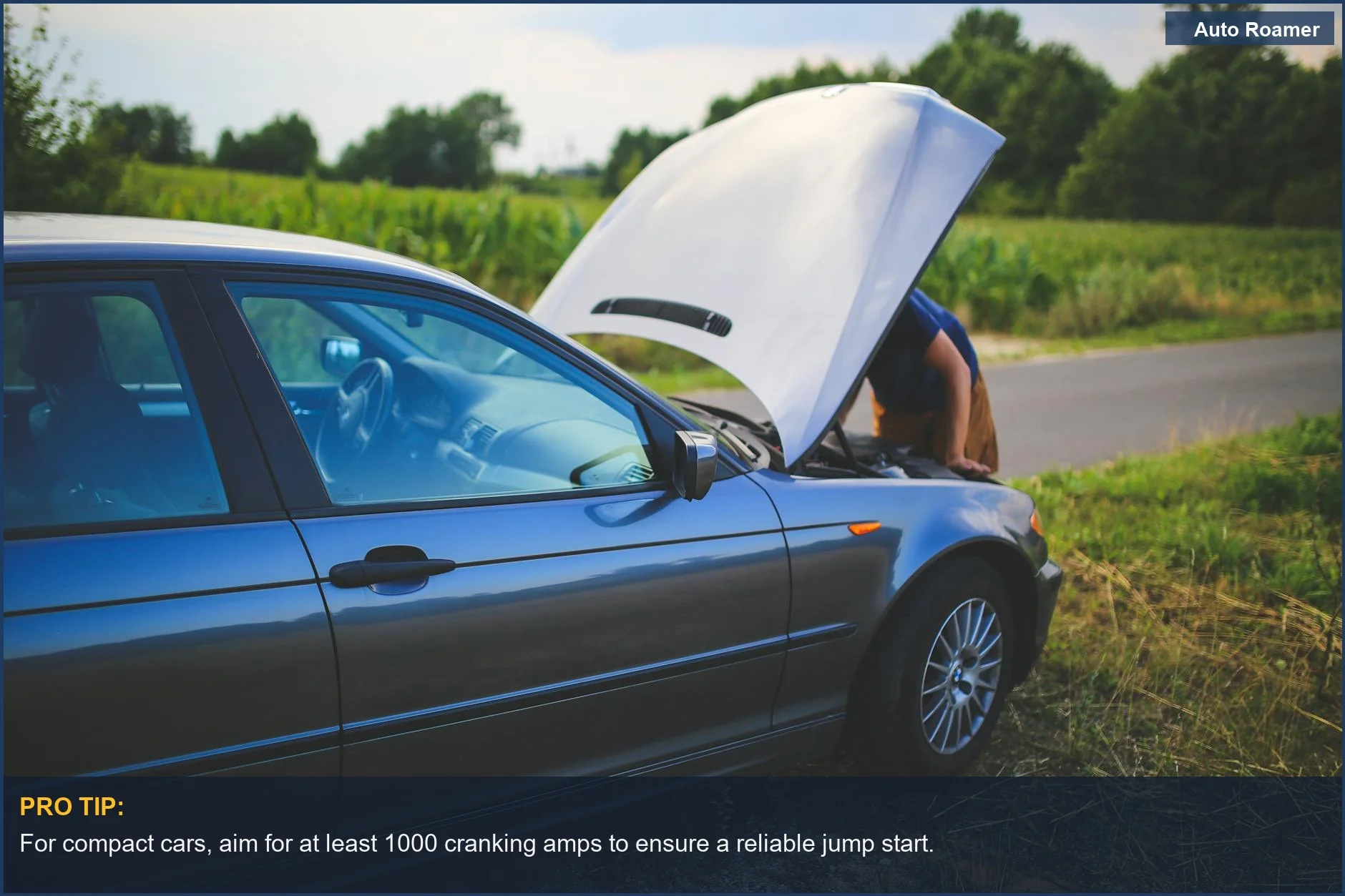
- Small four-cylinder gas engines (most compact and mid-size cars): a unit delivering roughly 400–600 cranking amps covers it.
- Six-cylinder and small V8 gas engines (larger sedans, most SUVs and half-ton trucks): plan on roughly 600–1000 cranking amps.
- Large diesel engines (heavy-duty trucks, big diesels): these are the hungriest, often needing 1500–2000+ cranking amps to turn over, especially cold.
Notice those are cranking amps, not the peak number. A pack advertised at “2000 peak amps” may only sustain a fraction of that. The whole rest of this guide is about reading past the marketing to the spec that matters, derating for cold, and understanding why a higher number is not always the answer — but if you want the one-line version, match the unit’s sustained cranking rating to your engine and add a margin for cold weather and an aging battery.
Peak Amps vs. Cranking Amps: The Marketing Trap
The single most important thing to understand is the difference between the three amperage numbers you’ll see, because manufacturers lead with the most flattering one. Getting this straight is what separates a unit that actually works from a “1000-amp” pack that just clicks uselessly.
- Peak amps is the maximum instantaneous current the unit can produce for a tiny fraction of a second — a brief spike that the internal electronics may not even allow to reach the clamps. It is the largest, most marketable number, and it tells you very little about real-world starting ability.
- Cranking amps (CA) is the current the unit can deliver continuously for a sustained burst (the industry reference is measured over a 30-second discharge). This is the number that actually spins your starter motor, and it is the one to compare.
- Cold cranking amps (CCA) is cranking current rated at 0°F (−18°C), where batteries are weakest and engines hardest to turn. It is the most conservative, real-world figure of the three.
Rule of thumb: if a jump starter advertises only a peak amp figure and hides or omits its cranking/CCA rating, treat that as a red flag. A reputable unit publishes the sustained number because the sustained number is what it can actually back up.
The reason this matters is physical. Starting an engine isn’t a momentary spark; it is several seconds of the starter motor dragging the pistons through their first compression strokes against cold, thick oil. That demands current delivered continuously, not a one-millisecond peak. A pack with an impressive peak number but a weak sustained output will sag the instant it’s under real load — the voltage drops, the clamps go warm, and the engine barely turns. When you compare two units, line up their cranking-amp or CCA figures and ignore the peak headline entirely; that is the apples-to-apples comparison the marketing is trying to talk you out of making.
There’s also a reason the peak figure can be so wildly inflated: it is often a theoretical maximum the internal safety circuitry will never actually let reach the clamps. Many lithium jump starters deliberately limit output to protect their own cells, so the “peak” number describes what the bare battery might do in a lab condition, not what the finished, protected product delivers to your battery. That gap between the marketed peak and the deliverable sustained current is exactly where buyers get burned. Two units can share an identical “2000 peak amps” sticker and perform completely differently the moment a real starter motor loads them down, because one was built to back the number up and the other wasn’t. The only way to tell them apart on paper is the sustained rating — which is precisely why the better brands publish it and the weaker ones bury it.
Matching Amperage to Engine Size and Fuel Type
Once you’re reading the right number, the next step is matching it to the actual job, which comes down to two variables: how big the engine is and whether it burns gas or diesel. Bigger engines have more rotating mass and higher compression, so they draw more current to crank, and diesels draw far more than gas engines of the same displacement.
Working from the engine outward:
- Compact and mid-size gas cars (up to roughly 3.0L, four-cylinder): these are the easiest to start. A pack rated around 400–600 cranking amps (commonly sold under a higher peak figure) handles them with margin to spare.
- Larger sedans, SUVs, and half-ton gas trucks (roughly 3.0–5.0L, six-cylinder or small V8): step up to the 600–1000 cranking-amp range so you have headroom for a tired battery and cold mornings.
- Large gas V8s and full-size trucks (over 5.0L): stay at the upper end of that range or above; the extra rotating mass wants sustained current.
- Diesel engines: a different category entirely. Diesels rely on very high compression to ignite fuel, so the starter fights much harder, and glow plugs add their own draw. Plan on 1500–2000+ cranking amps for anything but the smallest diesel.
Diesel deserves a closer look because it is where most under-buying happens. A diesel’s compression ratio can be roughly double a gas engine’s, which means the starter is shoving against far more resistance on every stroke. That is why a pack that confidently starts a six-cylinder gas SUV can stall out on a diesel pickup of similar size. If you own a diesel, size for the diesel, not for the vehicle’s footprint. You can also size more precisely by checking your own car battery’s CCA rating (printed on the battery label) and choosing a jump starter whose cranking output is in the same neighborhood or higher — the same logic applies when you’re shopping for a charger, covered in our guide to choosing the right car battery charger amperage.
Cold Weather: Why You Need More Than the Rated Amps
Amperage ratings assume comfortable conditions, and cold weather breaks that assumption from both ends at once — which is why winter is when undersized jump starters fail. Cold makes the engine harder to turn and makes every battery (the car’s and the jump pack’s) weaker, so you need a wider margin exactly when the hardware has less to give.
Two things happen as the temperature drops:
- The engine resists more. Cold thickens the engine oil, so the starter has to drag the moving parts through a stiffer, more viscous film. A frigid engine can require noticeably more cranking current than the same engine warm.
- The batteries deliver less. The chemical reactions inside any battery slow down when it’s cold. A battery’s usable capacity and available current both fall as the temperature drops — the reason CCA is rated all the way down at 0°F is precisely that this is the hard case.
The practical takeaway is a buffer. If you live somewhere with real winters, don’t buy the unit that just barely matches your engine’s warm-weather draw; step up a bracket so the pack still has the margin to crank a stiff engine on a single-digit morning. The same goes for an older battery: a battery five to seven years into its life holds less charge and provides less support, leaning even harder on the jump starter. Sizing for the worst realistic day — cold engine, weak battery — rather than the average day is the cheap insurance that keeps a jump starter from becoming a paperweight when you finally need it.
It helps to picture how steeply the math turns against you in winter. The car’s own battery, already weakened by the cold, has less to contribute, so the jump pack effectively has to do more of the work than it would on a mild day. At the same time the engine it’s trying to turn is at its stiffest. So the unit that cleared your engine with ease in a 70-degree garage may be operating right at its limit at 10 degrees — and a unit chosen with no margin at all can simply fail to make the start. This is the most common reason people conclude a jump starter is “defective” when it is really just undersized for the conditions. Buying a size up is far cheaper than a tow.
One more cold-weather habit matters: keep the jump pack itself warm and charged. A lithium jump starter left in a frozen trunk all winter will deliver less than its rating, and many lithium packs are designed to limit output in extreme cold to protect the cells. Storing it indoors or in the cabin and topping up its charge regularly means it can actually deliver the numbers on the box when the thermometer drops.
If you reach the point where the reader is dealing with (or preparing for) a roadside breakdown, it is worth taking the next step with a trusted service — compare roadside plans.
Lithium vs. Lead-Acid Jump Packs
Amperage isn’t the only choice you make; the battery chemistry inside the pack shapes how it performs, what it weighs, and how you have to care for it. Modern portable jump starters fall into two broad camps, and understanding the trade-off helps explain why a small lithium unit can out-crank a much bigger old-style box.
Lithium (typically lithium-ion or lithium-polymer) packs dominate the portable market now, and for good reason. They pack a large amount of energy into a light, pocketable case — a unit small enough to fit in a glovebox can deliver enough cranking current for most cars. They hold their charge reasonably well between uses and often double as a USB power bank for phones and tablets. Their weaknesses are sensitivity to extreme cold (output drops, and the cells need protection circuitry) and a finite cycle life, like any lithium battery.
Lead-acid (and AGM) jump boxes are the older, heavier design — essentially a small car battery in a case with clamps. They are bulky and you have to keep them charged or the lead-acid cells degrade, but they tolerate cold better than bare lithium and can sustain very high current, which is why some heavy-duty and professional units still use them. For most drivers the weight and maintenance make them a poorer everyday choice than lithium.
For the average car owner, a quality lithium jump starter with a published cranking rating that matches the engine is the sensible pick: light, dual-purpose, and easy to keep ready. Reserve the big lead-acid boxes for heavy diesel or fleet duty where their sustained output and cold tolerance earn their bulk.
Whichever chemistry you choose, the safety features matter as much as the amperage, and the better packs of both types now include reverse-polarity protection and spark-proof clamps — covered in more detail further down. If you’re weighing a jump starter against a larger battery for running gear as well as starting a car, the line between the two product categories is worth understanding; our guide to portable power stations for car camping covers the bigger-capacity end of the spectrum.
Capacity (mAh) vs. Amperage: Two Different Things
One of the most common points of confusion on a jump starter spec sheet is mixing up capacity and amperage. They sound related, they’re both about electricity, and marketing happily blurs them — but they answer two completely different questions, and you need to read both to judge a unit.
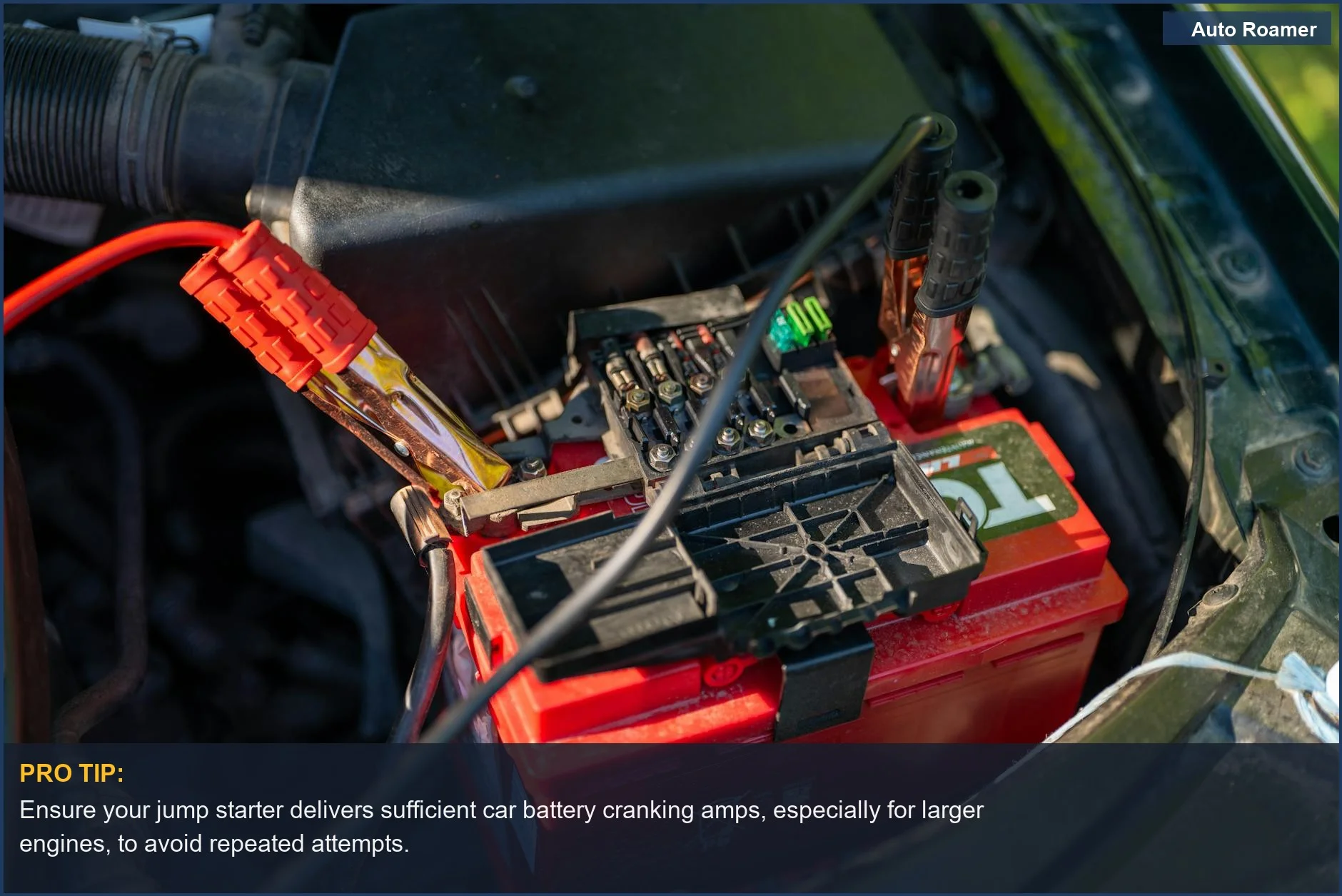
- Amperage (cranking amps) is about power: how hard the unit can push current in the moment, i.e. whether it can spin your starter at all. It’s the make-or-break number for actually starting the engine.
- Capacity (milliamp-hours, mAh, or watt-hours, Wh) is about how much energy is stored: how many starts you can get before recharging, and how long the pack can run a USB device. A high-mAh pack holds more energy; it says nothing directly about whether that energy can be delivered fast enough to crank an engine.
The useful analogy is a water tank with a hose. Capacity (mAh) is the size of the tank — how much water it holds. Amperage is how wide the hose is — how fast the water can rush out. A huge tank with a thin hose (high mAh, low cranking amps) can power your phone for days but may never crank an engine, because the engine needs a fast, fat gush of current, not a long thin trickle. Conversely a narrow-but-fierce unit could crank a car yet hold little reserve energy.
This distinction is also why you can’t shop for a jump starter the way you shop for a phone power bank, even though many modern units do both jobs. A power bank is sold almost entirely on capacity — more mAh means more phone charges, full stop. A jump starter has to satisfy a second, harder requirement first: it must be able to dump a huge current in a short burst. A pack can have a generous mAh rating and still be a poor jump starter if its cranking output is weak, which is exactly the trap behind some cheap, high-capacity units that look like a bargain on the capacity number alone. When a single device is marketed as both a jump starter and a power bank, judge its starting ability strictly on the cranking-amp spec and treat the mAh figure as a bonus that tells you how good a power bank it is — never the other way around.
So read both numbers for what each tells you: check the cranking amps to confirm the pack can start your engine, then check the mAh/Wh capacity to judge how many jumps per charge you’ll get and how useful it is as a power bank. The capacity side of the spec is the same number that determines whether a jump starter can double as a device charger at all — a question we dig into in whether a portable jump starter can charge your devices, and the broader meaning of the capacity figure is explained in our piece on what mAh really means for a jump starter.
How Many Jumps Per Charge, and Keeping It Ready
A jump starter is only useful if it has charge when the emergency comes, so two practical questions follow from the capacity figure: how many starts you can expect from a full charge, and how to make sure the pack is actually full when you reach for it.
On jumps per charge, the honest answer is “it depends, but usually several.” A single engine start draws a lot of current but only for a few seconds, so it uses a relatively small slice of a decent pack’s stored energy. Manufacturers commonly rate consumer lithium units for a number of starts on one charge — often in the range of a dozen or more for a smaller engine — though cold weather, a larger engine, and a battery that’s deeply dead (so the starter cranks longer) all eat into that count. Treat the rated number as a best-case figure and plan to recharge after any real-world use.
The bigger real-world failure, though, isn’t running out mid-trip — it’s self-discharge. Every battery slowly loses charge sitting idle, and a jump starter forgotten in a glovebox for a year is the classic dead-when-needed story. To keep one ready:
- Recharge on a schedule. Most manufacturers recommend topping a lithium jump pack up roughly every three to six months even if it’s unused.
- Check the charge indicator before trips. A thirty-second glance at the LED gauge before a long or cold-weather drive beats discovering a flat pack at the roadside.
- Store it in a moderate temperature. Heat and deep cold both accelerate degradation; the cabin is kinder than a baking or freezing trunk.
If you mainly want a unit for trips and camping where it may sit unused for stretches, that self-discharge habit matters even more — our roundup of the best portable jump starters for camping weighs the standby reliability and dual-purpose features that matter when help is far away.
Safety, Reverse-Polarity Protection, and What to Read on the Box
Power without protection is a hazard, so before settling on an amperage figure, confirm the unit has the safety features that keep a high-current device from hurting you or your car. A modern, reputable jump starter delivers a lot of current through those clamps, and the electronics that govern how that current flows are as important as the raw number.
The safety features worth insisting on:
- Reverse-polarity protection. This detects if the clamps are attached backward (positive to negative) and refuses to deliver current until they’re correct. It is the single most valuable safeguard, because a backward connection is the classic way people damage electronics or cause a dangerous spark.
- Spark-proof / short-circuit protection. Prevents sparking at the terminals and shuts down on a short — important around a battery that can vent flammable hydrogen gas.
- Over-current, over-voltage, and over-temperature cutoffs. These protect both the pack’s cells and your vehicle’s sensitive electronics from a surge.
The spec list that actually matters on the box, in order: the sustained cranking-amp (or CCA) rating, the battery capacity (mAh/Wh), the chemistry (lithium vs. lead-acid), and the safety suite (reverse-polarity and spark-proof protection). The peak-amp headline is the one number you can safely ignore.
Putting it all together, choosing the right amperage is less about chasing the biggest figure and more about reading honestly. Find your engine’s bracket, match the sustained cranking rating to it, add a margin for cold and an aging battery, confirm the capacity gives you several starts and any power-bank use you want, and verify the safety protections are present. A right-sized, well-protected unit you keep charged will out-perform an oversized “4000-amp” box that’s flat in the trunk. If you’d rather compare specific models against these criteria, our review of the best portable car jump starters lines them up on power, safety, and value, and our companion guide to choosing the right jump starter size covers the physical and capacity side of the decision.