
How Smart Car Tech Impacts Insurance Premiums (2026 Complete Guide)
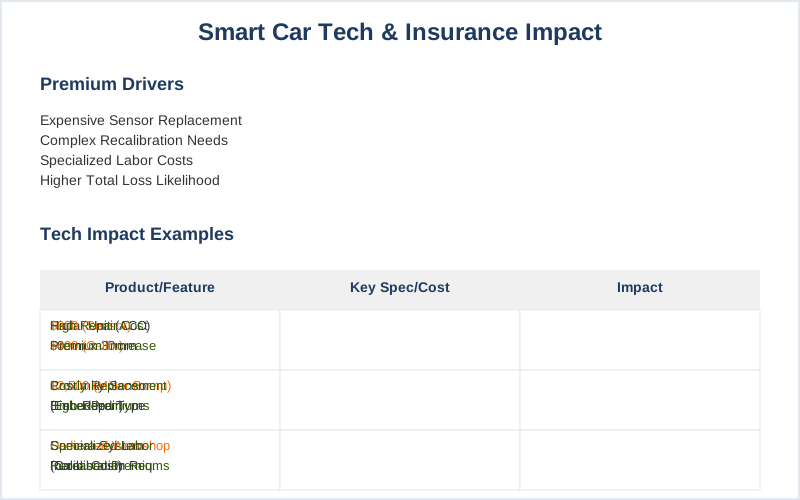
The dealer wanted $2,000 to fix a dented bumper on a 2023 Honda CR-V. Not because the plastic was complex, but because it had a tiny radar unit for the adaptive cruise control. That 50mm x 30mm sensor cost $800 to replace and another $400 to calibrate to the manufacturer's 0.1-degree angular tolerance.
The dealer wanted $2,000 to fix a dented bumper on a 2023 Honda CR-V. Not because the plastic was complex, but because it had a tiny radar unit for the adaptive cruise control. That 50mm x 30mm sensor cost $800 to replace and another $400 to calibrate to the manufacturer's 0.1-degree angular tolerance. Modern cars are packed with this kind of over-engineered garbage, and it's driving your insurance premiums through the roof.
This isn't just about a higher sticker price for parts; it's about specialized labor rates and the sheer complexity of electrical systems WeCovr.
I've seen firsthand how a simple fender bender on a new model can turn into a five-figure repair bill, all because of some embedded proximity sensor or a camera that needs a dedicated, controlled workshop environment for recalibration WeCovr. Your insurance company isn't stupid; they see these repair costs, the increased likelihood of total write-offs for seemingly minor damage, and they adjust their actuarial tables accordingly. It's pure physics on their end: higher risk, higher premium.
Forget the 'safety benefits' argument for a minute. While lane assist might prevent a 60 MPH side-swipe, that same system's components are brittle and expensive. A 10 MPH parking lot bump that used to be a $300 paint job is now a $2,500 bill because a radar module got vibrated out of its mounting bracket or its internal circuit board cracked from mechanical shock. The material properties of these sensors are not designed for impact, only detection.
We're talking about micro-tolerances and delicate integrated circuits mounted in plastic housings that were never meant to absorb kinetic energy. The thermal cycling alone can degrade solder joints over time, making them even more susceptible to shock-induced failure. This isn't theoretical; it's why your 'safer' car ends up costing more to insure, despite what the marketing brochures claim about preventing accidents CheapInsurance.com. It's all about the cost-per-fix, and that number is escalating rapidly.
Understanding how smart car tech impacts insurance premiums
Your insurance bill isn't some arbitrary number; it's a calculation based on the statistical likelihood of your car turning into a pile of expensive, unrepairable junk. And modern car tech, with all its bells and whistles, is pushing that likelihood up. Forget the 'safe driving' discounts for a second. The core issue is the increased repair complexity and the cost of replacing delicate, integrated components. Yahoo Finance reported auto insurance premiums jumped by over 64% between September 2020 and September 2025 - far outpacing general inflation. Take ADAS - Advanced Driver-Assistance Systems. These are the cameras, radar, and ultrasonic sensors glued everywhere. They prevent some accidents, sure, but they also turn a $100 headlight replacement into a $1,200 job because the unit contains an integrated camera that needs post-installation calibration. The sensor array itself is often a single, non-serviceable unit. If one part fails, you replace the whole thing. Then there's the labor. You can't just have any grease monkey swap out a radar unit. It requires IMI (Institute of the Motor Industry) certified technicians, specialized diagnostic tools, and a controlled environment to recalibrate sensors to OEM specifications WeCovr. These guys command higher wages because their skillset is narrow and in demand. That's a direct cost adder to any repair. Electric Vehicles (EVs) are a whole other beast. The battery pack, the single most expensive component, can easily be 40% of the vehicle's value. Even minor chassis damage can compromise a battery's structural integrity or its thermal management system. Insurers often write off the entire vehicle rather than risk a fire from a compromised lithium-ion pack or shoulder the astronomical replacement cost WeCovr. This shifts liability and cost, naturally. And then there's telematics, which is just Big Brother in a box. These systems track your speed, braking patterns, and mileage AbittO.us. Some claim it lowers your rates for 'safe driving,' but it also gives insurers granular data to penalize you for minor deviations. It's a double-edged sword: you might save 10% for driving like a grandma, but a hard brake from 50 MPH to avoid a deer could be logged as a 'high-risk event.' Consumer Reports acknowledges these systems can match rates to risk more accurately Consumer Reports. It's all about data points, and more data means more ways to find fault.
how smart car tech impacts insurance premiums in Detail
The reason your insurance bill keeps climbing isn't some conspiracy; it's a cold, hard calculation based on the cost of fixing your 'smart' car. Here's how that fancy tech hits your wallet.1. High-Cost Component Replacement
That plastic bumper isn't just plastic anymore. It's a housing for radar, lidar, and ultrasonic sensors. A fender bender that used to cost $300 for a body shop to pull and repaint now involves replacing a $700 radar unit and a $500 camera module. The material cost alone is insane because these aren't simple switches; they're complex integrated circuits with specific thermal operating ranges. WeCovr notes a £300 cosmetic fix can become a £2,000+ repair.2. Specialized Labor and Calibration
After replacing a sensor, you can't just drive off. The new unit needs to be calibrated. This means a technician with IMI certification, using proprietary software and a controlled workshop environment, aligning the sensor to within 0.1mm of its OEM spec. This isn't a quick job; it's a precision alignment that adds hundreds to the bill WeCovr. Your average mechanic can't do this; you're paying for specialized knowledge and tools.3. Increased Write-Off Risk
Electric vehicles are prime examples. The battery pack is the single most expensive component. Even minor structural damage to the chassis can compromise the pack's integrity, leading to a total write-off because replacing the battery costs more than the car is worth WeCovr. The internal cell connections, often welded, are highly susceptible to shear forces from impact, leading to internal shorts or thermal runaway risks. Insurers aren't taking that gamble.4. Telematics and Data Collection
Usage-based insurance programs like Progressive's Snapshot or State Farm's Drive Safe & Save track everything: speed, braking, acceleration, even time of day you drive AbittO.us. While they promise discounts for 'safe' drivers, they also create a detailed risk profile that can be used to justify higher rates if your driving habits don't meet their algorithms. It's a trade-off: privacy for a potential discount.5. Cybersecurity Risks
As cars become more connected, they become targets. A compromised vehicle system could lead to theft or even malicious control. While less common, the potential liability for a manufacturer or owner if a security flaw leads to an accident is a new factor insurers are considering Founder Shield. It's a failure mode related to software integrity, not mechanical stress, but the financial consequences are real.6. AI in Underwriting and Claims
Insurers are now using AI to analyze massive datasets, not just on your driving, but on repair costs, fraud detection, and even predicting future trends FW Business. This means more precise pricing, which often translates to higher rates for anyone not fitting the 'perfect' driver profile. This isn't about human error anymore; it's about algorithmic optimization of profit.
Common Questions About how smart car tech impacts insurance premiums
So, you've got a car that's smarter than you are, and your insurance company is milking it. Here are some common questions I hear from folks trying to navigate this mess. Q: Does my car's fancy safety tech actually lower my rates? A: Sometimes, by a statistically insignificant margin. While systems like lane assist or automatic emergency braking can theoretically reduce accident frequency, the repair costs associated with those same systems often outweigh the benefit from an insurer's perspective The Zebra. You might see a sub-1% discount for some features. Congratulations. Q: Will my insurance go down if I disconnect the telematics device? A: Probably, but you'll lose any 'safe driver' discount you might have been getting. More importantly, some policies are explicitly tied to these devices. Disconnecting it could violate your policy terms and potentially void your coverage in the event of a claim. Read the fine print; that small plastic box is a contractual obligation. Q: Are electric cars always more expensive to insure? A: Generally, yes. In 2026, electric car insurance is about 15-25% higher than petrol equivalents Electric Car Scheme. This isn't because they're inherently more dangerous to drive. It's because the battery pack is a multi-thousand dollar component that's prone to total failure from minor impact, and the high-voltage systems require specialist technicians. The cost-per-repair is just higher. Q: Is AI making insurance pricing fairer or just more expensive? A: It's making it more precise, which usually means more expensive for the average driver. AI analyzes vast datasets to assess risk, detect fraud, and optimize pricing FW Business. This means insurers can pinpoint high-risk profiles with greater accuracy, leading to tailored, often higher, premiums. They're not looking for 'fair'; they're looking for profitable risk assessment. Q: How much do vehicle modifications impact my premium? A: Any modification, especially those affecting performance or aesthetics, can raise your premium WeCovr. From aftermarket rims that change the unsprung weight and impact suspension stress, to engine tunes that increase thermal load, you're changing the vehicle's original failure modes. Insurers hate variables they didn't account for. Declare everything, or risk your claim being denied.
Tips and Best Practices
So, your car is a rolling computer, and your insurance company knows it. Here's how to fight back against the ever-climbing premiums, even with all that over-engineered tech.1. Shop Around Every 6-12 Months
This is the simplest, most effective fix. Insurance companies constantly tweak their algorithms and pricing models. What was a bad deal last year might be a good one today. I've seen two identical drivers get quotes differing by $500-$1,200 annually from different major insurers AbittO.us. They're all using different AI models to assess risk FW Business. Play them against each other.2. Strategically Increase Your Deductible
If you have an emergency fund of at least $1,500 sitting around, consider raising your deductible from $500 to $1,000. This can cut your premium by 10-25% AbittO.us. You're shifting the first chunk of repair cost onto yourself, which reduces the insurer's immediate liability. Just make sure you can actually cover it if something happens. It's a calculated risk based on your personal liquidity.3. Leverage Multi-Policy Discounts
Bundle your auto insurance with your home or renters insurance. This is a no-brainer. Insurers love to cross-sell, and they'll often give you a decent discount for keeping all your policies with them AbittO.us. It's a simple customer retention strategy that you can exploit. My personal savings on this alone were over $200 a year.4. Re-evaluate Optional Coverages
If you're driving an older car, say a 2010 Civic, do you really need full collision and comprehensive? The replacement cost might be less than your annual premium for those coverages. Run the numbers. At some point, the cost-benefit analysis for retaining full coverage flips. The market value of the vehicle dictates this, not your emotional attachment.5. Consider Aftermarket Security (Carefully)
Installing a high-quality aftermarket alarm or tracking device can sometimes lower your premium, especially if it's on a commonly stolen model. However, make sure it's professionally installed and doesn't interfere with your car's existing electrical system, causing parasitic draws or circuit integrity issues. Messing with the CAN bus can lead to more problems than it solves. Stick to proven, simple solutions.6. Drive Less, If Possible
Lower annual mileage can sometimes lead to lower premiums, especially with telematics programs. Less time on the road means less exposure to potential mechanical stress and collision events. If you can bike to work two days a week, that reduction in mileage can add up over a year, potentially lowering your risk profile in the insurer's eyes.
Real-World Examples
The numbers don't lie. Smart car tech is a double-edged sword, and right now, the sharp edge is pointed at your wallet. Here are some real-world impacts I've seen.Key Takeaways
The bottom line is, your 'smart' car isn't making your insurance cheaper. It's making it more expensive to fix, and therefore more expensive to insure. The physics of it is simple: complex systems with tight tolerances and delicate components cost more to replace and calibrate. Here's the rundown:Frequently Asked Questions
My backup camera is blurry. The dealer wants $600 to replace it. Can I just DIY it cheaper?
Do I need special tools to diagnose a failing sensor, or can I just guess?
What if I try to recalibrate an ADAS sensor myself and it's still off?
Can aftermarket dashcams permanently damage my car's electrical system if hardwired incorrectly?
I heard that if I drive very slowly and gently, my telematics insurance rates will plummet. Is that true?
🏅 Looking for Gear Recommendations?
Check out our tested gear guides for products that work with this setup:
Sources
- Car Insurance Rates Are Rising in 2026 — Here's How Smart ...
- article_f467fc3f-ea6f-5a47-8069-3ed3a300f82.html
- Are Electric Cars More Expensive to Insure? 2026 Guide
- article_f467fc3f-ea6f-5a47-8069-3ed3a4300f82.html
- wecovr.com
- Modern Car Tech Insurance Costs 2026 | Top Insurance Guides
- Technology Insurance Pricing Trends 2026: Navigating the Evolving ...
- Hidden Factors That Affect Auto Insurance Premiums in 2026
- wecovr.com
- Why Tech That Makes Your Car Safer Won't Lower Your Insurance ...
- Car Insurance Telematics Pros and Cons - Consumer Reports
- 2026 insurance outlook: Costs will rise as technology evolves
- What AI-processed insurance claims mean for drivers in 2026
- the_impact_of_vehicle_technology_on_insurance_what_drivers_need_to_know_in_2025