
The Short Answer: A Bed Outlet With Two Ceilings
The Honda Ridgeline is the rare pickup with a real household outlet in the bed, and the number Honda prints on the marketing is the one that gets campers in trouble. The in-bed AC outlet delivers up to 150 watts with the engine off or in accessory mode, and up to 400 watts only with the engine running. Read the 400-watt figure, plug in an AC fridge overnight, and the outlet quietly trips because the engine is off and the real ceiling is 150 watts.
That split personality is the whole story of the Ridgeline's electrical system. The bed outlet is generous when the engine turns and modest when it sleeps, while the cabin's 12V sockets are switched and die the moment you pull the key. Knowing which outlet does what, and which fuse guards each one, is the difference between a fridge that holds through the night and a warm cooler at dawn.
This page maps every 12V and 120V point on the Ridgeline, the fuse behind each, the honest wattage ceiling, and the one modification owners use to get always-on power. None of it comes from us personally wiring a Ridgeline; it is drawn from Honda's fuse-box documentation, the owner's manual, and the measurements Ridgeline owners have posted after tracing these circuits.
The In-Bed AC Outlet: 150 Watts Asleep, 400 Awake
On the RTL-E and Black Edition, the in-bed AC power outlet lives in the truck-bed side pocket and supplies 120V household power. Its two-tier rating is the key spec: up to 150 watts with the engine off or in accessory mode, and up to 400 watts with the engine running. In current terms, 150 watts at 120V is about 1.25 amps, and 400 watts at 120V is about 3.3 amps.
The reason for the two ceilings is simple once you see the plumbing. The outlet is a 12V-to-120V converter, and its real ceiling is set by the fused 12V supply feeding it. With the engine off, that supply is limited to protect the battery; with the engine running, the alternator lets the inverter reach its full 400 watts. So the 400-watt number is honest, but only under power.
The practical result: the Ridgeline in-bed outlet is excellent for charging a phone, a laptop, or a set of tool batteries, and it is marginal for a large AC compressor fridge at rest. A fridge drawing more than about 150 watts of AC will trip the outlet unless the engine is running. Plan for the resting ceiling, not the marketing one.
One convenience redeems the resting cap: owners confirm the AC power outlet works while driving, which lets you keep a 12V or AC fridge cold on the move without any accessory timer cutting out. Unlike the ignition-switched cabin 12V sockets, the bed outlet stays live as you cover ground, so you arrive at camp with a cold box and full device batteries. The moment you shut the engine, though, you are back under the 150-watt roof, and that is the number that governs your night.
The Cabin 12V Sockets Are All Switched
The Ridgeline has three 12V accessory power sockets from the factory: a front socket plus additional cabin and console positions per the owner's manual. Here is the catch that surprises campers: the 12V accessory sockets are switched. They are powered only when the ignition is in the ON or ACC position, controlled by the audio-navigation unit and fed through the DC-DC converter. None of them is always-on.
That means a 12V fridge wired to a cabin socket will lose power the moment you switch the ignition off, exactly when you want it running. Campers who try to run a DC fridge off the console socket wake up to a warm box and a confused search for a blown fuse that never blew. The socket did its job; it just went to sleep with the truck.
The workaround most Ridgeline campers land on is to run the fridge from the inverter-fed bed outlet while the engine or accessory mode is active, since owners confirm the AC power outlet works while driving, which keeps a fridge cold on the move without the accessory timer cutting out. For sustained overnight cooling, that still means auxiliary power. The Ridgeline camping guide covers how owners stage that power for a full weekend.
The Fuse Map, Point by Point
The Ridgeline splits its power fuses between the interior panel and the engine bay, so know which box to open:
- The front accessory 12V socket is protected by Fuse 5, a 20A fuse ('FR ACC SOCKET') in the passenger-compartment fuse box.
- On 2017-2019 trucks the center accessory 12V socket is Fuse 8, a 20A fuse ('CTR ACC SOCKET') in engine-compartment Fuse Box B.
- The USB charging circuit runs on a 15A fuse (Fuse 14, 'DISPLAY/USB') in the engine compartment.
- The AC inverter feeding the bed outlet is protected by a 70A fuse labeled 'AC INVERTER' in the engine compartment, on models so equipped.
On 2020-2026 models the front accessory socket remains Fuse 5 at 20A in the passenger compartment, and the AC inverter remains a 70A fuse in the engine compartment, so the core map is stable across both generations. The inverter unit itself is mounted behind the rear seat next to the factory subwoofer, which is worth knowing if you ever chase a fault back to the source.
The 70A fuse on the inverter can look alarming next to the 20A sockets, but remember it guards the 12V current the inverter draws to make its 120V output, not the current at the outlet face. To push about 150 watts of AC at rest, the inverter is already pulling a healthy chunk of 12V amps through that 70A fuse, and at 400 watts running it pulls proportionally more, which is exactly why the engine has to be on to reach the top figure.
The USB circuit sitting on its own 15A fuse is a useful detail for troubleshooting. If your phones stop charging from the dash ports but the 12V socket still works, you are looking at the USB fuse, not the socket fuse, and swapping the wrong one wastes an afternoon. Knowing the circuits are separate turns a mystery into a two-minute check.
What Each Fuse Lets You Actually Draw
On the DC side, the front 20A accessory socket supports about 240 watts peak at 12V, best derated to roughly 192 watts, which is 80% of the 20A rating, for continuous fridge and charger loads. That is a healthy budget for a compressor fridge, but only while the ignition keeps the socket alive.
On the AC side, the bed outlet's honest ceiling is the 150-watt resting limit. A typical 12V compressor fridge pulls only a few amps and would be trivial on the DC circuit, but running that same fridge as a 120V appliance through the resting inverter puts it right at the edge of the 150-watt cap, before you even count conversion losses. This is why AC-appliance camping on the Ridgeline is a poor plan at rest and a fine one while driving.
The clean division of labor: charge devices and tool batteries on the bed AC outlet, run a DC fridge on a switched cabin socket only while moving, and solve the overnight problem with either an always-on modification or a portable power station that ignores the truck's timers entirely.
It helps to think in terms of what each appliance actually pulls. A compressor fridge cycling on and off averages only a few amps, so it barely touches a 20A DC circuit; the constraint is never the fuse, it is whether the socket is awake. A laptop charger draws well under 150 watts, so it is comfortable on the resting bed outlet. A hair dryer, a kettle, or a space heater blows past 400 watts instantly and does not belong on this outlet in any state. Sorting your gear by its real draw, not its plug shape, is what keeps the Ridgeline's circuits boring.
The Always-On Modification Owners Use
Because every cabin socket is switched, Ridgeline owners who want constant 12V power do a specific relay modification. To make a 12V socket always-on, owners remove the front-outlet relay, located near the added trailer-hitch relay position behind the headlight switch, and install a jumper in its place so the circuit no longer waits for the ignition.
The safety step is not optional: Honda advises pulling the 15 amp under-hood accessory fuse before jumping the relay to prevent a short during the modification. Skip it and you risk arcing a live circuit while your hands are in the harness. Pull the fuse, make the jumper, reinstall the fuse, and test.
This mod turns a convenient but timed socket into a true constant-power feed, which is what a fridge needs. It also removes the truck's built-in protection against draining the battery, so it pairs with the same discipline every constant-power tap demands: a way to recharge and an eye on how long the fridge has been running without the engine.
The 400-Watt Myth, Busted Honestly
It is worth stating plainly because the marketing invites the mistake: the Ridgeline in-bed outlet is not a 400-watt-anytime plug. It is capped at 150 watts with the engine off, so any AC load above roughly 150 watts needs the engine running to hold. Owners who buy the truck expecting to run a household appliance at a quiet campsite are the ones who get surprised.
That does not make the outlet useless overnight; it makes it specific. Within 150 watts you can keep phones, a laptop, a fan, and a light going all night at rest, which covers most campers' actual needs. Step up to a microwave, a full-size AC fridge, or a space heater, and you are back to needing the engine or a separate power source. The line between a great night and a tripped outlet is drawn at that 150-watt mark, and the outlet enforces it without warning, so it pays to know where your gear sits relative to it before dark.
Framed correctly, the Ridgeline's bed outlet is one of the best factory conveniences in any midsize truck. Framed by the 400-watt headline alone, it is a setup for a bad night. Design your camp around the resting number and it never lets you down.
There is a subtler version of the same mistake worth naming. Some owners assume that because the bed outlet reaches 400 watts while driving, they can charge a big battery bank on the road and coast through the night on that. That works, but the 400-watt cap means the bank charges slowly, so a long-enough drive is required to bank real reserves. The outlet is a trickle-charger at highway speed, not a fast charger, and treating it as the latter leaves you short at camp.
Generation Notes: 2017-2019 vs 2020-2026
The Ridgeline's electrical layout is unusually consistent across its two generations, which makes planning easier. On 2017-2019 trucks the center accessory socket is Fuse 8, a 20A fuse in engine-compartment Fuse Box B, while the front socket sits on Fuse 5 at 20A in the cabin. On 2020-2026 trucks the front socket stays Fuse 5 at 20A in the passenger compartment and the AC inverter stays on its 70A fuse in the engine bay.
The USB circuit's 15A fuse and the switched behavior of the cabin sockets carry across both generations too. In practice, a wiring plan built for a 2018 Ridgeline transfers almost intact to a 2024, which is not something you can say about most trucks whose fuse maps shuffle every refresh.
The one thing to confirm on any specific truck is whether it actually has the in-bed AC outlet, since it is limited to the RTL-E and Black Edition. Lower trims skip the inverter entirely, in which case the bed has no 120V power and the whole AC discussion is moot; you are back to the switched cabin sockets and an auxiliary plan.
When you are shopping used, this matters more than the model year. A well-kept 2018 RTL-E with the bed outlet is a better camping platform than a newer base trim without it, purely on power. Check the bed side pocket for the outlet and the trim badge before you assume a given Ridgeline has the feature this whole page revolves around; the fuse map only helps if the inverter is there to feed.
Matching Camp Gear to the Right Ridgeline Outlet
The assignments follow the ceilings. Phones, a laptop, camera batteries, and tool batteries belong on the bed AC outlet, comfortably under its 150-watt resting limit and able to reach 400 watts while you drive to the next trailhead. A 12V compressor fridge belongs on a cabin socket only while the engine or accessory mode is live, or on an always-on modified socket if you have done the relay jumper.
Anything that must run untended all night, from a fridge to a CPAP, is happiest on a separate power source that does not care about the truck's ignition state. For most Ridgeline campers, the cleanest answer is a portable power station charged off the bed outlet while driving, then run independently at camp. It sidesteps the switched sockets, the resting-wattage cap, and the battery-drain risk in one move, and it scales: a bigger station simply buys more nights between drives.
Get the pairing right and the Ridgeline is genuinely one of the most useful trucks for a powered camp. Its bed outlet and stable fuse map reward planning; its switched sockets and two-tier inverter punish assumptions. The Ridgeline versus Santa Cruz comparison shows how that power setup stacks up against its closest rival.
The Verdict: Plan Around the Resting Number
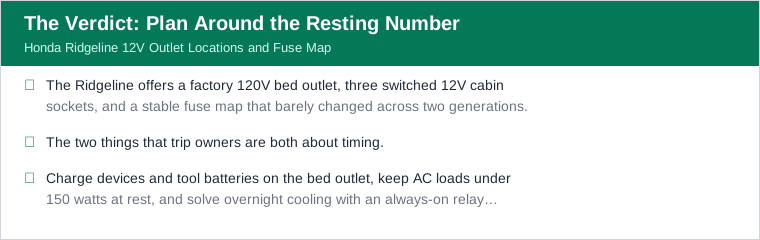
The Ridgeline offers a factory 120V bed outlet, three switched 12V cabin sockets, and a stable fuse map that barely changed across two generations. That is a strong foundation for camp power, stronger than most midsize trucks bring from the factory.
The two things that trip owners are both about timing. The bed outlet's 400-watt rating only applies with the engine running, dropping to 150 watts at rest, and every cabin 12V socket is switched off with the ignition. Neither is a defect; both are simply how Honda protects the single battery, and both are entirely workable once you know they are there rather than discovering them at midnight.
Charge devices and tool batteries on the bed outlet, keep AC loads under 150 watts at rest, and solve overnight cooling with an always-on relay modification or a portable power station. Do that and the Ridgeline delivers exactly what its bed outlet promises, on your schedule instead of the engine's. For the deeper build details, see the guide to powering a 12V fridge while camping.