
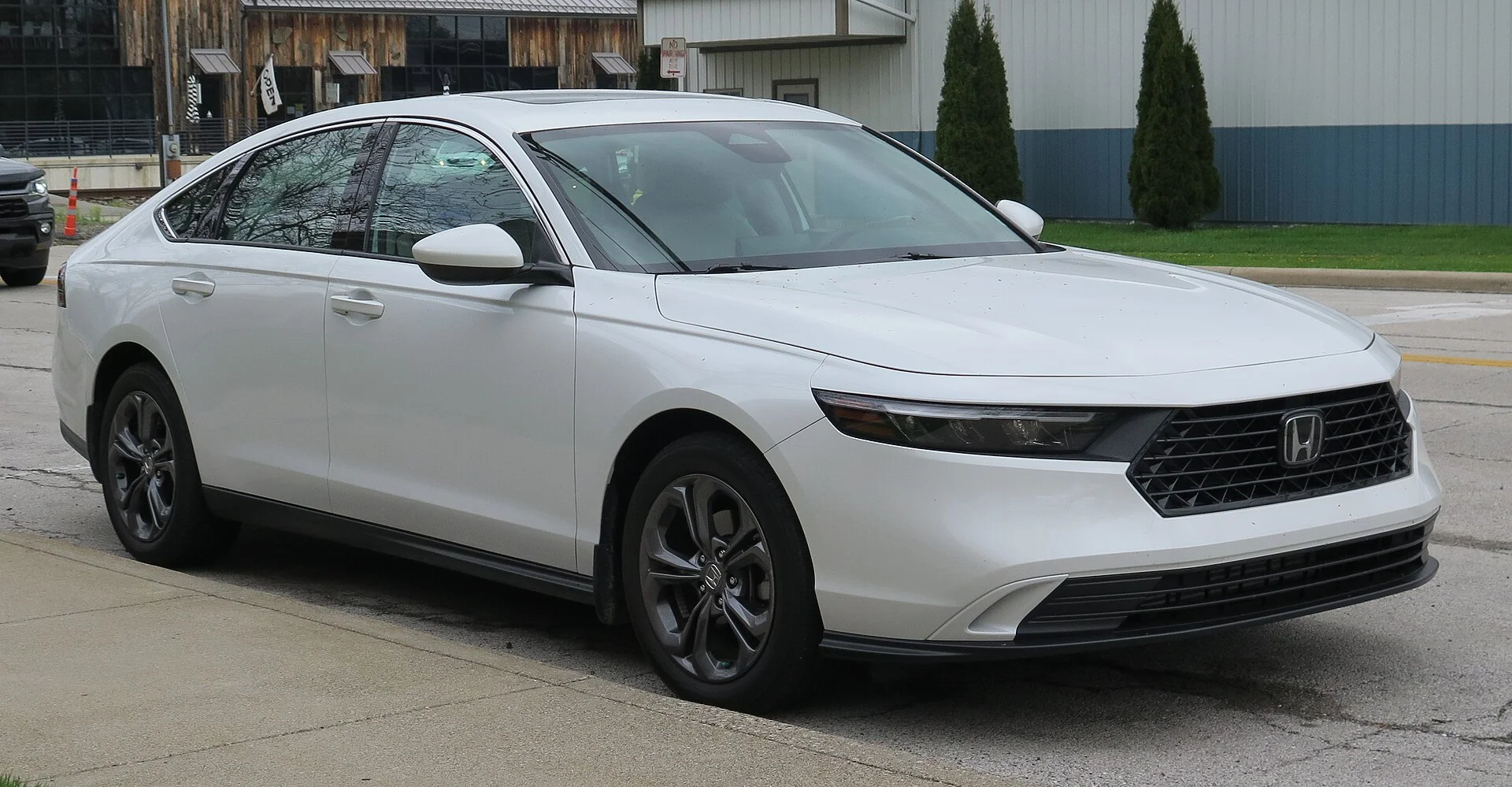
Can You Camp and Sleep in a Honda Accord? The Honest Answer
Yes — you can camp and sleep in a Honda Accord, but it's important to be honest about what that actually looks like, because an Accord is a sedan, not an SUV or a hatchback. You do not get a flat, rectangular cargo floor to stretch out on. Instead, you fold down the 60/40-split rear seats and sleep diagonally, with your torso on the folded seatback and your legs and feet running back into the trunk through the pass-through opening. Done right, it works for one person and is tight-but-doable for two who don't mind being close.
The numbers set the expectations. A modern Accord trunk holds around 16.7 cubic feet, which is generous for a sedan, and the rear seats fold to open that trunk into the cabin. What you don't get is the roughly six-and-a-half feet of flat floor an SUV gives you. Lying straight across the folded seats alone, most adults run out of room; the diagonal route through the trunk pass-through is what buys back enough length for a taller person to lie out reasonably flat.
So the realistic summary is this: a Honda Accord is a capable occasional car-camping platform — great for a festival, a one-night stop on a road trip, or a stealthy night in a city — rather than a purpose-built camper. If you go in expecting a flat king-size floor you'll be disappointed; if you go in understanding it's a fold-the-seats, sleep-on-the-diagonal sedan setup, it's surprisingly comfortable. Everything below is the detailed version of how to make that work, who it fits, and when a sedan simply isn't the right tool.
How the Accord's Trunk Pass-Through Actually Works
The single feature that makes sleeping in an Accord possible is the trunk pass-through created when you fold the rear seats. Without it you'd be limited to the length of the cabin between the folded seatback and the front seats — far too short for an adult. With it, the trunk and the cabin become one continuous space, and your lower body can extend into the trunk while your upper body rests on the folded seat platform.
A few specifics matter for how usable that space is:
- The seats fold 60/40, not always fully flat. On many sedans, including the Accord, the folded rear seatbacks sit slightly higher than the trunk floor, leaving a step or a gentle slope rather than a perfectly level surface. Closing that gap with padding is the core comfort challenge.
- The pass-through opening is sized for cargo, not people. It's wide enough to slide skis, lumber, or your legs through, but it is narrower than the full cabin, so the diagonal is what lets a wider sleeper still get their legs in.
- Trunk capacity is about 16.7 cubic feet. That's your gear hold by day and part of your bed by night — you can't have both full at once, so packing strategy matters.
The practical takeaway is to think diagonally from corner to corner. Position yourself from the rear footwell area on one side, across the folded seat, and out through the pass-through toward the opposite trunk corner. That diagonal line is the longest straight run the car offers, and it's how a person near six feet tall can lie out without their knees permanently bent.
Think of an Accord bed as a diagonal, not a rectangle. The trunk pass-through turns a too-short cabin into a usable sleeping length — but only if you orient your body across the car, not straight along it.
It's also worth confirming the fold mechanism on your specific model year before you commit to a trip. Some trims release the rear seats from levers in the trunk, others from the top of the seatback; some fold nearly flat while others leave a more pronounced step. Five minutes folding the seats and lying down in your own driveway tells you more than any spec sheet about whether the diagonal works for your height and build.
Who Fits: Height, Sleepers, and Realistic Length
The honest gating question for any sedan sleeping setup is your height, because the diagonal length is finite. The Accord's advantage is that it's a relatively large sedan with a long trunk, so the diagonal run is generous by sedan standards — but it is still a sedan, and there's a point where a taller adult simply runs out of room.
As a rough guide to expectations:
- One average-height adult: comfortable. With the seats folded and a sleeping pad bridging the step into the trunk, a person of average height can lie out diagonally with room to spare.
- One taller adult (around six feet): workable on the diagonal. You'll use most of the available length and want your feet aimed into the deepest trunk corner; a slight bend is normal but it's far from cramped.
- Two adults: tight. Two people can share the space if they're comfortable being close and at least one is on the shorter side, but it's a squeeze, and many couples find the Accord better as a one-person bed plus a tent or rooftop option for the second person.
Sleeping position also changes the math. Side sleepers fit a sedan more easily than back sleepers because they take up less length and can curl slightly without discomfort. If you're a starfish back sleeper who needs to lie dead straight, a sedan will feel more confining than it does for someone who naturally sleeps on their side.
Because fit is so personal, this is exactly the kind of decision worth pressure-testing against the broader question of whether a sedan suits you at all. Our overview of whether you can car camp in a sedan walks through the trade-offs across body types and trip styles, and the same diagonal-sleeping logic that works in the Accord is covered for a smaller car in our guide to sleeping comfortably in a Honda Civic. If the Civic works for someone, the roomier Accord is a clear step up.
Mattress and Sleeping Pad Options for a Sedan
The biggest comfort problem in a sedan isn't space — it's the uneven surface. Because the folded seatbacks and the trunk floor rarely line up perfectly flat, your sleeping system has two jobs: cushion you, and bridge the step or slope so you're not sleeping in a valley. The right choice depends on how much that gap is and how much you're willing to carry.
The main categories, and where each fits a sedan:
- Self-inflating or inflatable sleeping pads are the most practical default. They pack down small — a real advantage when the trunk doubles as your bed — and a thicker pad (three inches or more) does a good job of evening out a modest step between seat and trunk. A single wide pad or two regular pads side by side covers the diagonal.
- Foam pads are cheaper and never puncture, but they don't compress, so they eat trunk space you may want for gear. They're a reasonable budget choice for a fixed setup.
- A thin foam topper plus a pad is a common sedan trick: lay a cut-to-fit piece of foam to fill the worst of the step first, then an inflatable pad on top for comfort. This levels the surface better than either alone.
- Air mattresses can work but are the riskiest fit. A queen will not lie flat in an Accord; a twin or a sedan-specific inflatable shaped to fold into the footwells fits far better. The honest rule is to match the mattress to the diagonal, not to force a full-size bed into a space that won't take it.
Whatever you choose, the goal is a continuous, level surface along your diagonal sleeping line. It's worth measuring your own car with the seats folded and the step's height before buying, since the exact gap varies by model year and trim. For a deeper comparison of the two main pad types and how they behave in a vehicle, see our guide to inflatable versus foam sleeping pads for car camping, and for sizing a pad or mattress to a smaller vehicle specifically, our rundown of the best car-camping mattresses for an SUV or sedan covers what actually fits.
If you camp in the Accord often, a simple low platform is the next step up: a cut-to-fit board supported just above the folded seats can create a genuinely flat surface and free storage underneath, though in a sedan it has to be modest to clear the limited headroom. The general approach is laid out in our walkthrough of a DIY car-camping sleeping platform.
Window Covers and Privacy in a Sedan
Privacy is more of a challenge in a sedan than in an SUV, because an Accord has a lot of glass and you're lying low and close to the windows. Covering that glass does three jobs at once: it gives you privacy and security, it blocks streetlight and morning sun, and it insulates the cold single-pane windows, which cuts down on the condensation that builds up overnight from your breath.
The common approaches, from simplest to most polished:
- Cut-to-fit reflective panels. Reflective bubble-foil or foam-board insulation cut to each window's shape is the workhorse of sedan privacy. It's cheap, it blocks light completely, and the foil layer reflects summer heat and insulates against winter cold.
- Magnetic or suction-cup covers. Panels held by small magnets on the steel door frame or by suction cups go up and come down quickly and store flat — convenient if you set up and break camp every day.
- Fabric shades or curtains. A simple curtain rigged across the cabin behind the front seats, plus stretchy sun shades on the side windows, gives a softer look that draws less attention than foil in an urban setting.
The detail that trips people up is the windshield and front side windows. They're the largest expanse of glass and the most exposed, so a sedan setup that only covers the rear looks obviously occupied. Cover all the glass — including a windshield shade pulled across the front — for both real privacy and a parked car that reads as empty. The full method, including how to keep covers tidy and quick to deploy, is in our guide to blocking car windows for sleeping privacy.
One bonus of covering the glass well is that it pairs directly with the next concern: those same insulating panels keep the window surfaces warmer, which is one of the main levers against the condensation that any sealed-up sleeper in a cool climate has to manage.
A practical note specific to sedans: because you're lying low and the side glass is right beside your head, light leaks at the edges of a panel are more noticeable than in a tall vehicle, and so are gaps that let a passerby see movement. Cutting each panel a touch oversize so it wedges against the rubber seal, and overlapping the windshield shade with the front side covers, closes those seams. The payoff is a darker, more private cabin that also reads convincingly as an empty parked car — which, in a sedan you may be sleeping in on a city street, is as much about not being noticed as it is about blocking light.
Ventilation, Condensation, and Carbon-Monoxide Safety
Sleeping in a sedan means sleeping in a small, fairly sealed metal box, which makes ventilation both a comfort issue and a genuine safety issue. Two related problems come up every night you sleep in an Accord: condensation on the inside of the glass, and the air quality of the cabin itself.
Condensation happens because the warm, moist air from your breath touches the cold windows and cools below its dew point, leaving water on the glass. The fix is the same as in any vehicle: crack two windows on opposite sides by about an inch to create a cross-flow, keep wet gear and cooking out of the cabin, and insulate the glass with the window covers above. The complete breakdown of why it forms and how to beat it lives in our guide to reducing condensation when sleeping in a car.
One rule overrides every comfort tip: never seal the car completely, and never run the engine to stay warm while you sleep. The ventilation that fights condensation is also what keeps the air breathable.
That rule deserves emphasis because it's where sedan camping can actually be dangerous. Idling the engine for heat — especially in an enclosed spot, near a wall, or with snow around the tailpipe — risks carbon monoxide entering the cabin, and a sealed car compounds the danger. The safe posture is always: engine off, at least a small ventilation gap, and warmth solved by a proper sleeping bag and insulation rather than by running the car. The risk and the precautions are spelled out in our explainer on whether you can get carbon monoxide poisoning sleeping in a car.
For airflow on a still night, a small battery or USB-rechargeable fan turns a cracked window into active ventilation without draining the starter battery. Aim it to move air across the cabin rather than directly at your face, and keep the flow gentle and continuous — enough to carry humid breath out, not enough to chill you.
Power, Lighting, and Charging Without Draining the Battery
Power in a sedan setup comes down to one warning and one good habit. The warning: do not run lights, fans, or chargers off the car's 12V socket and battery all night. A standard starter battery isn't designed for deep, sustained draw, and a long night of accessories can leave you unable to start in the morning — the classic, avoidable car-camping mistake.
The good habit is to keep your overnight power entirely separate from the car. The options, roughly in order of cost and capacity:
- USB power banks handle phones, headlamps, and a small fan for a night or two. They're cheap, pack into a glovebox, and never touch the starter battery.
- A portable power station is the upgrade if you want to run a fan all night, charge a laptop, or power a small 12V appliance. Sized to your needs, it keeps the car battery untouched and can be recharged from a wall outlet, the car while driving, or a folding solar panel.
- Folding solar panels extend a power station for multi-day trips by topping it up during the day, which suits the Accord's modest storage since panels fold flat.
For lighting, a rechargeable LED lantern or a couple of battery-powered puck lights give you warm, even light without tapping the car, and a headlamp keeps your hands free for setup. Avoid anything with a flame inside the cabin — not just for fire risk but because combustion adds both moisture and carbon-monoxide concerns to an enclosed space.
The throughline is simple: in a sedan, treat the car's battery as sacred. Bring your own power for everything you run overnight, and you'll never face the worst-case scenario of a dead battery far from home.
It helps to estimate your real overnight draw before a trip rather than guessing. A phone or two charging, a headlamp, and a small fan running for several hours is a modest load that a mid-size power bank or an entry-level power station handles easily; add a laptop, a 12V cooler, or an electric blanket and the demand climbs fast, which is the point at which a proper power station earns its place. Knowing roughly how many watt-hours you'll use lets you buy the right capacity instead of over- or under-spending, and it removes the temptation to fall back on the car's battery mid-trip.
If you do recharge from the car, do it while driving, not while parked. The alternator replenishes a power station or banks as you move between stops, so a day of driving effectively refills your overnight supply for free, and you arrive at each campsite with the car's own battery untouched and your separate power topped up.
When a Sedan Works, and When to Give Up on the Accord
An honest guide has to say where the line is. A Honda Accord is a genuinely good occasional car-camping platform for certain trips and a frustrating one for others, and knowing which is which saves you a miserable night.
The Accord works well when:
- You're one person, or a couple comfortable being close, for one or a few nights — a festival, a concert, a stopover on a long drive.
- You value stealth and fuel economy. A sedan reads as an ordinary parked car far more than a kitted-out van, and the Accord's efficiency keeps a road trip cheap.
- You're staying on pavement — rest areas, city streets where it's legal, campground sites you can drive right up to.
- You're willing to fold the seats and sleep on the diagonal, with a pad that bridges the step.
A sedan is the wrong tool when:
- You need to sleep flat and straight, you're tall, or two larger adults need real space — the diagonal only stretches so far.
- You want to stand, change clothes, or cook inside. There's no headroom in a sedan; living happens outside the car.
- You're heading off pavement. The Accord's low clearance rules out rough forest roads and remote dispersed sites that an SUV or truck reaches easily.
- You camp constantly. For frequent or long-term vehicle living, a hatchback, wagon, SUV, or van with a flat floor and headroom is worth the upgrade.
If you've decided the Accord is your camper for now, two more reads round out a safe, comfortable setup. Make sure you know the rules of where you stop — our guide to sleeping in your car safely and legally covers where it's allowed and how to do it discreetly — and if you're outfitting a small car as a regular base, the gear priorities in our look at the best gear for living in a small car translate directly to the Accord. Go in with realistic expectations and the right pad, covers, and power, and a sedan becomes a perfectly comfortable place to spend the night.