

The honest verdict: weight and charge speed vs capacity and surge
Put these two 1,000Wh-class stations side by side and you are not choosing on capacity alone — they are within about 100Wh of each other. You are choosing between a lighter, faster-charging box that grows, and a bigger tank with more surge and a charging pad on the lid.
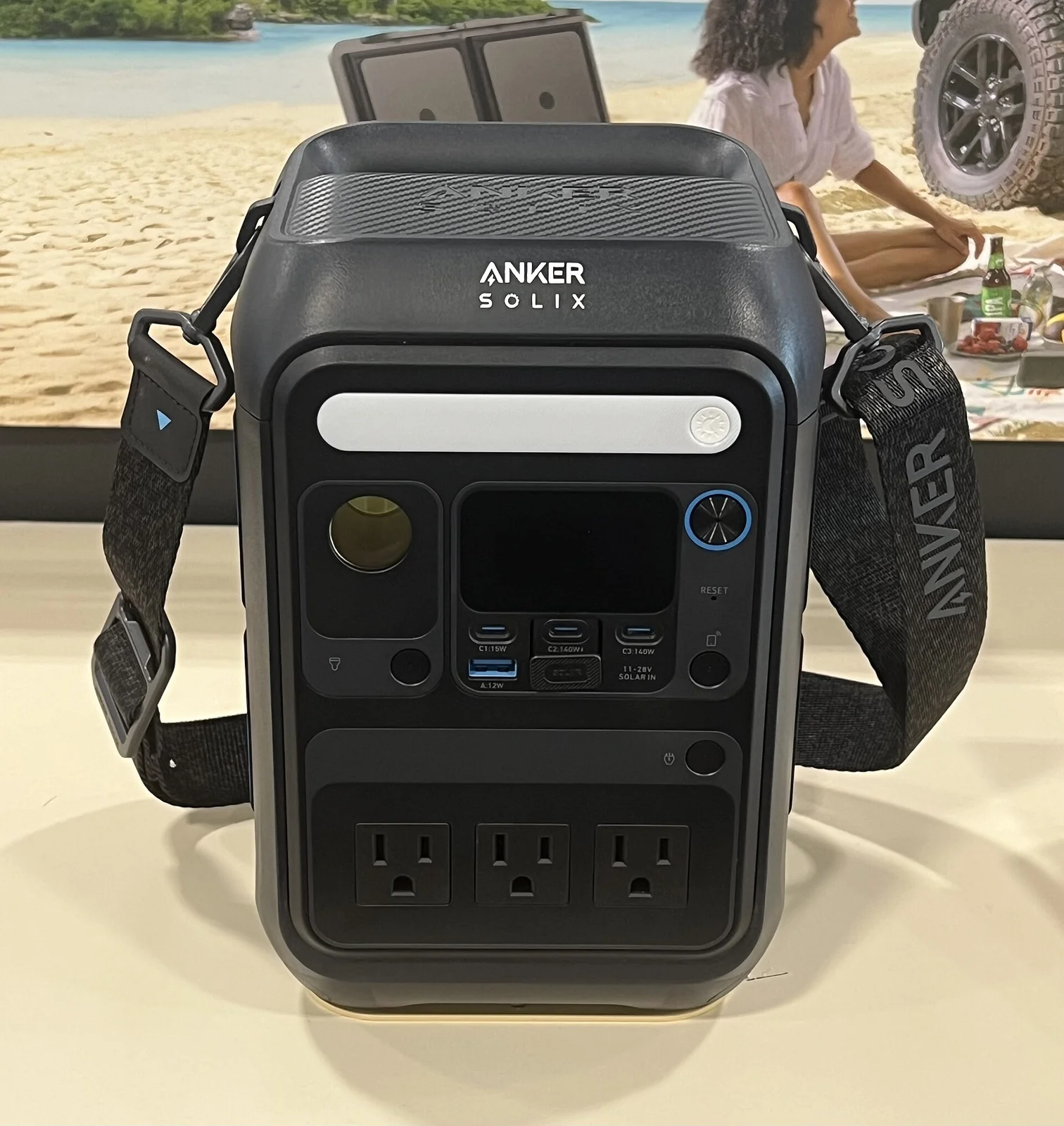
The Anker SOLIX C1000 is rated at 1,056Wh with a manufacturer-rated 0-80% recharge in 43 minutes, and it weighs a published ~28 lb — the one you actually want to lift in and out of a trunk every trip. The Bluetti AC180 counters with a rated 1,152Wh, an 1,800W inverter that surges to 2,700W, and a wireless charging pad built into the top. Both run LiFePO4 chemistry, so both are rated for thousands of cycles and a decade of weekend use. For the majority of car campers — phones, lights, a 12V fridge, a CPAP, occasional coffee — the Anker's lighter body and faster refill win the daily-use argument. The Bluetti earns its place when you want more reserve and the headroom to start a stubborn high-wattage appliance.
Specs at a glance
Here is how the two stations line up on the numbers that decide the buy, drawn from each manufacturer's published specs. The full grid is in the comparison table above; the short version is that the Anker is lighter and charges faster while the Bluetti carries more energy and more surge.
The gap that matters most day to day is weight: Anker lists the SOLIX C1000 at roughly 28 lb, while Bluetti rates the AC180 near 35 lb. Seven pounds does not sound like much until it is the difference between a one-hand grab and a two-hand lift over a bumper.
Capacity and real-world runtime
On paper the Bluetti's rated 1,152Wh gives it about a 10 percent larger tank than the Anker's rated 1,056Wh. In practice that is roughly one extra phone-and-lights evening, or a little more fridge runtime before you need sun or a wall.
- A 45W 12V fridge cycling at ~50 percent duty pulls close to 20Wh per hour — either station will run it well over a full day on a charge.
- Both are rated to recharge phones dozens of times and run 10-15W LED lights for many nights.
- The Bluetti's extra headroom shows up on multi-night trips with no way to recharge; the Anker closes that gap with its expansion battery.
Neither delivers its full rated watt-hours to an AC load — inverter conversion loses a slice on both, which is normal and reflected in every independent review.
Charging: the Anker's 43-minute refill vs Bluetti's dual-input turbo
This is where the Anker SOLIX C1000 pulls ahead for trip logistics. Anker rates a wall recharge of 0-80 percent in 43 minutes and a full charge in under an hour, which means a lunch stop with shore power can nearly top it off. The Bluetti AC180 is no slouch — Bluetti rates a full recharge near 1.3 hours and supports dual AC-plus-solar input to shorten that further.
For campers who move between campgrounds with hookups, the Anker's rated fast charge is a genuine convenience. For those charging mostly from solar, both accept a healthy solar input and the difference narrows.
Surge power: starting the stubborn appliances
Both stations share an 1,800W continuous inverter, so they run the same everyday loads. The difference is the surge ceiling: Bluetti's published spec lists a 2,700W power-lifting mode, while Anker rates a 2,400W SurgePad. That 300W of extra surge headroom on the Bluetti AC180 can be the margin that starts a compressor-driven appliance or a high-draw kettle without tripping.
If your kit tops out at a fridge, fans, and charging, either inverter is plenty. If you occasionally run a small induction cooktop or a heat gun, the Bluetti's higher rated surge is the safer bet.
Expandability: the Anker grows, the Bluetti stands alone
The single biggest capability difference is not on the spec sheet's headline row — it is that the Anker accepts an expansion battery and the Bluetti does not.
Anker's published specs show the SOLIX C1000 pairing with a BP1000 expansion battery to roughly 2,112Wh. That turns a weekend station into a multi-day one without buying a whole second unit. The Bluetti AC180 is a fixed 1,152Wh — excellent as it is, but what you buy is what you get. If you expect your power needs to grow, the Anker's expansion path is a real long-term advantage.
Ports, app, and everyday livability
Both stations cover the modern port mix: multiple AC outlets, 100W USB-C, USB-A, and 12V. The Bluetti AC180 adds a wireless charging pad on the top surface — a genuinely handy place to drop a phone at camp. Both offer app monitoring, though independent reviewers generally praise Anker's app polish.
Noise is comparable; both spin a fan under heavy load and stay quiet on light loads. LiFePO4 chemistry on both means you can leave them partially charged between trips without the degradation older lithium packs suffered.
Durability and warranty
Both makers back these with multi-year warranties and rate LiFePO4 packs for thousands of cycles — Bluetti publishes ~3,500 cycles to 80 percent capacity and Anker ~3,000, which for weekend campers is well over a decade of use either way. Build quality on both is solid molded plastic with protected ports; neither is weather-sealed, so both want a dry spot in the vehicle.
Check each manufacturer's current warranty terms at purchase, since coverage lengths are periodically revised.
Running either safely in your vehicle
- Keep the station in the cabin or trunk, not a sealed hot compartment — both are rated for room-temperature operation and dislike extreme heat.
- Secure it so it cannot become a projectile; a cargo strap or a milk-crate cradle works.
- Charge from the alternator via a 12V or USB-C car input on drive days to arrive topped up.
- Never run a fuel appliance to recharge inside a closed vehicle — these are battery stations for a reason.
Both are safe to sleep beside; LiFePO4 packs are the calmer, more thermally stable chemistry, which is part of why both makers chose it.
Price and value
The two launch at a similar list price, and both spend much of the year discounted. Dollar for watt-hour they are close; the Anker SOLIX C1000 tends to undercut on sale while the Bluetti AC180 gives you more capacity and surge at parity. Value therefore tracks your priority: lightest-and-fastest, or most-energy-and-surge.
Factor the Anker's expansion battery into the math if you foresee needing more capacity — growing an existing station is cheaper than replacing it.
Charging from solar and the alternator
Neither station has to see a wall outlet on a trip. Both accept solar input through an MPPT charge controller, and both can top up from your vehicle's 12V socket or USB-C on drive days per their published specs. The Bluetti AC180 supports dual AC-plus-solar input to shorten a recharge, while the Anker SOLIX C1000 pairs its fast wall charging with a healthy solar ceiling.
For a fully off-grid weekend, size a portable solar panel to your daily draw: a 100-200W folding panel in good sun will replace a meaningful share of what a fridge and lights consume in a day on either station. Charging from the alternator while you drive between sites is the simplest way to arrive at each camp topped up, and both makers rate their DC inputs for exactly that.
A realistic weekend of power
Picture a two-night trip for a couple: a 45W 12V fridge, phone and headlamp charging, a few hours of LED string lights, and a morning coffee from a low-wattage kettle. That load lands well within either station's rated capacity for the first night, and a few hours of midday sun or a drive to the trailhead keeps both ahead of the draw.
- The fridge is the constant draw; lights and charging are small by comparison.
- The kettle is the surge test — both inverters handle a low-wattage travel kettle, and the Bluetti's higher rated surge adds margin for a stronger one.
- Recharge opportunities (sun or alternator) matter more than the last 100Wh of capacity for trips like this.
Scale the trip up — more nights, hotter weather, no recharging — and the Bluetti's larger tank or the Anker's expansion battery becomes the deciding factor.
Which to buy: match the station to how you camp
- Buy the Anker SOLIX C1000 if you value a light, fast-charging station you can expand later — the best all-round car-camping pick for most people.
- Buy the Bluetti AC180 if you want the larger 1,152Wh tank, the 2,700W surge for demanding appliances, and the built-in wireless charging pad.
- Solar-first campers: both accept strong solar input; decide on weight and expandability, not charge speed.
- Weight-sensitive packers: the Anker's ~28 lb published weight is the clearest daily-use advantage.
Both are genuinely good LiFePO4 stations. The Anker wins on portability and flexibility; the Bluetti wins on capacity and surge. Pick the trade-off that fits your trips.