
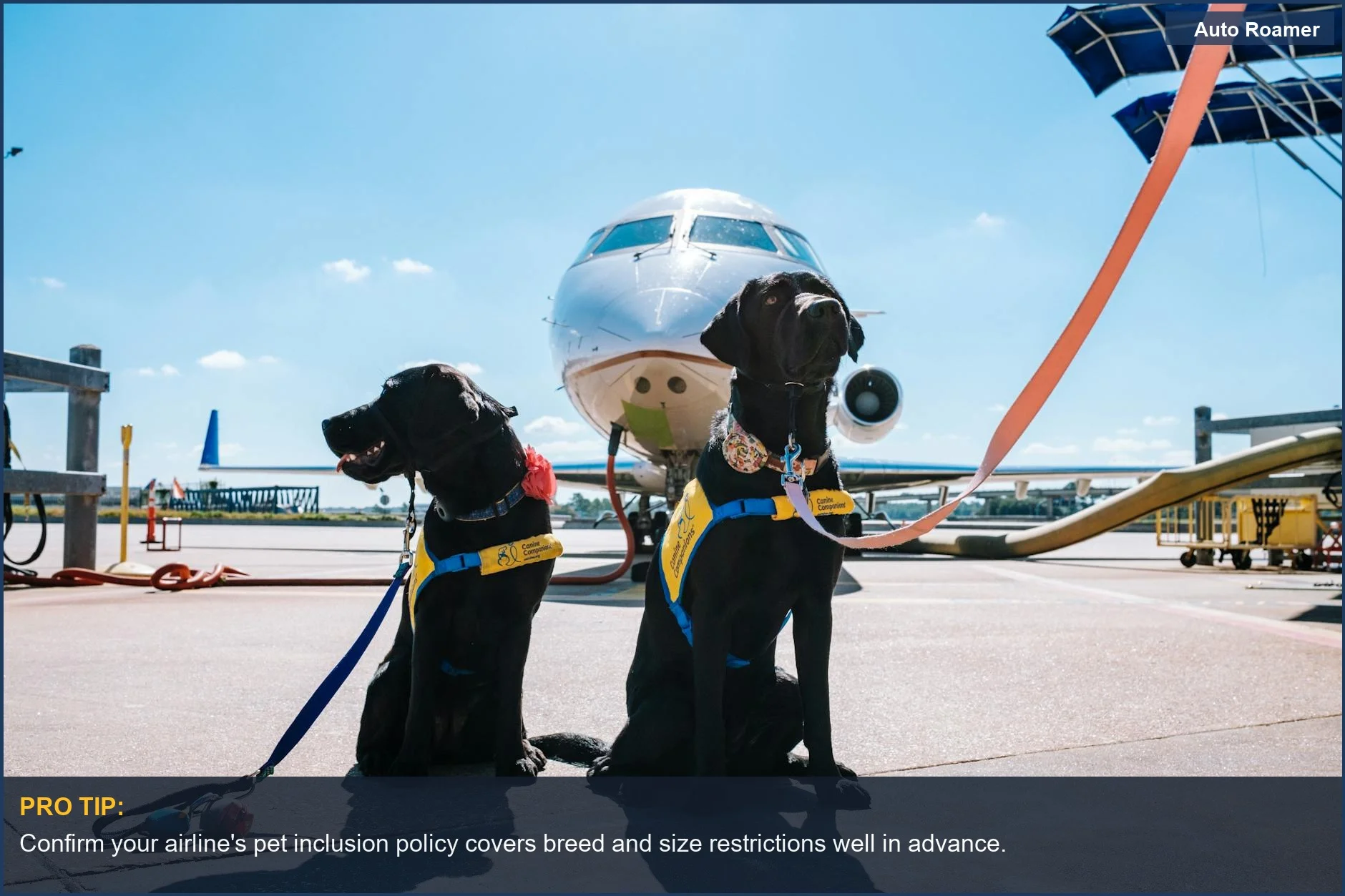
Which Airlines Are Best for Traveling With Pets?
For most travelers flying within the United States with a small dog or cat, Alaska Airlines is the standout choice: its published policy accepts small dogs, cats, rabbits, and household birds in the cabin for roughly $100–$105 each way, and Alaska remains one of the few major US carriers that still offers a pet cargo option for animals too large for the cabin. For everyone else, the right airline depends on one simple question: is your pet small enough to fly in the cabin under the seat in front of you?
Sorted by what most pet owners actually need, the major US carriers break down like this, according to each airline's published pet policy:
- Best overall for in-cabin and cargo: Alaska Airlines — small pets in cabin (~$100–$105 each way) and one of the few still offering pet cargo.
- Best for small in-cabin pets on a budget: Southwest and JetBlue — small cats and dogs in the cabin for roughly $95–$125 each way; neither flies pets as cargo.
- Widest in-cabin network: American, Delta, and United — dogs and cats in the cabin for roughly $95–$150 each way, with large route maps but mostly carry-on-only pet travel for general passengers.
One honest caveat up front, and it is the most important sentence in this guide: airline pet policies change frequently — fees rise, breed and temperature rules get stricter, and cargo programs get paused or reinstated. Every figure below reflects each airline's published policy as of early 2026. Before you book, always confirm the airline's current policy on its own website. The rest of this guide explains how cabin, cargo, and checked pet travel differ, then walks through each major carrier so you can match the airline to your pet.
In-Cabin vs. Cargo vs. Checked: The Three Ways Pets Fly
Before comparing carriers, it helps to understand the three fundamentally different ways a pet can travel by air. The category your pet falls into — decided almost entirely by its size and the airline's rules — determines which airlines are even an option for you.
- In-cabin (carry-on). Your pet rides with you in an airline-approved soft carrier that fits under the seat in front of you. This is reserved for small pets — typically a dog or cat whose carrier fits roughly 17–18.5 inches long and where the animal can stand up and turn around. The carrier counts as your personal item or carry-on. This is the safest, least stressful option and the one most pet owners want.
- Cargo (manifest cargo). Larger pets travel in a pressurized, temperature-controlled cargo hold in an airline-approved hard kennel, often booked through a dedicated program. After several high-profile incidents, many US airlines paused or sharply restricted pet cargo — so this option is far less available than it once was, and where it exists it carries breed and temperature embargoes.
- Checked baggage. A few airlines historically let pets travel as checked baggage on the same flight as their owner, distinct from manifest cargo. This too has been curtailed by most US carriers and now survives mainly for service-animal or specific-program situations.
The single biggest factor in choosing a pet-friendly airline is your pet's size. If it fits in an under-seat carrier, almost every major airline is an option. If it is too large for the cabin, your choices narrow dramatically, because most US carriers no longer fly general-passenger pets in cargo.
Because cabin travel is by far the most common and the most available, the per-airline summaries below lead with each carrier's in-cabin policy, then note whether a cargo option exists at all. If you have a large dog, pay closest attention to the handful of airlines that still run a real cargo program — and read the section on breed and temperature restrictions, because those rules bite hardest in cargo.
It also helps to be realistic about which category your trip will fall into before you fall in love with a particular airline. A New York couple flying a ten-pound terrier to Florida has the entire major-carrier map open to them and can shop on price and schedule. A family relocating across the country with a seventy-pound retriever is in a completely different situation: their shortlist may be one or two airlines and a specific season, and the planning lead time is weeks, not days. Sorting your pet into cabin, cargo, or checked first — honestly, by its real size and breed — is what turns an overwhelming list of policies into a short, manageable set of choices.
Per-Airline Pet Policy Summary: Major US Carriers
Here is how the major US airlines compare, based on each carrier's published pet policy as of early 2026. Fees are quoted per pet, each way, for in-cabin travel unless noted — and again, every airline can change these at any time, so confirm the current figure before booking.
- Alaska Airlines. Accepts small dogs, cats, rabbits, and household birds in the cabin for roughly $100–$105 each way, and is one of the few major US carriers that still offers a pet cargo option for animals too large for the cabin. Its broad acceptance of pet types and the surviving cargo program make it the most flexible mainstream choice. See what carrier fits under the seat in our guide to the best pet carriers for flying.
- American Airlines. Allows dogs and cats in the cabin for roughly $150 each way, with a published under-seat carrier limit (commonly around 18 x 11 x 11 inches for soft carriers). General-passenger pet cargo has been paused since 2020; American's PetEmbark program handles certain situations. For most travelers, American is effectively a carry-on-pet airline.
- Delta Air Lines. Accepts dogs, cats, and household birds in the cabin for roughly $95–$150 each way. Delta Cargo limits live-animal shipping to active US military and State Department personnel under transfer orders — it is not available to general passengers — so plan on cabin travel only unless you qualify.
- United Airlines. Allows dogs and cats in the cabin for roughly $125 or more each way. United has historically run a PetSafe cargo program for larger animals, though availability and embargoes vary, so confirm directly whether your route and season qualify.
- Southwest Airlines. Accepts small vaccinated cats and dogs in the cabin for roughly $95–$125 each way. Southwest is in-cabin only — it does not transport pets as cargo or checked baggage — which makes it simple and affordable for small pets but a non-option for large ones.
- JetBlue Airways. Allows small cats and dogs in the cabin for roughly $125 each way through its JetPaws program, which adds pet-friendly perks. Like Southwest, JetBlue is in-cabin only with no cargo option.
Two patterns stand out. First, in-cabin fees cluster in a fairly narrow $95–$150 band, so price is rarely the deciding factor for a small pet — route, schedule, and carrier-size rules matter more. Second, real cargo options for large pets have become scarce: among these six, Alaska and (route- and season-permitting) United are the realistic large-pet choices, while American, Delta, Southwest, and JetBlue are effectively cabin-only for the typical traveler. Whichever you choose, your carrier must meet that airline's exact size limits.
A few practical notes round out the comparison. Reputation matters as much as the published fee: Alaska and JetBlue, in particular, are frequently praised by pet owners for clear policies and helpful staff, while budget-focused carriers keep costs down by limiting pet types and options rather than by cutting corners on safety. It is also worth checking whether your preferred airline counts the pet carrier as your carry-on or as a personal item, because that single detail changes how much else you can bring aboard. And if you hold airline status or a co-branded card, confirm whether any pet-fee waivers apply — they occasionally do, and on a round trip the savings are real. None of these perks should outweigh choosing the airline whose size rules and route actually fit your pet, but among otherwise-equal options they make a sensible tiebreaker.
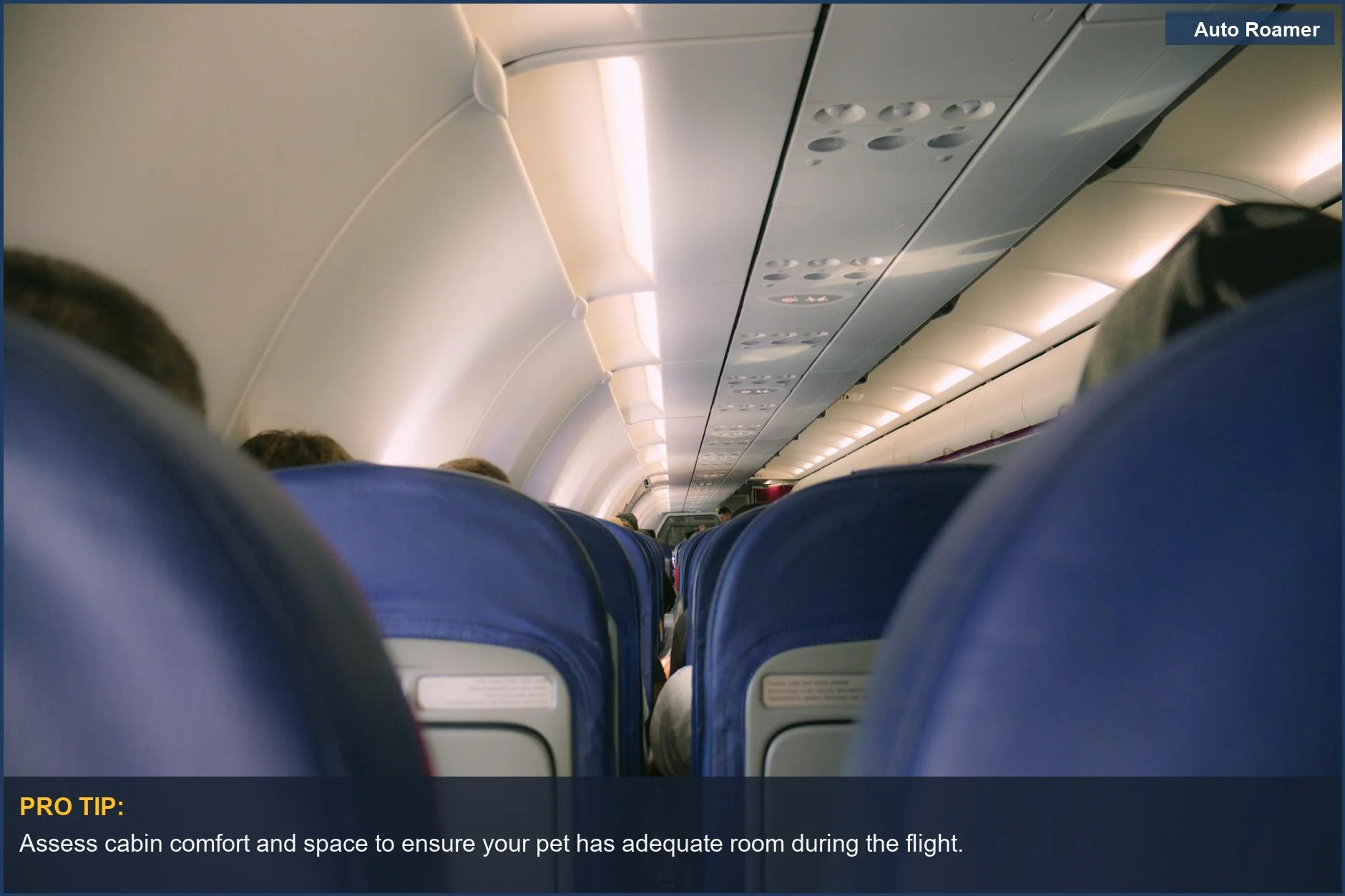
In-Cabin Pet Rules: Size, Carriers, and Under-Seat Limits
Because in-cabin travel is the option most pet owners want, it pays to understand its rules in detail. The cabin is for small pets only, and the limiting factor is almost always the carrier: it has to fit under the seat in front of you, and your pet has to be able to stand up and turn around inside it.
The core in-cabin requirements that nearly every airline shares:
- The carrier must fit under the seat. Published soft-carrier limits typically run around 17–18.5 inches long, 11 inches wide, and 11 inches high, though the exact figures vary by airline and even by aircraft, since under-seat space differs. Soft-sided carriers are preferred for the cabin because they flex to fit.
- Your pet must fit comfortably inside. The animal must be able to stand, turn around, and lie down naturally. If it is cramped, gate agents can deny boarding — a pet too big for any compliant cabin carrier simply cannot fly in the cabin.
- The carrier counts as a bag. On most airlines the pet carrier counts as your carry-on or personal item, so you cannot also bring a full-size carry-on plus the pet carrier plus a personal item.
- Pets stay in the carrier. The pet must remain inside the closed carrier, stowed under the seat, for the duration of the flight, including taxi, takeoff, and landing.
- Limited pets per flight. Airlines cap the number of in-cabin pets per flight (and per passenger), so reserving your pet's spot when you book your own ticket is essential — popular flights fill their pet slots.
The right under-seat carrier is the make-or-break purchase for cabin travel. It must be soft-sided, ventilated, leak-proof, and within your specific airline's published dimensions — not just "airline approved" in general. Measure your pet and confirm the airline's current limits before buying.
For carrier specifics that satisfy these rules, our roundup of the best pet carriers for flying covers compliant models, and the comparison of soft-sided vs. hard-sided pet carriers explains why soft carriers win for the cabin while hard kennels are for cargo.
Pet Cargo and Checked Travel: Availability and Safety
If your pet is too large for the cabin, cargo is the only way it flies — and this is where the airline landscape has changed most. After several widely reported incidents involving animals in cargo, many US carriers paused or heavily restricted pet cargo, so options are now limited and rules are strict.
What you need to know about flying a large pet as cargo today:
- Few airlines still offer it. Among the majors, Alaska maintains a pet cargo option, and United has historically run a dedicated cargo program, while American has paused general pet cargo and Delta restricts cargo to qualifying military and government personnel. Southwest and JetBlue do not fly pets as cargo at all.
- An airline-approved hard kennel is required. Cargo pets travel in a rigid, ventilated kennel meeting strict size, ventilation, and security standards — the animal must be able to stand and turn around. This is very different from the soft carrier used in the cabin.
- The hold is pressurized and temperature-controlled. Modern cargo holds that carry live animals are pressurized and climate-controlled in flight, but the riskiest moments are on the ground — loading, unloading, and tarmac waits in extreme heat or cold.
- Health paperwork is mandatory. Cargo travel generally requires a recent veterinary health certificate, usually issued within about 10 days of travel, plus up-to-date vaccination records.
Is cargo safe? The honest answer is that for most healthy, non-snub-nosed pets traveling with a reputable program in moderate weather, it is generally safe — but it carries more risk and stress than cabin travel, and the risk concentrates on the ground and in temperature extremes. Many veterinarians advise avoiding cargo for very young, very old, snub-nosed, or anxious animals. If your pet cannot fit in the cabin, weigh whether the trip is essential, consider ground transport for shorter distances, and book with one of the few airlines that still runs a vetted cargo program rather than improvising.
Breed and Temperature Restrictions That Can Ground Your Pet
Even on a pet-friendly airline, two categories of restriction can stop your pet from flying — and they catch unprepared owners off guard. Both apply most forcefully to cargo travel, where the risks they address are greatest.
The restrictions to plan around:
- Brachycephalic (snub-nosed) breed limits. Many airlines restrict or outright ban snub-nosed breeds — bulldogs, pugs, boxers, Persian cats, and similar — from cargo travel, because their compressed airways make them far more prone to breathing distress and overheating under stress. Some of these breeds can still fly in the cabin if they are small enough; in cargo, they are frequently prohibited.
- Temperature embargoes. Airlines impose seasonal temperature limits on cargo pet travel — commonly refusing to fly animals when forecast ground temperatures exceed about 85°F or fall below roughly 20°F at any point on the itinerary. A summer heat wave or a winter cold snap at your departure, connection, or arrival airport can cancel your pet's booking even if your own seat is fine.
- Aircraft and route limits. Some smaller aircraft cannot carry live animals in cargo, and some routes or connections are excluded, so a pet-eligible airline does not guarantee a pet-eligible flight.
If you have a snub-nosed breed, assume cargo is off the table and plan for cabin travel or ground transport. For any cargo pet, book direct flights in mild-weather months and early-morning or late-evening departures in summer to dodge the temperature embargoes that can strand a pet at the worst moment.
These rules exist for the animal's safety, not as red tape, so the practical move is to read your airline's breed and temperature policy before you book a large or snub-nosed pet — and to build in schedule flexibility, because weather embargoes are decided close to departure.
Service Animals vs. Pets: Why the Distinction Matters
One of the most misunderstood parts of flying with an animal is the difference between a service animal and a pet — and the rules changed significantly in recent years. Getting this distinction right determines whether your animal flies free in the cabin or pays a pet fee and follows pet rules.
- Trained service dogs. Under US Department of Transportation rules, a service dog is a dog individually trained to do work or perform tasks for a person with a disability. Recognized service dogs fly in the cabin at no charge and are not subject to pet fees or pet carrier rules, though airlines require advance notice and a completed DOT service animal form attesting to the dog's training, health, and behavior.
- Emotional support animals (ESAs). Since the DOT's 2021 rule change, airlines are no longer required to treat emotional support animals as service animals. In practice, US airlines now treat ESAs as pets — meaning they pay the standard pet fee, must fit in an under-seat carrier, and follow all the same in-cabin size rules as any other pet.
- Pets. Everything else — the family dog or cat traveling for a vacation or a move — is a pet, subject to the fees, carrier limits, and breed/temperature rules covered above.
If your animal is not a task-trained service dog, plan and budget for it as a pet. The emotional-support-animal loophole that once let many animals fly free in the cabin no longer exists on US airlines — ESAs now follow standard pet policy.
For international service-dog travel, requirements get stricter still, with destination-country entry rules, additional documentation, and longer lead times, so begin preparing well in advance. Whatever the classification, confirm the airline's current service-animal and pet policy directly, since these rules have shifted more than once in recent years.
The reason this distinction is worth getting exactly right is money and certainty. A task-trained service dog flies in the cabin at no charge and is not bound by the under-seat carrier rules, but it must be submitted on the DOT form and the airline can deny boarding to a dog that is out of control or not housebroken. A pet — including every emotional support animal under the current rules — pays the fee and must clear the carrier-size test like any other animal. Trying to pass a pet off as a service animal is both against the rules and counterproductive, because gate agents are trained to ask the two permitted questions about task training. Classify your animal accurately, prepare the right paperwork for that category, and you avoid the most stressful possible outcome: being turned away at the gate with a non-refundable ticket and nowhere for your pet to go.
Booking Tips for a Smooth Trip With Your Pet
Choosing the right airline is half the job; booking and preparing correctly is the other half. A little planning prevents the most common pet-travel disasters — a sold-out pet slot, a non-compliant carrier, or missing paperwork at check-in.
A reliable sequence for booking pet travel:
- Reserve your pet's spot when you book your seat. Airlines cap in-cabin pets per flight, and the slots fill. Add the pet to the reservation immediately, and call the airline to confirm a slot is actually available on your specific flight — online systems do not always show real-time pet availability.
- Confirm the airline's current policy and fee. Because pet rules change often, verify the in-cabin fee, carrier dimensions, and any breed or temperature limits on the airline's own website before you commit, rather than relying on a number you saw months ago.
- Buy and test a compliant carrier early. Get a soft carrier within your airline's exact published dimensions and let your pet acclimate to it for days or weeks before the trip, so the airport is not its first time inside.
- Schedule the vet and paperwork. Many trips — and nearly all cargo and international travel — require a health certificate issued within about 10 days of departure plus current vaccination records. For international destinations, start 30 or more days ahead because of quarantine and entry rules.
- Book direct, mild-weather flights when you can. Direct flights cut stress and tarmac time, and off-peak temperature windows dodge cargo embargoes. Avoid feeding a large meal right before the flight, and exercise your pet beforehand.
Finally, pack a small pet kit — a collapsible bowl, a few hours of food and water, waste bags, and any medication — in your personal item, and clip current ID and vaccination tags to the carrier. If your journey includes a road leg before or after the flight, our guides to the best dog harness for car travel, the best dog travel crate for the car, and a protective pet car seat cover cover keeping your pet safe on the ground, too. Match the airline to your pet, confirm the current policy, and the rest of the trip falls into place.