
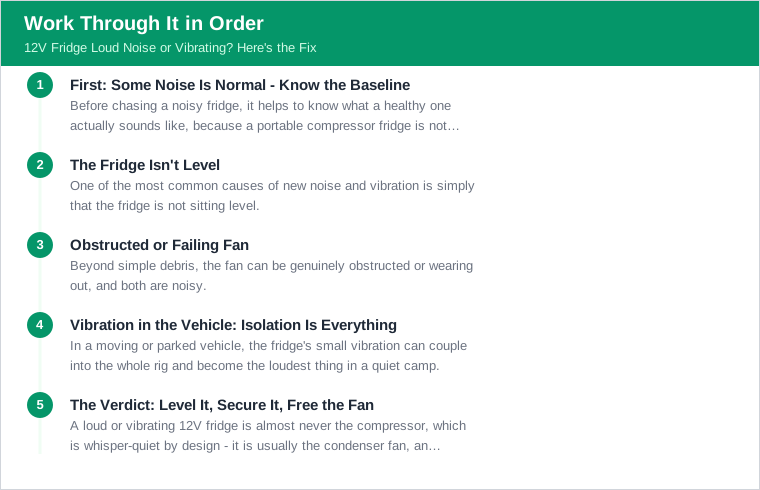
First: Some Noise Is Normal - Know the Baseline
Before chasing a noisy fridge, it helps to know what a healthy one actually sounds like, because a portable compressor fridge is not silent. The Danfoss/Secop BD35 at the heart of most quality units is a brushless variable-speed compressor marketed as whisper-quiet, and much of a portable fridge's audible noise actually comes from the condenser cooling fan rather than the compressor itself. A soft, steady hum with a low fan whir is normal operation.
That matters because it tells you where to look. If the compressor is inherently quiet and the fan is the main sound source, then a fridge that has become loud has usually developed a fan, mounting, or leveling problem - not a compressor one. The sealed refrigeration system rarely announces itself; when a fridge gets noisy, something around it changed.
So the goal is to separate normal from abnormal. A gentle hum, a faint gurgle of refrigerant, and a low fan note are the baseline. A new buzz, rattle, grinding, or heavy vibration is the signal worth chasing - and nearly all of those trace to how the fridge sits, how it is secured, and whether its fan can spin freely, all of which you can fix without opening the sealed unit.
It's Usually the Fan, Not the Compressor
Since much of the noise comes from the condenser fan, that is the first place to look when a fridge gets loud. The fan sits on the vent side, pulling air across the condenser to shed heat, and anything that makes it work harder or spin unevenly turns a quiet whir into a buzz or a drone. A fan is a small spinning part with a bearing, so it is the component most likely to get noisy over time.
Common fan noises have common causes. A buzzing or rattling fan often has debris in the blades or something lightly touching them; a droning fan can be a bearing starting to wear; a fan that surges loud and soft may be reacting to the compressor speeding up under load. None of these is the sealed system - they are all the accessible fan doing its cooling job noisily.
Start by listening with the fridge running to localize the sound to the vent side, then power down and inspect the fan. Clearing the blades and confirming nothing rests against them fixes a surprising share of sudden noise. Because the fan is essential to cooling, a loud fan is worth addressing promptly - but it is a cheap, accessible part, not the compressor.

The Fridge Isn't Level
One of the most common causes of new noise and vibration is simply that the fridge is not sitting level. Abnormal noise or vibration typically traces to the fridge not sitting level, loose internal mounting of the compressor, or an obstructed cooling fan. A compressor fridge is designed to run on a reasonably flat surface, and tilting it can make the compressor and its internal suspension work against gravity in a way that buzzes or knocks.
Overland use makes this easy to get wrong. A fridge wedged on a sloped cargo floor, perched on uneven gear, or tipped in a drawer that is not flat will run louder than the same unit sitting square. The tilt can also, on some designs, affect oil return in the compressor, which is another reason manufacturers ask you to keep it within a modest angle of level.
The fix is to level it. Set the fridge on a flat, stable surface, shim it if the cargo area slopes, and avoid leaving it tilted for long runs. A unit that quiets down the moment you sit it level was never faulty - it was just being asked to run at an angle it was not built for, and leveling is a thirty-second cure.
Loose Mounting and Rattles
The second common cause is a fridge, or its surroundings, not being held still. A unit set loose in a cargo area vibrates against whatever it touches, and a fridge in a mount whose bolts have worked loose buzzes against its own bracket. The compressor's normal running vibration, harmless on its own, gets amplified into a rattle when it can transmit into a loose panel, drawer, or slide.
This is where the noise is often not the fridge at all. A gentle compressor hum couples into a nearby plastic trim panel, a slide rail, or a stack of gear, and the panel becomes the speaker. You chase the fridge for a sound the fridge is only feeding, when the real fix is securing whatever is resonating around it. Overland rigs are full of these hard, hollow surfaces waiting to buzz.
Track it down by pressing on suspect panels and gear while the fridge runs - if the noise changes or stops when you steady something, that is your culprit. Tighten any mount hardware, pad contact points, and secure loose items so nothing is free to rattle. Anti-vibration pads under the fridge and between it and its mount break the path that turns normal hum into a rattle.
Obstructed or Failing Fan
Beyond simple debris, the fan can be genuinely obstructed or wearing out, and both are noisy. An obstruction - a stray wire, a bag pressed against the vent, a buildup of dust and grit in the blades - forces the fan to push against resistance, which drones and can make it strain. A failing bearing, meanwhile, produces a grinding or rattling that gets worse over time as the fan loses its smooth spin.
The distinction is worth making. A blocked or dirty fan is a maintenance fix: clear the vent, keep gear away from the intake, and blow the dust out of the blades so it spins freely and quietly again. A fan whose bearing has gone is a parts fix: it will keep getting louder and eventually seize, and on many units the fan is a replaceable component that is far cheaper than the compressor.
Either way, keep the vent side clear as a habit. The fan needs unobstructed airflow to cool the condenser, so packing gear against the vent both makes noise and hurts cooling. A fridge that goes quiet once the vent is clear and the blades are clean was obstructed; one that keeps grinding after that has a worn fan to swap.
Gurgling and Ticking: The Sounds That Are Fine
Not every unfamiliar sound is a problem, and knowing the benign ones saves needless worry. A soft gurgling of refrigerant flow is normal - it is simply the refrigerant moving through the sealed loop, most noticeable when the compressor starts or stops, and it means the system is working. Bubbling or trickling from inside the walls is the cooling cycle doing exactly what it should.
A faint tick or click as the compressor cycles on and off is also normal - the control board switching the compressor, not a fault. This is different from the rapid, repeating click-and-quit of a compressor that cannot start on low voltage; a single soft tick as the fridge settles into or out of a cooling cycle is just the unit operating. Context tells them apart: an occasional tick is fine, a persistent clicking loop is a power problem.
So do not chase these. If the only sounds are a low hum, a soft gurgle, and the occasional tick as the compressor cycles, the fridge is healthy and quiet by design. Reserve your troubleshooting for the sounds that are genuinely out of place - buzzing, rattling, grinding, and heavy vibration - which are the ones with fixable mechanical causes.

MAX vs ECO: Speed Changes the Volume
On variable-speed fridges, the running mode changes how loud the unit is, and that can look like a fault when it is just the compressor working harder. Alpicool models with ECO and MAX modes draw about 45W in ECO and about 60W in MAX, and that extra power is the compressor and fan running faster - which is audibly louder. A fridge in MAX pulling a warm box down to temperature is simply working, and working is not silent.
This explains a noise that comes and goes. A fridge set to MAX, or one cycling its variable-speed compressor up to fight a big heat load, runs louder during that hard pull and quiets as it reaches temperature and eases off. If the unit is loudest right after loading warm contents or opening the lid repeatedly, that is the compressor ramping up on purpose, not a defect.
If the noise level bothers you at night, ECO mode runs the compressor gently to hold temperature once the box is already cold, at the cost of a slower pulldown. Using MAX to get cold and ECO to stay cold gives you the quiet you want when it matters. The volume tracking the mode is normal behavior, not a fault to fix.

Vibration in the Vehicle: Isolation Is Everything
In a moving or parked vehicle, the fridge's small vibration can couple into the whole rig and become the loudest thing in a quiet camp. The compressor's normal running motion, negligible on a solid bench, transmits through a hard mount into the vehicle's panels and frame, which broadcast it as a hum or buzz you feel as much as hear. The problem is not the fridge's vibration but the path it takes.
Overlanders solve this with isolation. Anti-vibration matting or rubber feet under the fridge, soft pads between it and its mount or slide, and a bit of padding where it contacts hard surfaces all interrupt the path that turns a gentle running motion into cabin noise. The goal is to let the fridge vibrate its tiny amount without handing that vibration to the vehicle's sounding boards.
Secure but decoupled is the target: firmly held so it cannot slide, but cushioned so it cannot transmit. A fridge that hums annoyingly when hard-mounted and goes near-silent on isolation pads has told you the vibration was always normal - it just needed somewhere soft to go instead of into the truck. That is the difference between a rattling night and a quiet one far from a plug.
When the Noise Is a Real Fault
Only after leveling, mounting, isolation, and the fan are all addressed is a genuine internal fault the honest suspect. The signature is a fridge that stays loud - a persistent grinding, knocking, or heavy vibration - when it is sitting level on a solid surface, securely but softly mounted, with a clean, freely-spinning fan and nothing around it resonating. When every external cause is ruled out and the noise remains, the compressor or its internal mounting may be the source.
Loose internal mounting of the compressor is a named cause of abnormal noise, and on a sealed unit that is not a home repair. A compressor bearing or suspension that has failed will grind or knock in a way that cleaning the fan and leveling the box cannot cure, and it typically gets worse rather than settling. That is the point at which the noise is telling you the sealed unit needs service.
Reaching this conclusion last is the discipline. Because the compressor is whisper-quiet by design, a genuinely loud compressor is rare, and the overwhelming majority of noise complaints resolve at leveling, mounting, isolation, or the fan. If you have honestly worked through all of those and the unit still grinds, it is a warranty conversation - but you will get there having fixed the far more likely causes first.
The Verdict: Level It, Secure It, Free the Fan
A loud or vibrating 12V fridge is almost never the compressor, which is whisper-quiet by design - it is usually the condenser fan, an unlevel unit, loose mounting, or vibration handed to the vehicle. Know the baseline first: a low hum, a soft refrigerant gurgle, and the occasional tick as the compressor cycles are all normal, and MAX mode is simply louder than ECO because the compressor is working harder.
For real noise, work the mechanical causes. Sit the fridge level on a stable surface, secure loose mounts and rattling panels, and put anti-vibration padding under it and between it and its mount so its small motion does not become cabin noise. Clear and inspect the cooling fan, since a blocked or dirty fan drones and a worn bearing grinds - both accessible fixes far cheaper than the compressor.
Only a fridge that keeps grinding or knocking while level, securely and softly mounted, with a clean free-spinning fan and nothing resonating around it, is a genuine internal fault for service. Level it, secure it, free the fan, and you will quiet nearly every noisy fridge in minutes - and enjoy a still, quiet camp instead of a rattling one.