
First: Most Error Codes Are Protection, Not Breakage
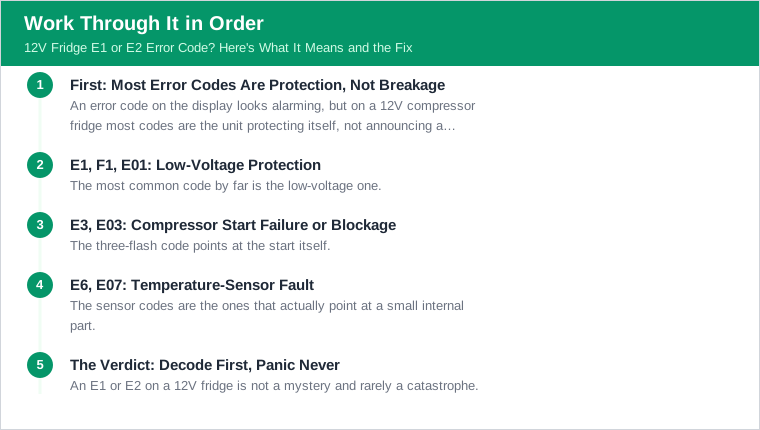
An error code on the display looks alarming, but on a 12V compressor fridge most codes are the unit protecting itself, not announcing a failure. The controller watches voltage, current, speed, and temperature, and when any of those steps outside a safe band it stops and shows a code. That is the fridge refusing to damage itself - a warning to fix a condition, far more often than a report that a part has died.
The skeptic's move is to decode the code before believing the worst. Each number maps to a specific measured condition, and the majority of those conditions - low voltage, a stalled fan, overheating - are things outside the sealed compressor that you can find and fix. A code is a diagnosis handed to you for free; the mistake is treating every one of them as a reason to return the unit.
So the plan is straightforward: translate the code to its cause, fix the cause, and clear the code. This guide covers the common ones - E1, E2, and the rest - across the brands that share the same underlying controller. Only a couple of codes point at the compressor or a sensor itself, and even those have a clear test before you conclude the fridge is done.
The Rosetta Stone: One Controller, Many Labels
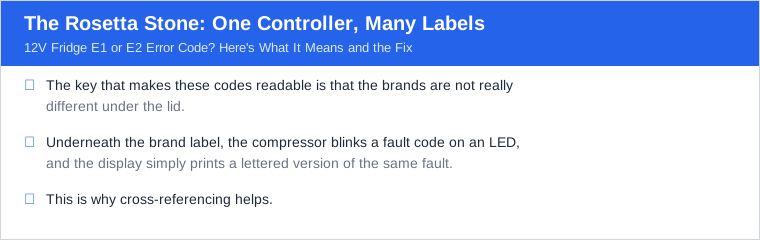
The key that makes these codes readable is that the brands are not really different under the lid. The Alpicool, Dometic CFX2, and ICECO code sets all map onto the same Danfoss/Secop controller flash codes, so an E1, F1, or E01 low-voltage fault is a protection cutoff and not a broken compressor. Learn the underlying controller's fault list once and you can decode almost any portable fridge.
Underneath the brand label, the compressor blinks a fault code on an LED, and the display simply prints a lettered version of the same fault. A single flash is low voltage, two flashes a fan overcurrent, three a failed start, four a speed too low, five a thermal overload. The E-numbers and F-numbers on the screen are that flash count in a friendlier form.
This is why cross-referencing helps. If your brand's manual is thin, the equivalent code on another brand that shares the controller often spells out the same cause in more detail. Treat E1/F1/E01 as one code, E2/E02 as another, and so on, and a confusing wall of brand-specific labels collapses into a short, understandable list.
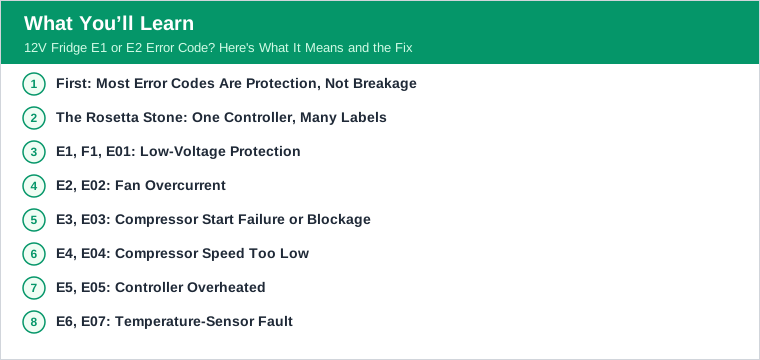
E1, F1, E01: Low-Voltage Protection
The most common code by far is the low-voltage one. On ICECO fridges E1 is battery low-voltage protection; on Alpicool the F1 code means the low-voltage battery protection has activated because input voltage fell below the current protection level; on Dometic CFX2 the E01 covers low or over-voltage. All three are the same underlying fault: the supply dropped below the threshold and the fridge shut off to spare the battery.
The controller's own trigger is documented - the low-voltage alarm fires when input dips below about 10.4V, and voltage must recover above about 11.8V before the compressor restarts. But your fridge may cut out well above that, because the adjustable battery protection sits higher: in High mode an Alpicool needs above about 12.4V to start and shuts off below about 11.1V. A car battery that sags is easily enough to trip it.
The documented fix is to step the protection setting down from High to Medium to Low. At 12V the Low setting cuts off at 9.6V, Medium at 10.1V, and High at 11.1V, so dropping the level lets the fridge keep running on a supply that dips - use High on a starter battery to protect the car, Medium or Low on a house or portable battery. Also check the wiring, because thin cable and loose connections drop voltage under load. A multimeter at the plug confirms what the compressor is really seeing.
E2, E02: Fan Overcurrent
The two-flash code is about the cooling fan, not the compressor. The Danfoss/Secop two-flash fault is a fan or pump overcurrent on the controller's F terminal, which is limited to roughly 1A surge or about 0.7A continuous. On ICECO, E2 is the cooling fan drawing more than 1A; on Dometic CFX2, E02 is a fan overcurrent. The controller sees the fan pulling too much and shuts down to protect that circuit.
A fan pulls excess current when it is obstructed, jammed, or failing. Debris in the blades, a bearing going bad, or something pressing against the fan makes the motor strain and draw past the roughly 1A limit, which trips the code. Because the condenser fan is essential to cooling, the controller stops rather than let the circuit or the fan cook.
The fix is at the fan. Power down, find the condenser fan on the vent side, and clear any debris, dust, or obstruction so it spins freely. If a blade is bent or the fan is seized, it needs replacing - a far cheaper part than the compressor. A fridge that clears its E2 once the fan spins clean was tripped by airflow, not by the sealed system.
E3, E03: Compressor Start Failure or Blockage
The three-flash code points at the start itself. The Danfoss/Secop three-flash fault indicates the compressor motor could not start; on ICECO, E3 is a blocked compressor or excessive system pressure; on Dometic CFX2, E03 is a compressor start failure. The controller commanded a start, the motor did not spin up, and it flagged the failure.
Here is where the skeptic slows down, because a genuine start failure and a starved start look identical. The far more common cause is still voltage: a low or sagging supply cannot provide the inrush current the compressor needs to spin up, so it fails to start and throws the code even though the compressor is fine. Before believing E3 means a dead compressor, prove the supply with a short, thick cable to a healthy battery.
If the compressor starts cleanly on a proven-good feed, the E3 was a power problem. If it still will not start on strong, direct power with protection set right, then a genuine start failure or an internal blockage - excessive system pressure - is the real cause, and that is a sealed-unit fault for warranty service. The order matters: rule out voltage first, hardware last.
E4, E04: Compressor Speed Too Low
The four-flash code is subtler: the compressor started but could not keep up. The Danfoss/Secop four-flash fault indicates the motor started but could not maintain the minimum running speed of 1,850 RPM; on ICECO, E4 is the motor failing to hold that 1,850 RPM minimum; on Dometic CFX2, E04 is compressor speed too low. The motor spun up, then bogged down below the speed the controller requires.
The usual reason is, again, marginal power. A compressor running on a supply that is just barely adequate can start but then lack the voltage to hold its speed under load, so it sags below 1,850 RPM and the controller cuts it. An overtaxed system - a huge heat load, a fridge crammed with warm contents in a hot cabin - can also drag the speed down. Both are conditions, not necessarily a failed motor.
Treat it like E3: confirm strong, clean power and a reasonable heat load first. Give the fridge a healthy feed, ease the thermal load, ensure the condenser can breathe, and see whether the compressor holds speed. Only if it still cannot maintain 1,850 RPM on a proven-good supply and a sane load is the compressor itself the honest suspect.
E5, E05: Controller Overheated
The five-flash code is a thermal one, and it is about the electronics, not the fridge interior. The Danfoss/Secop five-flash fault means the electronics heat sink exceeded 100C (212F); the compressor stops and only restarts once it cools. On ICECO, E5 is temperature protection with the controller internal temp over about 212F; on Dometic CFX2, E05 is a controller-overheated fault. The brain got too hot and shut down to save itself.
This is almost always an airflow problem. The controller and condenser live on the vent side of the fridge, and if that side is pressed against a wall, buried in a tight cabinet, or sitting in a hot car with no clearance, the heat sink cannot shed heat and climbs past 100C. The fridge is not overheating its food; its electronics are cooking in a dead pocket of hot air.
The fix is ventilation. Pull the unit into open air, leave clearance around the vent side, keep it out of direct sun and hot enclosed spaces, and clear any dust choking the condenser. Let a hot unit cool and the code clears. A fridge that throws E5 in a baking, enclosed spot but runs fine once it can breathe was suffocating, not failing.
E6, E07: Temperature-Sensor Fault
The sensor codes are the ones that actually point at a small internal part. On ICECO, E6 is an NTC temperature-sensor open or short; on Dometic CFX2, E06 is an NTC sensor open circuit and E07 is an NTC sensor short circuit. The NTC is the little thermistor that tells the controller how cold the box is, and the code means the controller has lost a sane reading from it.
Without a trustworthy temperature reading, the controller cannot regulate cooling, so it stops and flags the sensor rather than run blind. The cause is usually the sensor itself or its wiring - a broken lead, a corroded connector, a pinched wire, or a failed thermistor. It is a genuine fault, but a minor and specific one, not a compressor problem.
On some units the sensor or its connector is accessible and the fix is straightforward; on sealed units it is a service item. Either way, an E6 or E07 is telling you exactly where to look - the temperature sensor and its wiring - which is a far cheaper conversation than the sealed refrigeration system. Match the code to the part and you avoid condemning the whole fridge over a two-dollar thermistor.
The Fix Order by Code
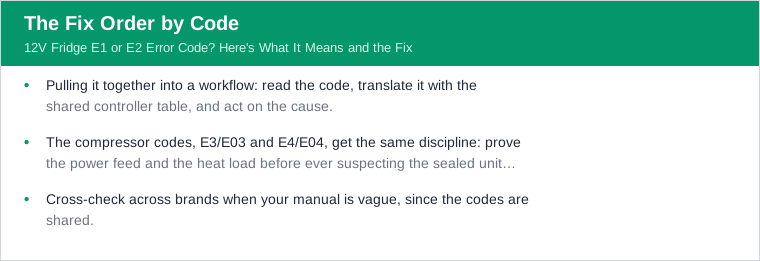
Pulling it together into a workflow: read the code, translate it with the shared controller table, and act on the cause. E1/F1/E01 sends you to voltage and wiring first - drop the battery protection level, fix thin cable and loose connections, confirm a healthy supply. E2/E02 sends you to the condenser fan - clear debris so it stops drawing past its roughly 1A limit. E5/E05 sends you to airflow - ventilate the vent side so the heat sink stays under 100C.
The compressor codes, E3/E03 and E4/E04, get the same discipline: prove the power feed and the heat load before ever suspecting the sealed unit, because a starved compressor throws these codes while perfectly healthy. Only when the fridge still fails on a short, thick cable to a good battery, with protection set right and the condenser breathing, is the compressor itself the answer. The sensor codes, E6/E07, point narrowly at the thermistor and its wiring.
Cross-check across brands when your manual is vague, since the codes are shared. Working in this order - external conditions first, sealed hardware last - resolves the large majority of error codes without a return, because most codes are protection reacting to voltage, airflow, or a fan, all of which you can fix.
The Verdict: Decode First, Panic Never
An E1 or E2 on a 12V fridge is not a mystery and rarely a catastrophe. The brands share one Danfoss/Secop controller, so the codes decode to a short, readable list: E1/F1/E01 is low-voltage protection, E2/E02 a fan overcurrent past about 1A, E3/E03 a start failure, E4/E04 a speed below 1,850 RPM, E5/E05 the controller overheating past 100C (212F), and E6/E07 a temperature-sensor fault.
Most of those are conditions outside the sealed compressor - voltage, wiring, a blocked fan, poor airflow - that you can find and fix yourself. Match the code to its cause and act in order: power and wiring for the low-voltage code, the fan for the overcurrent code, ventilation for the overheat code, and a proven-good supply before you ever blame the compressor on the start and speed codes.
Only the compressor codes on a proven-good feed, and the sensor codes, point at hardware - and even the sensor is a small, specific part rather than the whole fridge. Decode before you panic, fix the cause the code names, and you will clear the large majority of error codes without tools and without a return.