
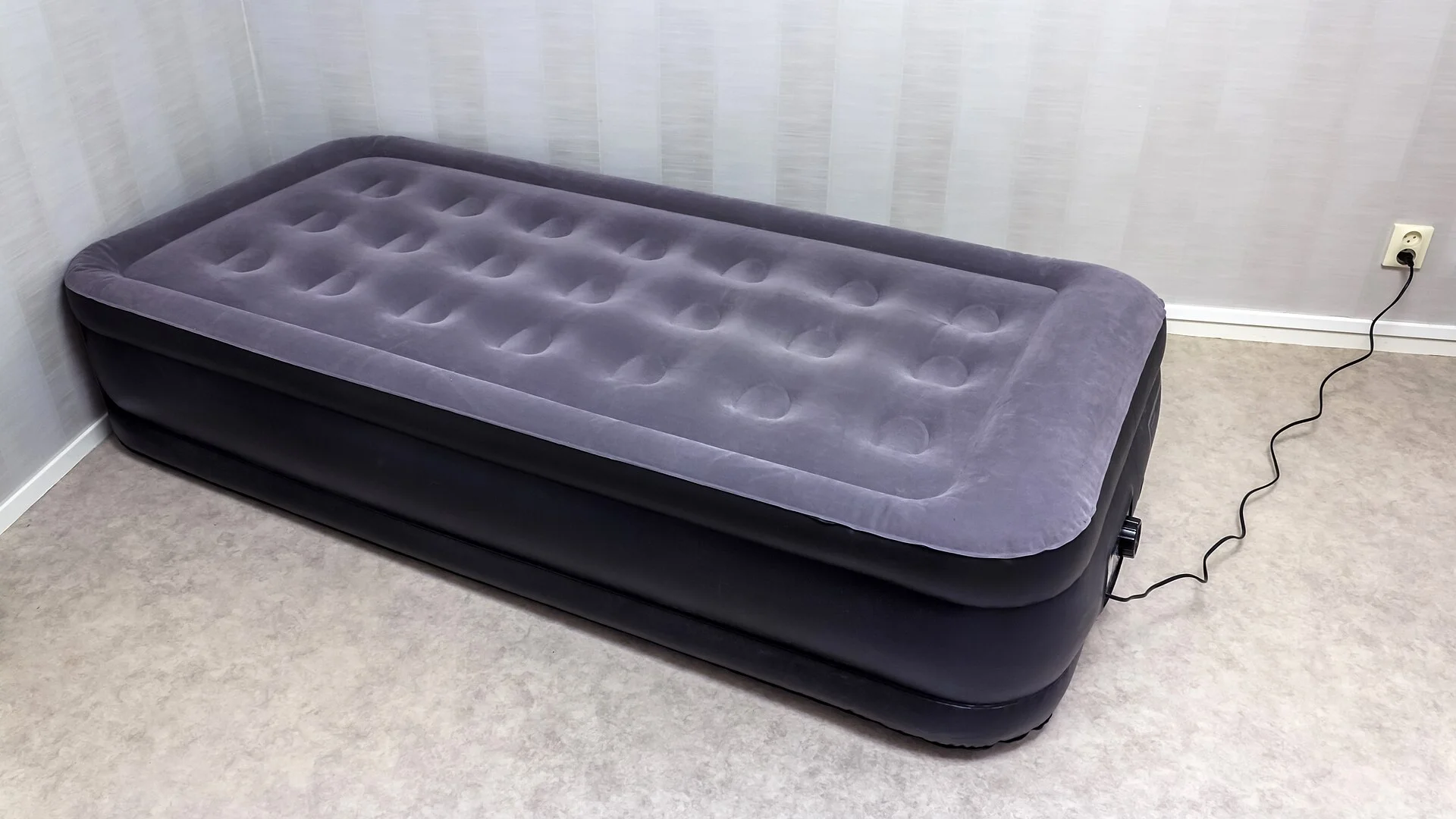
The Cold Is Coming From Under You, Not Around You
You did everything right. You bought a thick, comfortable air mattress, you brought a warm blanket, the cabin was sealed up for the night — and you still woke up shivering with a cold patch pressed against your back. It feels like a betrayal, because the obvious suspect is the air temperature, and the obvious fix is more blankets on top. Both are wrong, and that is why piling on another layer rarely helps.
The real reason an air mattress sleeps so cold has nothing to do with how thick it is or how warm your bedding is. It is a heat-transfer problem. The big column of air sealed inside the mattress does not sit still and insulate you — it quietly circulates, carrying your body heat down and away faster than your blanket can replace it. On top of that, a bare air mattress has almost no measurable insulation value to begin with, so the cold floor and cold cabin air reach you with very little to stop them.
Once you understand the mechanism, the fix becomes obvious and cheap, and it is the opposite of what most people try. This guide walks through exactly why the cold comes up through the mattress, the one number that explains the whole thing, why a car makes it worse than a tent, and the layer-the-underside setup that turns a freezing air mattress into a warm one — usually without spending much at all.
Three Ways Your Body Loses Heat at Night
To see why the mattress is the culprit, it helps to know the three roads your body heat takes to escape. Physicists call them conduction, convection, and radiation, and a cold night in a car uses all three against you.
Conduction is heat flowing through direct contact with something colder. Press your hand flat on a cold metal table and feel the heat drain out of it — that is conduction. When your body lies on a cold surface, heat conducts straight out of you into whatever you are touching. Convection is heat carried away by a moving fluid, and air counts as a fluid. A breeze feels cold because moving air sweeps warmth off your skin; the same thing can happen inside a sealed space if the air in it is free to circulate. Radiation is infrared energy your warm body throws off toward colder surroundings, the same way you feel heat from a fire across a room without touching it; at night you radiate heat toward cold windows and cold cabin walls.
Here is the part that surprises people: an air mattress weaponizes the first two. The cold you feel is not mostly the cabin air chilling your face — it is conduction and convection pulling heat out of your back, downward, through a mattress that does almost nothing to stop it. Keep that direction in mind, because it changes everything about the fix: the heat is leaving from below, so that is where the insulation has to go.
The Convection Loop Inside the Mattress
This is the mechanism at the heart of the whole problem, and it is genuinely counter-intuitive. We are taught that air is a good insulator, and it is — but only when it is held perfectly still. Trapped, motionless air in the tiny pockets of foam or fiber is what makes a jacket warm. The moment air is free to move in bulk, it stops insulating and starts transporting heat by convection.
An air mattress is a large, open chamber of air several inches tall — the perfect place for a convection loop to form. Your body warms the thin layer of air touching the top surface of the mattress. Warm air is less dense, so it gets displaced as cooler, denser air sinks toward the cold underside. That sinking cold air is then warmed in turn, rises, and the cycle repeats. The result is a slow but steady circulation that continuously ferries your body heat from the top of the mattress down to the cold floor side, where it is lost.
That is why the cold seems to come up through the mattress no matter how warm the top felt when you lay down. You are not insulated from the floor by a thick cushion of air — you are connected to it by a conveyor belt of circulating air. A taller mattress can even be worse, because a deeper air column gives the convection loop more room to run. The thickness you bought for comfort is doing nothing for warmth, and may be working against it.
R-Value: The One Number That Explains It
Campers who sleep warm tend to talk about one number, and it is the key to this whole topic: R-value. R-value measures thermal resistance — how well a layer resists conductive heat loss. The higher the R-value, the more it slows heat escaping from your body into the cold beneath you, and the warmer you sleep. Quality sleeping pads print their R-value on the packaging for exactly this reason.
As a rough guide, a pad around R-value 1 to 2 is a warm-summer surface, roughly 3 to 4 covers three-season use into chilly nights, and 5 or higher is built for genuine cold and winter. Now here is the punchline for air mattresses: a bare air mattress typically has an effective R-value of about 1 or even less, no matter how thick it is. The convection loop inside it means the thick air column does not act like thick insulation — it acts like almost no insulation at all. The number is low because the air moves.
This single fact reframes the entire problem. A cold air mattress is not a temperature issue you can blanket your way out of; it is a low-R-value surface, and the only real cure is to raise the R-value between your body and the cold. That is also why two campers in identical bags on the same night can have completely different experiences: the one on an R-4 foam pad is warm, and the one on a bare R-1 air mattress is miserable, with the bag doing the same job for both. The surface, not the bag, decided it.
Why a Car Makes It Worse Than a Tent
Sleeping in a vehicle adds insults that a tent camper on insulated ground does not face, and they all converge on the mattress. The first is the shell itself. A car cabin is a thin envelope of metal and glass with essentially no insulation in the walls, so once the engine is off it cools toward the outside temperature within a couple of hours. Your mattress spends the whole night sitting in cold air, and that cold air feeds the convection loop inside it.
The second is the glass. Single-pane automotive windows are poor insulators and strong radiant heat sinks — they pull warmth out of everything in the cabin, including the exposed sides of the mattress, by radiation. An uncovered window is, in heat-transfer terms, a hole in your insulation. The third is the floor. A mattress laid directly on a cold cabin floor — usually metal, or thin plastic over metal — loses heat by direct conduction into that floor, stacked on top of the convection already happening inside the bladder.
So the car version of a cold air mattress is the tent problem times three: a colder surrounding shell, cold radiant glass on multiple sides, and a hard conductive floor right beneath you. It is also why the same mattress that sleeps perfectly fine on a carpeted bedroom floor at home turns into an icebox in the car. The mattress did not change; the environment pulling heat out of it did. Managing that environment — covering glass, lifting off the floor — is part of the fix, but the biggest lever is still the layer directly under you.
Half Your Heat Escapes Downward
If there is one idea to carry out of this guide, it is this: in cold conditions, roughly half of a sleeping person's heat loss goes downward, into the surface beneath them. Not out the top, not out the sides — down. This is why experienced cold-weather campers obsess over what is under them far more than what is over them.
The reason is partly the convection-and-conduction mechanism we have already covered, and partly simple geometry: your body is pressed firmly against the surface below, compressing any loft in your sleeping bag to nothing at the contact points. A sleeping bag works by trapping still air in its insulation, but where your weight crushes that loft flat, it stops insulating. So underneath you, the bag is doing almost nothing — and whatever is below the bag is what actually keeps you warm.
This is the trap people fall into when they respond to a cold night by adding blankets on top. The blanket addresses the half of the heat loss that was already the smaller problem, while the larger downward loss continues unchecked. You can pile on every layer you own and still feel cold from below, because you are insulating the wrong side of your body. The moment you understand that the air mattress is the weak point and the loss is downward, the solution writes itself: get insulation between your body and the mattress.
The Fix: Insulate the Top of the Mattress
The cure for a cold air mattress is not a warmer blanket and not a thicker mattress. It is an insulating layer placed on top of the mattress, between your body and the air, so the heat is stopped before it ever reaches the convection loop. This single change fixes the problem more reliably than anything else, and it can cost very little.
The most dependable option is a closed-cell foam pad. Its sealed bubbles trap air so it cannot circulate, giving a solid, predictable R-value that does not deflate, collapse under your weight, or depend on the mattress staying inflated. It is cheap, bombproof, and the classic answer. A higher-rated sleeping pad with a published R-value works the same way and adds comfort; the key is to choose one whose number matches the cold you expect rather than guessing from thickness. Even a humble layer — a wool blanket, a moving blanket, a foam mat, or a couple of folded blankets — placed under your body and over the mattress will help, because anything that interrupts the air-to-body contact slows the loss.
The placement is the part people get wrong. Insulation goes on the mattress, not just under it. A pad beneath the mattress helps a little with conduction into the cold floor, but it does nothing about the convection happening inside the bladder above it. To block that, the insulating layer has to sit between you and the air. Put the pad on top, climb in over it, and you have cut off the main escape route for your heat. This is also the foundation of any plan to stay warm sleeping in your car on a cold night: surface first, everything else second.
Stacking R-Value: How the Numbers Add Up
One of the most useful facts in cold sleeping is also one of the simplest: when you stack insulating layers, their R-values add together. R-values combine in series, so a layer rated R-2 placed on a layer rated R-1 gives you roughly R-3 of total resistance under your body. This is what makes the air mattress salvageable instead of disposable.
Take that bare air mattress sitting at about R-1. On its own it is a summer-only surface. Lay a closed-cell foam pad rated R-2 on top, and the combined surface is now around R-3 — genuine three-season territory. Add a thicker self-inflating pad rated R-4 instead, and you are near R-5, which is winter-capable. You did not replace the mattress; you turned it into the comfortable base layer of a warmer system by stacking resistance on top of it.
This is why the foam pad and the air mattress are partners, not rivals. The mattress gives you the soft, level cushion that makes sleeping in a hard vehicle bearable, and the pad on top supplies the insulation the mattress lacks. Thinking in additive R-value also tells you exactly how far to go: for a mild night a single thin pad may push you over the line, while a hard freeze calls for a higher-rated pad or two layers stacked. You are no longer guessing with blankets — you are adding up a number until it clears the conditions.
Self-Inflating and Foam Alternatives
Sometimes the better answer is to change what you sleep on rather than patch it, and it helps to know why the alternatives run warmer. The core issue with a pure air mattress is the open air chamber that lets convection run free; every warmer option works by killing that internal circulation.
A self-inflating pad combines an open-cell foam core with an air chamber. When you open the valve, the foam expands and draws in air, but crucially the foam fills the chamber so the air inside can no longer circulate in a big loop. That trapped, subdivided air insulates the way still air is supposed to, which is why a self-inflating pad of a given thickness delivers a much higher and more reliable R-value than a pure air bladder of the same size. It is the convenience of inflation with most of the warmth of foam.
A solid closed-cell foam pad goes further still on dependability: there is no air to leak, nothing to puncture, and the R-value never changes. It is less plush, which is why many car campers use it as the insulating layer beneath a comfort layer rather than on its own. If you are weighing the broader trade between an inflatable and a foam alternative for your setup, the warmth difference traces directly back to this one mechanism — foam stops the convection that the air bladder allows. For three-season car camping, the popular middle path is exactly the stack described above: keep the air mattress for comfort and add foam for warmth.
Taming the Cabin: Glass, Floor, and Condensation
With the underside handled, the rest of the gains come from making the cabin itself less hostile, which slows how fast the mattress and the air around it shed heat. None of these replace the insulating layer, but together they noticeably raise the floor on a cold night.
Start with the windows. Reflective or insulated window covers cut the radiant heat loss through the glass and slow the cabin's cooling, so the mattress spends the night in less brutally cold air. Covering glass also helps with a quieter problem: a cold mattress surface is a place where humid cabin air can condense, and managing that condensation keeps your bedding from turning clammy and making the cold feel worse. Next, get the mattress off the cold floor where you can — a foam pad or even cardboard underneath breaks the direct conductive path into the metal. Finally, match your bedding to the surface: a warm bag is only as good as what is under it, so once the pad is sorted, choose a bag whose temperature rating suits the night.
Active heat comes last, not first. A 12V heated blanket adds real warmth and can be wonderful on a hard freeze, and a good cold-weather blanket over the top traps it — but neither fixes the downward loss on its own. If you skip the insulation and rely on heat alone, you are pouring warmth into a surface that keeps draining it away, and the moment the heat source runs down the cold returns. Insulate first so the warmth you add actually stays with you, and remember that a bag's stated rating quietly assumes you fixed the surface underneath it.
A Layer-by-Layer Warm Setup for the Car
Here is the whole fix assembled into an order you can build from the floor up. Each layer addresses a specific heat-loss path, so you can stop adding once you have cleared the conditions you actually camp in.
- Break the floor conduction. Put a foam pad, mat, or even flattened cardboard between the cold cabin floor and the mattress so heat is not draining straight into the metal.
- Place the air mattress for comfort and a level surface — this is your cushion, not your insulation, and that is fine.
- Lay the insulating layer on top of the mattress. A closed-cell foam pad or a sleeping pad with a real R-value goes here, between your body and the air. This is the single most important step and the one most people miss.
- Add R-value until the number clears the night. Stack a second pad or choose a higher-rated one for a freeze, remembering the R-values add together.
- Cover the windows with reflective or insulated covers to cut radiant loss, slow the cabin cooling, and help control condensation on cold surfaces.
- Match the bag to the surface. With the underside insulated, a bag whose temperature rating fits the night will finally perform as advertised.
- Add active heat only if needed. A heated blanket on top of a properly insulated base is comfort; on a bare mattress it is a band-aid.
Run that order and you have addressed every path the heat was taking: conduction into the floor, convection inside the mattress, radiation out the glass, and the crushed loft beneath your body. The mattress that felt freezing becomes a comfortable, warm base — and you did it by understanding the mechanism rather than fighting the symptom with more blankets.
The Bottom Line
Your air mattress sleeps cold because of physics, not bad luck. The big pocket of air inside it does not insulate you the way its thickness suggests — it circulates in a slow convection loop that carries your body heat down to the cold underside and away, and a bare mattress has an effective R-value of about 1 no matter how tall it is. In a car, a thin uninsulated shell, cold single-pane glass, and a hard conductive floor all pile on, which is why the same mattress that is fine at home turns frigid in the cabin.
The fix follows straight from the cause. Because roughly half your heat escapes downward, the answer is insulation between your body and the mattress — a closed-cell foam pad or a rated sleeping pad on top — not another blanket over you. Stack R-value until the number clears the night, lift the mattress off the cold floor, cover the windows, and match your bag to the surface. Add active heat only after the insulation is in place, never instead of it.
Do that and the cold air mattress stops being a mystery and becomes a solved problem. You keep the comfort of the mattress and gain the warmth it never had on its own, for the price of one foam pad and ten minutes of understanding why the cold was coming from under you all along.