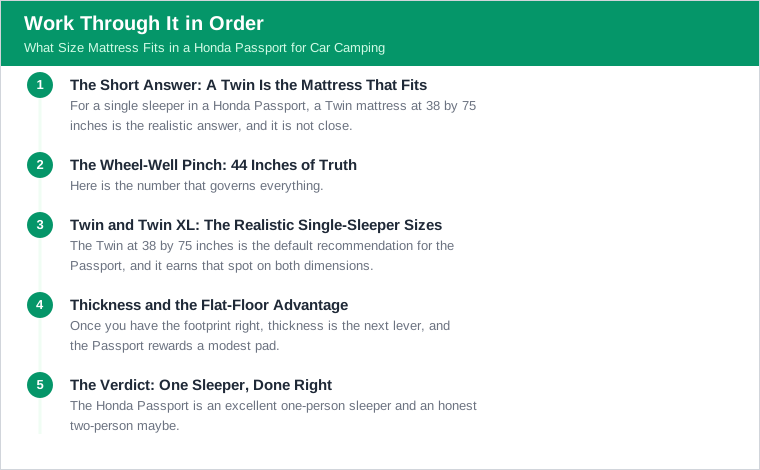
The Short Answer: A Twin Is the Mattress That Fits
For a single sleeper in a Honda Passport, a Twin mattress at 38 by 75 inches is the realistic answer, and it is not close. The Passport is a two-row, five-passenger SUV with no third-row seat, so once the second row folds the entire rear becomes one continuous cargo zone. That gives you a clean floor to work with, but the width you can actually use is narrower than the raw volume suggests.
The number most buyers reach for is cargo volume, and the Honda Passport Camping Guide lists a healthy figure. Behind the second row the Passport holds 50.5 cubic feet, and with the 60/40 second row folded that rises to 100.8 cubic feet. Volume like that sounds queen-sized. It is not, because a mattress is a rectangle and a cargo hold is a shape pinched by wheel wells.
The rest of this guide walks the two numbers that actually decide the fit: the wheel-well width, which caps how wide a mattress can lie flat, and the floor length, which the front seats can stretch. Get both in your head before you buy a mattress, because the wrong one turns a flat bed into a night spent wedged against a plastic panel.
Why the Cubic-Foot Number Lies
Cargo volume is a bragging number. It counts every cubic inch up to the headliner, including the tapered space above the wheel wells and the air over the seatbacks, none of which a person lying down can use. A Passport advertised at 100.8 cubic feet still forces a mattress down onto a floor that is far narrower than the volume implies.
What matters for sleeping is the flat, rectangular footprint at floor level. Honda states the second-row seats fold to a flush, flat load surface, which is genuinely useful and one of the flatter seats-down floors in the midsize class. A flush floor means a pad beds down evenly instead of sagging into a gap, so the Passport starts with a real advantage over SUVs whose seats leave a slope.
But flat is not the same as wide. The floor is level, yet the wheel wells still intrude from both sides, and that intrusion is the ceiling on mattress width. Read the volume figure as a measure of how much gear you can pile in, not as a promise of how big a bed you can lay down.
This is the single most useful reframe for any car-camping mattress question. Manufacturers quote volume because it is a big, flattering number that sells cargo capability, but nobody sleeps in cubic feet. Translate every brochure claim into two flat measurements before you shop, and the Passport stops looking like a queen-sized cavern and starts looking like the honest one-person space it is.
The Wheel-Well Pinch: 44 Inches of Truth
Here is the number that governs everything. Owners who put a tape measure to the Passport report the narrowest width between the rear wheel wells is roughly 44 to 44.5 inches at floor level. That pinch is the hard limit on any mattress laid directly on the floor, and it is the single most important figure in this guide.
A Twin is 38 inches wide, so it clears the 44-inch pinch with room to spare and lays flat on the floor without fighting the wheel wells. Step up to a Full at 54 inches wide, and you are well over the 44-inch gap, so a Full simply cannot bed down flat between the panels. The math is unforgiving and it is the same in most midsize SUVs.
There is one escape hatch. Owners measuring about 12 inches above the cargo floor find the span between the wheel-well bumps opens up to about 52 inches. That means a raised platform clears the wheel wells and approaches full-size width, which is exactly why platform builds exist. On the flat floor, though, 44 inches is your world.
Commit that 44-inch figure to memory, because it is the difference between a mattress that beds down and one that rides up the panels. Before you buy anything, lay a tape across the back of your own Passport and confirm the pinch, since trim and model year can shift it slightly. The measurement takes a minute and saves a return.
Length: The Front Seats Are Your Lever
Width is fixed by the sheet metal, but length is adjustable, and the Passport gives you a surprising amount of it. With the front seats slid all the way back, owners measure 76 inches from the rear hatch to the front seat. That is enough for a Twin's 75-inch length to fit almost exactly, with the sleeper's head near the tailgate.
Slide the front seats fully forward and the seats-down cargo length grows to 87 inches. That extra room is the lever that changes which mattress works. A Twin XL is 80 inches long, too long for the 76-inch floor with the seats back, but it fits comfortably once the seats move forward toward the 87-inch measurement.
The practical move is to set the front seats for your height before you commit to a size. A shorter camper can leave the seats back and run a Twin at 76 inches; a taller one slides the seats forward and unlocks a Twin XL. This one adjustment is the difference between a mattress that fits and one that folds up against the dashboard.
It also means the Passport is more flexible than its single width number suggests. Length is the dimension you can tune trip to trip, so the same vehicle sleeps a five-foot camper and a six-foot camper without a different mattress, just a different seat position. Note where your seats need to sit, and set them there before you inflate anything.
Twin and Twin XL: The Realistic Single-Sleeper Sizes
The Twin at 38 by 75 inches is the default recommendation for the Passport, and it earns that spot on both dimensions. Its 38-inch width sits inside the 44-inch wheel-well pinch, and its 75-inch length fits the 76-inch seats-back floor. Nothing has to be slid, trimmed, or elevated. It is the size the vehicle is shaped for.
The Twin XL at 38 by 80 inches is the taller camper's version of the same pad. The width is identical, so it clears the wheel wells the same way, but the 80-inch length only fits once the front seats slide forward toward the 87-inch floor. If you are over six feet, the Twin XL is worth the seat adjustment for the extra five inches at your feet.
One owner reported going to the dealer with a tape measure and confirming room for a 28-inch-wide pad or cot with just the 60 side of the second row folded, leaving the 40 side up for a passenger. That split-fold trick is handy for solo trips where you want to keep a seat, and a 28-inch pad fits it easily.
Full-Size: Only on a Raised Platform
A Full mattress is 54 by 75 inches, and it is the size where the Passport starts saying no. At 54 inches wide, a Full is well over the 44-inch wheel-well pinch, so it cannot lie flat on the cargo floor. Lay one down and its edges ride up the wheel-well humps, leaving you sleeping in a shallow trough.
The only way a Full works is on a raised sleeping platform. Build the deck about 12 inches up, where owners measure the span opening to about 52 inches, and a 54-inch Full very nearly fits, with a slight overhang at the edges that a platform lip can support. This is the standard trick for squeezing more width out of a midsize SUV.
Whether that is worth it depends on how you camp. A platform adds weight, build time, and lost gear space underneath, in exchange for a wider bed and storage below. For most solo Passport campers a Twin on the flat floor is simpler and just as comfortable; the platform earns its keep mainly when two people insist on sleeping inside.
If you do build one, size the deck to that 52-inch upper span rather than to the floor, and add a lip to catch the Full's slight overhang. Owners who plan the platform around the real above-well width end up with a stable, near-full-size surface; those who copy a generic build and ignore the Passport's own numbers end up with a deck that overhangs or wobbles.
Queen and King: The Honest No
A Queen is 60 inches wide and a King is 76 inches wide, and neither fits flat in a Honda Passport. Both exceed even the elevated 52-inch clearance you get above the wheel wells, so no platform height rescues them. A true queen air mattress laid in the back will buckle against the wheel wells and never sit flat, no matter how you angle it.
This is the reality-grounding surprise that trips up buyers. The 100.8-cubic-foot volume figure sounds like it should swallow a queen, but volume counts air the mattress cannot occupy. The usable flat sleeping width is gated by the 44-inch pinch, not by the cubic-foot number, and a 60-inch queen sits far wider than the pinch and stays too wide even up above the wheel wells.
If two people must sleep inside a Passport, the honest setups are two narrow pads side by side on a platform, or a single wider pad trimmed to the interior. A retail queen is the wrong tool. Believe the tape measure over the brochure, and you will not waste money on a mattress that never lies down.
The temptation is understandable, because a queen is what people sleep on at home and it feels like the standard. But a home is not shaped like a cargo hold, and the wheel wells that make a Passport drive well are the same panels that make a queen impossible. Sizing down is not settling; it is matching the mattress to the room the vehicle actually offers.
Thickness and the Flat-Floor Advantage
Once you have the footprint right, thickness is the next lever, and the Passport rewards a modest pad. Because the folded seatbacks sit slightly above the rear cargo floor, a thinner pad of roughly four inches or less beds down more evenly across the transition than a tall inflatable that can rock on the seams. Lower and firmer beats tall and bouncy here.
That advice runs against instinct, because thick air mattresses feel more comfortable in a showroom. In a vehicle, a tall mattress magnifies every gap and ridge underneath it, and it also eats headroom you want for sitting up. A four-inch foam or self-inflating pad hugs the flush floor the Passport gives you and turns its flatness into a genuine benefit.
The Passport's flush-folding floor is its real camping strength, so lean into it. Where a sloped-seat SUV needs a thick pad just to level the surface, the Passport lets a thinner, lighter, cheaper pad do the job. Match a modest thickness to that flat floor and you sleep better than you would on a plusher pad in a bumpier vehicle.
Building the Passport Bed
Putting it together is straightforward. Fold the 60/40 second row flat, set the front seats for your height, and lay your pad with the head toward the tailgate. For a Twin at 76 inches you can leave the seats back; for a Twin XL at 80 inches, slide them forward toward the 87-inch length first. Confirm the pad clears the 44-inch pinch before you inflate.
For the pad itself, a Twin-size car-camping air mattress sized to a Twin footprint is the easiest match, since anything wider will fight the wheel wells. If you want a firmer, flatter surface, a four-inch foam pad or a self-inflating mat suits the Passport's flush floor better than a tall inflatable. Add a fitted sheet and the seams disappear.
Two accessories make the difference between camping and sleeping. Window covers cut light and add privacy, and a small gap-filler pad bridges the slight step at the seatback so nothing sags. For the full setup, including ventilation and power, the Can You Sleep in a Honda Passport Car Camping Guide and the Honda Passport Payload Capacity Specs cover how the Passport handles longer stays and where the sleeping room ends.
The Verdict: One Sleeper, Done Right
The Honda Passport is an excellent one-person sleeper and an honest two-person maybe. A Twin at 38 by 75 inches is the mattress it was shaped for: narrow enough for the 44-inch wheel-well pinch, short enough for the 76-inch seats-back floor, and low enough to lie flat on the flush surface Honda gives you. That is the recommendation for almost everyone.
Scale up only with a plan. A Twin XL needs the front seats forward to reach the 87-inch length, and anything wider than a Twin needs a raised platform to clear the wheel wells up where the span opens to 52 inches. A Full is a platform-only size, and a Queen or King does not fit flat at all, brochure volume notwithstanding.
Trust the two governing numbers and you will get it right the first time: 44 inches of width at the floor and 76 to 87 inches of length depending on your seats. The Passport's flush floor does the rest. For how the vehicle handles the wider camping picture, the What Size Mattress Fits in SUV Camping lays out the sizing logic across vehicles so you can sanity-check your pad before it ships.