The Short Answer: Build a Platform, Do Not Lay a Mattress
The honest answer for a four-door Ford Bronco is that no standard mattress lies flat on the factory floor, and the fix is a raised sleeping platform rather than a mattress size. This is the finding that surprises Bronco buyers, so it belongs at the top: unlike most SUVs in this comparison, the four-door Bronco's rear seats do not fold flat, and they are not designed to.
This guide covers the full-size four-door Bronco from 2021 on, the five-passenger body-on-frame SUV, and not the smaller unibody Bronco Sport, which is a different vehicle with a different cargo shape. If you have the Sport, its numbers do not apply here. For the full-size four-door, the seatback problem is the whole story.
The Ford Bronco Camping Guide lays out the cargo figures: about 35.6 to 38.3 cubic feet behind the second row depending on top and configuration, and up to 77.6 cubic feet with the second row folded on the hardtop, or up to 83 cubic feet on the soft top. Those are respectable numbers for gear. They are not a promise of a flat bed.
So set expectations honestly before you shop. A Bronco is one of the best vehicles here for a rooftop tent or a platform build, and one of the worst for laying a mattress on the folded seats. The measurements below show exactly why, and why so many Bronco campers sleep above the vehicle or on a deck rather than on the floor.
The Seats Do Not Fold Flat
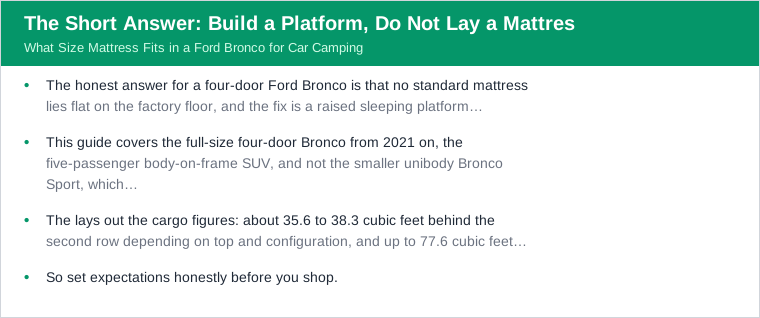
Here is the defining fact. The four-door Bronco's rear seats do not fold flat and are not meant to; folded, they leave a pronounced slope plus a raised hump at the seat base. That is not a defect or a trim quirk, it is how the vehicle is built, and it is the single biggest obstacle to sleeping inside a Bronco.
Most SUVs in this series give you a flat or near-flat floor once the seats drop, so the mattress question is really a width-and-length question. The Bronco breaks that pattern. Its folded seatbacks create a two-level, interrupted surface, and no mattress laid across a slope and a hump will sleep like a bed. The problem is geometry, not padding.
This is why the usual mattress-size chart barely applies to a Bronco. On a flat-floor SUV you pick a size and lay it down; in a Bronco, the floor itself has to be rebuilt before a mattress makes sense. Owners who understand this early build a platform or pitch a rooftop tent; those who do not spend a frustrating night wedged against the hump.
The overlander's read is to treat the Bronco as a platform vehicle, not a floor-sleeping one. That is not a downgrade; a well-built Bronco sleeping platform is stable, comfortable, and stows gear beneath it. But it does mean the honest first question is not what mattress, it is how you level the floor the seats refuse to make.
The Flat Patch: Roughly 30 by 42 Inches
When owners actually measure the flat area behind the folded seats, the number is sobering. The Bronco's flat cargo-floor patch behind the folded seats is roughly 30 by 42 inches before the hump interrupts it. That is a footwell-sized rectangle, not a bed, and it is the honest measure of what the factory floor gives you flat.
Thirty by forty-two inches is shorter than any standard mattress in every direction that matters. A Twin is 75 inches long; the flat patch is 30 inches deep before the surface rises. There is no orientation, straight or diagonal, in which a standard mattress lies flat on that patch. The hump ends the flat surface long before a mattress would.
This is the measurement that converts the abstract seats-do-not-fold-flat statement into a concrete no. People imagine the folded seats give a usable, if imperfect, floor. The tape says otherwise: a small flat patch, then a slope and a hump. Any real sleeping surface has to bridge over that geometry, which is exactly what a platform does.
It is also why width is not the Bronco's real problem. The flat patch is 42 inches wide, and a Twin at 38 inches would fit that width if the length existed. It does not. The Bronco is length-and-flatness limited, not width limited, and that is a different problem than any other vehicle in this comparison faces.
Length and Width: The Full Picture
Filling in the rest of the tape measure confirms the shape of the problem. The load floor width is about 43 inches, narrowing to 42.5 inches at the tailgate and about 42 inches at the narrowest point. That width would comfortably take a Twin's 38 inches, so on width alone the Bronco looks fine. The catch is always the length and the hump.
Depth tells the real story. Owners measure about 29 inches from the tailgate to the base of the rear-seat hump, with some citing about 33 inches. Either way, that is the flat run before the surface rises, and it is far short of a mattress. The hump is not a minor bump; it is where the usable flat floor ends.
Measured to the folded seatback edge rather than the hump, it is about 60 inches, roughly five feet, from the rear door to the seatback edge, and even the diagonal from the back corner to the seatback edge is only about six feet. Sixty inches is still shorter than a Twin's 75-inch length, so even measuring generously, no standard mattress lies flat.
For context, the four-door Bronco is 189.4 inches long overall on a 116.1-inch wheelbase, a genuinely large SUV. That exterior size makes the small interior sleeping floor all the more surprising, and it is a good reminder that outside dimensions tell you nothing about whether a body fits flat inside. The Bronco is big outside and short-and-humped inside.
Why No Standard Mattress Fits Flat
Put the measurements together and the conclusion is unavoidable. The flat run is only about 60 inches from tailgate to seatback edge, shorter than a Twin's 75-inch length, so no standard mattress lies fully flat inside the four-door Bronco without a leveling platform. That is true for the smallest size in the chart, and it only gets worse from there.
A Full at 54 inches, a Queen at 60 inches, and a King at 76 inches all exceed the roughly 42-to-43-inch load-floor width, so none of them fits flat between the panels regardless of length. The Bronco fails the width test for everything but a Twin and the length-and-flatness test for a Twin too. There is no standard size that simply drops in.
This is the reality-grounding surprise stated plainly: unlike most three-row SUVs in this comparison, the four-door Bronco's rear seats intentionally do not fold flat, and the usable flat floor is only about 30 by 42 inches before the hump. That is why Bronco campers overwhelmingly choose rooftop tents or platform builds over inside sleeping.
None of this makes the Bronco a poor camping vehicle. It makes it a platform-or-tent camping vehicle. The sooner a Bronco owner stops shopping for a mattress size and starts planning a leveling solution, the sooner they get a good night's sleep. The vehicle is honest about what it is; the brochure volume figure is the only thing that misleads.

The Platform Solution
The real answer is a raised sleeping platform built over the folded seats and the hump. Because the seats will not fold flat, realistic Bronco sleeping means building a deck that spans the slope and the hump, then topping it with a thin pad rather than trying to lay a mattress on the factory floor. This is the standard, proven approach in the Bronco community.
A platform does three jobs at once. It creates the flat surface the seats refuse to provide, it extends the usable sleeping length past the 60-inch flat run by bridging over the seatback edge, and it opens storage underneath for the water, recovery gear, and bins an overlander carries. One build solves the flatness, the length, and the storage in a single structure.
Sizing the platform is where the earlier numbers come back. Build to the roughly 42-to-43-inch load-floor width so the deck sits between the panels, and run it long enough to reach past the hump toward the tailgate. Topped with a thin foam pad, that deck sleeps far better than any mattress balanced on the factory slope, and it is stable enough for real use.
The trade is build time and lost floor-to-ceiling height, both of which most Bronco campers accept happily. A platform is a weekend project, not a purchase, but it is the difference between a Bronco you can sleep in and one you cannot. For owners who would rather not build, a rooftop tent is the other honest answer, sleeping above the vehicle entirely.
Rooftop Tent vs Platform: The Bronco's Two Real Paths
Because inside-floor sleeping is off the table, the Bronco funnels you toward two genuine options, and both are good. A rooftop tent puts a flat, full-size sleeping surface above the vehicle, sidestepping the seatback problem entirely, and the Bronco's rugged roof and rails make it a natural platform for one. You sleep flat, up top, and the interior stays free for gear.
A platform build keeps you inside and lower, which many campers prefer in weather or for stealth. It costs a weekend of work rather than the higher price of a tent, and it turns the interior into a two-level sleep-and-stow space. The trade-off is the effort and the reduced sitting height compared to a flat-floor SUV.
Which to choose depends on how you travel. Overlanders covering long distances often favor the rooftop tent for its flat comfort and quick setup, while budget-minded and stealth campers lean toward the platform. Both are legitimate, and both exist precisely because the Bronco's folded seats leave only that 30-by-42-inch flat patch to work with.
What neither path is, is a retail mattress on the floor. That is the option the geometry rules out. Deciding between a tent and a platform early, rather than discovering the seatback hump on your first night out, is the move that makes a Bronco a comfortable camper instead of a frustrating one.
If You Insist on Sleeping on the Floor
Some owners will still want to sleep on the folded seats without building anything, so here is the honest best case. You can lay a thick, firm pad over the slope and the hump and accept a compromised, uneven surface. It will not be flat, and the hump will sit under your hips or legs, but for a single night it can be survivable rather than good.
A thicker pad helps here in a way it does not on flat-floor SUVs. On a level floor a thin pad is better; on the Bronco's interrupted floor, extra thickness partially masks the hump and the slope, at the cost of headroom. A four-inch or thicker foam pad is the tool if you are committed to floor sleeping without a deck.
Keep the expectation low. Even the best pad cannot turn a sloped, humped floor into a flat bed, and the roughly 60-inch flat-to-seatback length means a taller camper's feet run up onto the seatback incline. This is a fallback for an unplanned night, not a setup to rely on for a real trip.
The moment floor sleeping becomes a pattern rather than an emergency, build the platform. It is the difference between tolerating the Bronco's geometry and solving it. The pad-on-the-hump approach is worth knowing for the night you did not plan for, but it is not the way a Bronco camps well, and no mattress size changes that.
Setting Up the Bronco to Sleep
The practical setup starts with a decision, not a purchase: platform, rooftop tent, or a compromised pad for one unplanned night. For the platform route, a car-camping sleeping-platform kit or a DIY deck sized to the 42-to-43-inch load-floor width is the foundation, topped with a thin pad. For the tent route, the roof is your surface. Only the last, weakest route uses the factory floor.
Whichever you choose, the Bronco's other camping strengths come into play once the sleeping surface is solved. The Ford Bronco Ground Clearance for Overlanding covers the vehicle's ground clearance and off-pavement ability, which is where a Bronco earns its keep getting you to campsites other vehicles cannot reach. Sleeping is the one thing it does not do easily; getting there is what it does best.
Ventilation and power planning finish the build the same as any vehicle. Because a platform sits higher, cross-flow through the windows works well, and the storage beneath keeps a fridge and battery organized. The Car Camping Mattress Size Vehicle lays out how to think about mattress sizing across vehicles, which is useful precisely because the Bronco is the exception that proves the flat-floor rule.
Set up this way, the Bronco is a capable, comfortable camper that happens to sleep on a deck or a roof instead of the floor. Accept the seatback reality, pick your leveling solution, and the vehicle that fails the mattress-on-the-floor test becomes one of the better platforms in this comparison. The What Size Mattress Fits in SUV Camping covers how it handles cold nights once your sleeping surface is sorted.
The Verdict: A Platform Vehicle, Not a Mattress Vehicle
The four-door Ford Bronco is the exception in this series, and the honest verdict is that no standard mattress fits flat on its factory floor. The rear seats do not fold flat, the usable flat patch is only about 30 by 42 inches before the hump, and the flat run to the seatback edge is about 60 inches, all shorter than a Twin.
That rules out floor sleeping as a real plan. A Twin fits the 42-to-43-inch width but not the length or the flatness, and a Full, Queen, or King all exceed the width outright. The 77.6 to 83 cubic feet of cargo volume is for gear, not for a flat bed, and the vehicle's large 189.4-inch exterior hides a short, interrupted interior sleeping floor.
The answer is a raised platform or a rooftop tent, and both are genuinely good. A platform spans the slope and hump, extends the length, and stows gear beneath; a rooftop tent puts a flat, full-size surface above the vehicle. Either one turns the Bronco from a poor floor-sleeper into a strong platform camper. The mattress question becomes a build question.
So skip the mattress-size chart for a Bronco and plan a leveling solution instead. That is not a compromise; it is how the vehicle is meant to camp. Build the deck or pitch the tent, and the Bronco that fails the flat-floor test rewards you with capability to reach campsites and a stable, comfortable bed once you stop asking the factory floor to be flat.