
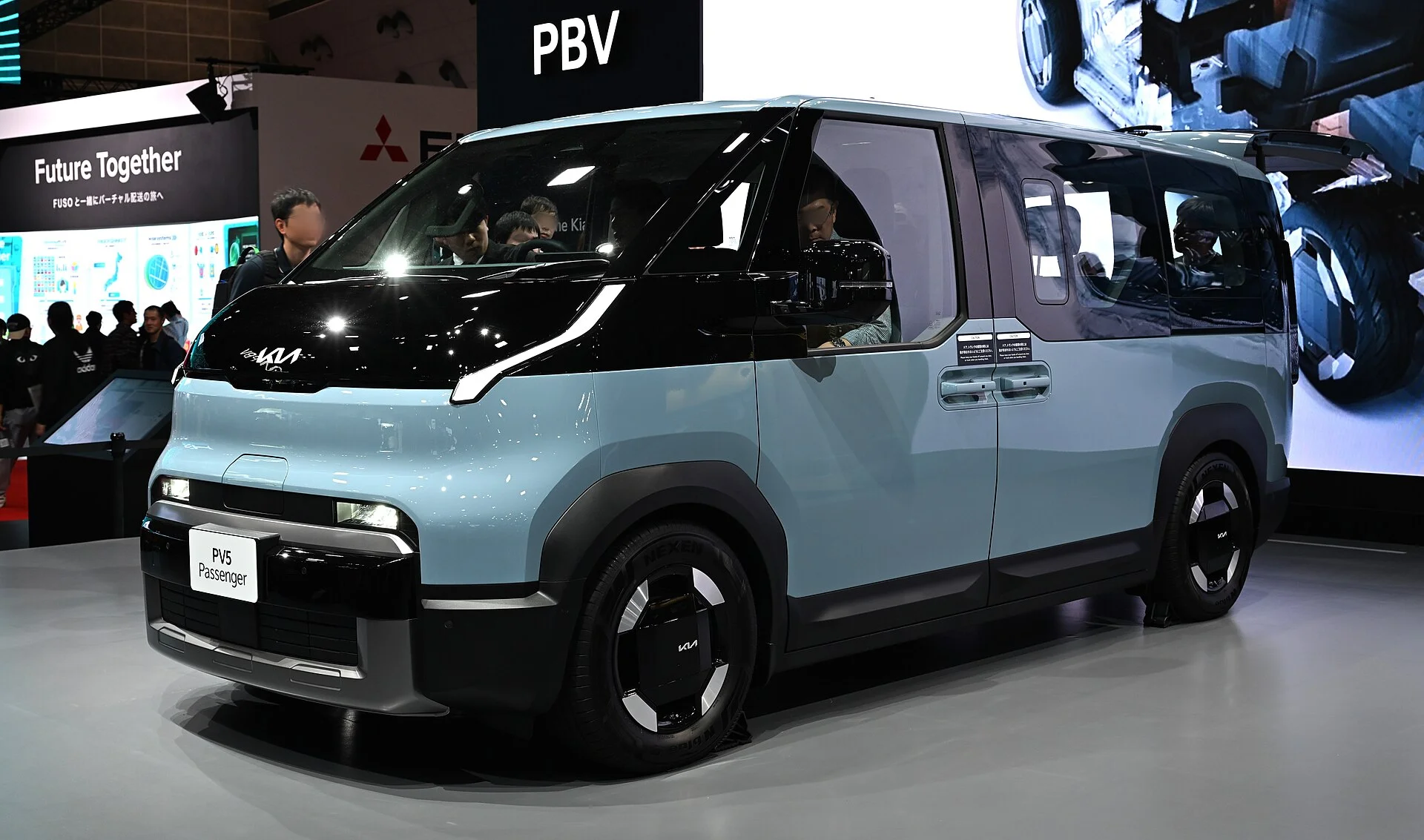
Does the Kia PV5 have a camping mode?
If you've typed “Kia PV5 camping mode” into a search bar, you're really asking two things at once: can I keep the cabin comfortable while I sleep in the back, and can I run my gear off the van? The honest answer is that the PV5 does both about as well as anything its size — but it does not have a single button or screen labeled “Camping Mode” or “Camper Mode.” That name is Tesla's. What Kia gives you instead is two real, documented features that together do the same job: Utility Mode, which keeps the climate, lights and accessories running off the big traction battery while you're parked, and V2L (Vehicle-to-Load), which turns the van into a rolling power station rated up to about 3.6 kW.
The terminology gap is exactly why this page exists. Owners search “camping mode,” Kia's owner's manual says “Utility Mode,” and almost nobody connects the two with real numbers. So here's the connection, built entirely on Kia's published specs, the owner's manual, and aggregated owner reports from the PV5 forums — not a test I'm pretending I ran. The PV5 is new and largely a European / international launch first, so where the facts are still settling I'll say so plainly. We'll walk through what Utility Mode actually powers and what it costs overnight, exactly how V2L works, the battery floor that keeps you from getting stranded, and how to plan a real night in the PV5 so you wake with charge to drive home.
Utility Mode vs. V2L: the two halves of the PV5's “camping mode”
These get conflated constantly, so separate them cleanly — they solve different problems and you'll usually use both in one night.
Utility Mode is the climate-and-comfort half, and it's a documented feature in Kia's owner's manual. Activate it through the infotainment screen — on the PV5's E-GMP-family electronics the path is EV → EV Setting → Utility mode — and the van then runs the heater or A/C, the audio, the lights and the screens from the high-voltage traction pack, not the little 12V battery. In Kia's own words, “the high voltage battery is used instead of the 12 V auxiliary battery for operating the convenient features of the vehicle.” The electronic parking brake engages automatically and the gear stays in Park — the van can't be driven, but everything electrical keeps working for hours. This is the feature that answers “can I sleep in it comfortably,” and because it draws from the main battery it won't strand you on a dead 12V the way idling accessories can.
V2L is the power-export half. It converts the battery's DC into household-style AC so you can plug in a fridge, an induction hot plate, a kettle, a fan, a laptop, even power tools. The PV5 Passenger is rated at up to 3.6 kW through its V2L outlet, and because the van is built on Kia's PBV (Platform Beyond Vehicle) architecture, the official conversion kits lean on V2L to run an outdoor kitchen rather than a separate house battery.
Put simply: Utility Mode keeps you comfortable; V2L keeps your gear running. Tesla bundles a slimmer version of both under one “Camp Mode” button. The PV5 splits them into two more capable tools — which is more powerful and slightly more to learn, and the reason a dedicated guide beats a one-line spec sheet.
How much battery does Utility Mode actually use overnight?
This is the number that decides everything, and the honest answer is a range, not a single figure — because climate demand dominates and weather sets that demand. The PV5's advantage is sheer capacity: the 71.2 kWh battery offers about 67 kWh usable, and an owner running the in-built 230V plug reports that over 50 kWh of that is accessible for camp loads. Here's what owner reports and basic energy math show, with the basis of each figure labeled plainly:
- Heat-driven nights: a PV5 owner estimates roughly 10% of the battery per night for heat, which is why they peg the van at “at least a week in winter” of camping on a single charge — and far longer in mild weather, where they suggest a typical couple could stretch it 14–25 days with daily lights, phone and laptop charging, and a kettle.
- Light power use only (no heavy heat): running lights, a fan, charging phones and a small fridge keeps a night in the 1–4 kWh band — only a few percent of a 67 kWh usable pack.
- Aggressive heating or A/C: here it climbs fast. A 1,500W space heater pulls roughly 1.5 kWh every hour, so an all-night run could eat a serious chunk of the pack. The van's own climate is more efficient than a plug-in heater, but the lesson holds: heat is the expensive load.
The takeaway is the same one Tesla owners learn: plan with a percentage, not a promise. In mild weather the PV5's big pack means the battery is rarely the limiting factor — you'll run out of clean socks before you run out of electrons. In a cold snap, assume the climate works harder, budget toward that ~10%-per-night figure, and start with more in the tank. One efficiency note owners across the Hyundai/Kia EV family point out: pulling power through V2L is a touch more efficient than full Utility Mode for running devices, because Utility Mode also keeps the dash and infotainment awake. Need only to power a fridge? V2L alone is the leaner choice. Need the cabin heated? Utility Mode is the tool.
How to turn on Utility Mode and V2L on the Kia PV5
Both are simple once you know the menu path. The order that works for the PV5's E-GMP-family electronics:
- To run cabin climate (Utility Mode): with the van powered on and in Park, go to EV → EV Setting → Utility mode on the infotainment screen and activate it. The parking brake sets itself, and the climate, audio and lights now run off the high-voltage pack. You can lock the doors from outside and leave it holding your set temperature — this is the camp-comfort mode. To exit, deactivate it from the same menu (and note that pressing the EV/start button without the brake simply turns the van off).
- To power gear (V2L): use the supplied V2L adapter with the PV5's outlet to get a household-style AC socket rated up to ~3.6 kW. That's enough to run a compressor fridge, an induction hot plate, a kettle, lights and device charging — just not several high-draw appliances at once. The PBV-platform conversion kits are built around exactly this: an outdoor kitchen that runs off V2L instead of a bolted-in house battery.
Treat about 3.6 kW as the ceiling and stage your high-draw appliances — boil the kettle, then run the induction hob, then the heater — and you'll never trip the limit. A continuous fridge plus lights plus a fan together sit comfortably under it for hours.
A portable power station like the EcoFlow River 2 is a smart companion here, not a replacement: park it inline so the heavy, steady loads ride the station, top it back up off V2L during the day, and you stretch the traction battery further while keeping a buffer for the drive out.
The battery floor: how the PV5 keeps you from getting stranded
This is the piece that separates a relaxed night from a white-knuckle morning. Two layers protect you on the PV5.
First, the van's battery management system (BMS) guards the pack itself: owners report it's designed to stop drawing power around 10–20% state of charge so the cells are never over-discharged. That's a hard floor you don't set — the van simply won't let you run V2L or Utility Mode into oblivion.
Second, and more importantly for camping, is the floor you choose. The smart move is the same one Ioniq 5 and EV9 owners make: decide before you settle in how much charge you need to reach your nearest reliable charger, with margin, and treat that as your personal stop line. On the Hyundai/Kia EV family this is often a V2L discharge limit you set in the EV menu (commonly 20–30%); set it deliberately around the drive to your next charging stop. The PV5 is new enough that the exact menu wording may differ by market and software version — if you can't find a discrete discharge-limit toggle, the principle still holds: know your “drive-home” number and stop V2L there yourself, well above the BMS's automatic ~10–20% cutoff.
One honest note from owner threads: keeping the van in proper Utility Mode (powering accessories from the HV pack) is exactly how you avoid leaning on the small 12V auxiliary battery overnight in the first place — the same nuisance that strands people who try to camp by just leaving accessories on.
Before you park: a checklist to estimate your PV5 night
You don't need a measured test to plan a night — you need a percentage and a little arithmetic. Run this order before you settle in:
- Set your drive-home floor first. Pick the charge (commonly 20–30%) that guarantees range to your next charger with margin, and either set the V2L discharge limit to it or commit to stopping there yourself. Do this before anything else.
- Estimate the climate cost. Mild night with modest heat or A/C? On the PV5's big pack that's only a few percent. Near freezing or running hard heat? Budget toward ~10% for the night, the figure owners use for winter.
- Add your device loads. A fridge, lights, a fan and charging together sit well under the 3.6 kW V2L ceiling and add only a couple percent over a night.
- Do the simple sum. Climate budget + device budget + your drive-home floor = the charge you want to start the night with. If you're below that, top up before you settle or run leaner.
- Cut the climate demand. Every step here is battery you don't spend: thermal window covers over the van's big glass, a warm bag and an insulating pad so the heater barely runs, a fan to spread the heat you do make.
Worked example: it's a mild 50°F night, you start at 70%, and your floor is 25%. Budget ~4% for light heat and ~2% for a fridge and lights, and you'll wake near 64% — nowhere near your floor. The PV5's pack is big enough that, in friendly weather, the limiting factor is rarely the battery; it's whether you brought the gear to stay comfortable.
The gear that makes the PV5's battery last the night
The biggest lever is climate demand, and almost everything that lowers it is cheap. Stack these before you ask the battery to do all the work:
Thermal window covers. A set of blackout thermal covers for the van's glass is the highest-value buy for a roomy EV camper: they keep sun out so A/C works less, trap your warmth in so the heater works less, and add privacy. With the PV5's flat floor and tall greenhouse, they pay for themselves in battery alone over a few nights.
A 12V/USB fridge run off V2L. A compressor unit like the BougeRV portable refrigerator is the appliance most EV campers plug in first — it cycles on and off, so its average draw is modest and sits easily inside the 3.6 kW ceiling, and it means real food instead of gas-station snacks.
A rechargeable fan. A clip-on USB camping fan lets you spread the heat you make and run the climate on a lower setting — and it fights condensation, which the PV5's large interior volume will produce with two people breathing for eight hours.
A power station as a buffer. An EcoFlow River 2 or similar isn't redundant with V2L — it's insurance. Run the steady loads off it, recharge it from V2L by day, and you keep more of the traction battery for the drive home. And the foundation under all of it: a plush self-inflating pad like the Hest Dually turns the PV5's flat folded floor into a genuine bed, so all the power and climate work actually buys you sleep.
Real-world nights: a trailhead, a cold snap, and a power-out at home
The PV5's “camping mode” toolkit shines for the trips van campers actually take. Three common ones, and how the math plays out:
A mild night at the trailhead. You arrive at dusk with 72%, set your drive-home floor at 25%, fold the seats flat across the PV5's level load floor, and roll out a pad. The forecast is mild, so you open Utility Mode, set a comfortable temperature on a low fan, and clip a fan to spread it. A fridge hums off V2L. You wake near 67% — an easy night, with a buffer the size of most cars' entire range.
A cold snap. Now it's near freezing. Heat is the expensive load, so you lean on insulation first: thermal covers up, a four-season bag, an insulating pad under you. The climate runs more than on a mild night — this is where owners' ~10%-per-night winter figure applies, so start higher and be honest that a genuinely cold night might spend 10–15% to stay warm. On the PV5's pack that's still a week-plus of winter camping per charge; just plan for it.
A power outage at home. This is where the PV5 stops being a camper and becomes a generator. Run V2L to a fridge and a few essentials and the van's 67 kWh usable pack will keep the lights and the food going for a long time at modest loads — the same V2L feature, a completely different emergency. Mind your floor so you keep range to reach a charger after the grid comes back.
The myth of the one exact “PV5 camp mode drain” number
Search this topic and you'll find confident, precise claims — “exactly 1% per hour,” “we measured 8% overnight” — often presented as a single first-hand test. Treat them with caution. Overnight battery use in any EV is dominated by climate demand, and climate demand swings enormously with outside temperature, how warm you set the cabin, fan speed, insulation, and how many people are breathing in the box. A figure that's true for one owner on a 55°F night with the heat barely on is simply not the same figure for a 28°F night with the heater fighting the cold.
That's why this guide gives you ranges with their basis — a few percent in mild weather, toward ~10% in the cold — and an arithmetic method to estimate your night, rather than a single hero number I'd have to fabricate a test to defend. The owner reports we cite (the ~10%-per-night winter figure, the 14–25-day mild-weather estimate, >50 kWh accessible through the 230V plug) are useful precisely because they come labeled with conditions. Anyone quoting one universal percentage for the PV5 is, at best, describing their own weather.
Is overnight camping bad for the PV5's battery?
Short version: with normal use, no. The energy a comfortable night pulls — typically a single-digit to low-double-digit percentage — is a routine, shallow cycle for a modern EV pack. The general guidance owners and EV sources converge on is that cycling in the friendly middle band (roughly 50–80%) is fine for long-term battery health, and the PV5's BMS already refuses to drain the pack past its ~10–20% protective floor.
The things to actually avoid are the same ones that apply to daily driving: don't repeatedly drain the pack to very low levels, and don't make a habit of fast-charging to 100% right after. For camping that translates to a simple rule — set a sensible drive-home floor, don't end every trip at rock bottom, and you'll never give battery longevity a second thought. Camping out of a PV5 a few nights a month is, in battery terms, a non-event — and with 67 kWh usable, the van shrugs off loads that would worry a smaller EV.
A night in the Kia PV5, start to morning
You roll into a quiet forest-road pullout just before dark with 66% on the battery. First thing, before the views distract you: decide your drive-home floor — the nearest fast charger is a comfortable drive away, so 25% is plenty and you set it (or simply commit to stopping there). You fold the rear seats flat across the PV5's level load floor, roll the self-inflating pad out, and clip thermal covers over the big glass while there's still light to see the clips.
The fridge goes on V2L. The night is mild, low 50s, so you open Utility Mode on the screen — EV, EV Setting, Utility mode — set a comfortable temperature on a low fan, clip the little fan to push the warm air around, and lock the doors from outside. Phones charge off USB; a paperback and a headlamp do the rest. Somewhere around midnight you wake just enough to notice the cabin is still exactly as warm as you set it, and the battery readout has barely moved.
In the morning the screen reads 60%. The fridge kept the milk cold, the covers come down wet with the dew they kept off your bedding, and you're nowhere near your 25% floor. You boil water on the induction plate through V2L — one quick high-draw load, done before you touch anything else — pour coffee, and drive out with most of a tank of electrons and a night's sleep. No idling engine, no generator, no dead 12V. That's the PV5's version of camp mode working exactly as it should.
The verdict: the PV5's “camping mode” is two tools, used together
The Kia PV5 doesn't have a button called Camping Mode — it has something better and only slightly more to learn: Utility Mode to keep you comfortable off the big traction battery, and V2L (up to ~3.6 kW) to run your gear. Learn where they live in the menu (EV → EV Setting → Utility mode), plan with a percentage instead of chasing one mythical drain number, and a mild night costs you only a few percent of a 67 kWh usable pack big enough to camp on for a week-plus in winter and far longer in good weather.
Do three things and the PV5 becomes one of the best vehicles you can sleep in: set a drive-home floor (often 20–30%, well above the BMS's automatic ~10–20% cutoff) so you always keep range to a charger, kill the climate demand with thermal covers and good insulation so Utility Mode barely works, and run your steady loads — fridge, lights, fan — off V2L, staging any high-draw appliance so you stay under the 3.6 kW ceiling.
Plan it that way and the questions that brought you here answer themselves: yes, you can sleep in it comfortably; yes, you can run real gear off it; and no, a normal night won't hurt the battery. One honest caveat: the PV5 is a new, largely-European-first launch, so exact menu wording and US availability are still settling — but the Utility-Mode-plus-V2L approach is the same proven E-GMP toolkit that already makes the Ioniq 5 and EV9 excellent places to spend a night.