The Jeep Cherokee represents a compelling middle ground for camping enthusiasts who want genuine off-road capability combined with practical vehicle versatility. The current generation (2019+) Cherokee offers 31.3 cubic feet of cargo space (or 76.5 cubic feet with rear seats folded), Trail Rated four-wheel drive capability with multiple terrain management modes, and the psychological satisfaction of Jeep ownership that appeals to adventure-minded campers. The Cherokee's 4,500-pound payload capacity and up to 3,500-pound towing limit mean you can carry serious camping gear while maintaining capability for recovery equipment and emergency supplies essential for remote camping. What makes Cherokee camping particularly interesting isn't just the vehicle's specifications—it's the integration of legitimate off-road engineering with daily drivability, meaning you can commute to work during the week and access remote campsites on weekends without compromise. The Trail Rated designation carries real significance: it certifies the vehicle meets specific capability standards in articulation, ground clearance, water fording depth, and approach/departure angles, ensuring your Cherokee can actually navigate the rough roads leading to backcountry camps. This guide focuses on practical Cherokee camping configurations that leverage the mid-size cargo space efficiently, implement weather protection strategies appropriate for exposed cargo areas, and integrate off-road capability into camping planning. We'll cover everything from sleeping platform configurations that maximize the Cherokee's unique geometry to power solutions for remote camps, gear organization strategies that honor the vehicle's moderate cargo space, and integration of Trail Rated capability into expedition planning. Whether you're planning weekend backcountry escapes or extended off-grid adventures, understanding how to properly configure your Cherokee transforms it from an economical daily driver into a genuinely capable mobile basecamp that enables camping experiences unavailable to traditional SUV owners.
Jeep Cherokee sleeping dimensions at a glance
For those with a Jeep Grand Cherokee, our guide on camping comfortably in your vehicle offers great tips.
Understanding Your Cherokee's Cargo Space: Dimensions, Configuration Options, and Sleeping Area Planning
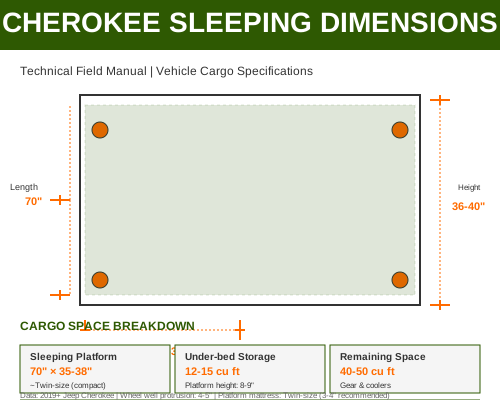
The Jeep Cherokee's cargo space presents a realistic canvas for camping configuration: 31.3 cubic feet with rear seats upright, expanding to 76.5 cubic feet with seats folded, creates approximately 71-72 inches of length from the rear liftgate to the rear seat area when seats are folded. The cargo width at the widest point (between wheel wells) measures approximately 40-42 inches, creating a notably narrower space compared to full-size SUVs but still accommodating realistic camping setups. Height clearance from the cargo floor to the ceiling (accounting for the sloped roof) measures approximately 36-40 inches depending on the measurement location, providing adequate space for sitting partially upright though not full standing height. The wheel wells protrude approximately 4-5 inches into the cargo area, creating angular constraints that affect bed platform design. Understanding these specifics is essential because they determine whether you can orient a sleeping platform lengthwise across the Cherokee or whether a sideways configuration works better. The actual usable sleeping surface (accounting for wheel wells and safe platform construction) is approximately 70 inches long by 35-38 inches wide—essentially a compact twin-size configuration, though some creative configurations achieve slightly larger sleeping areas. The Cherokee's relatively flat cargo floor (compared to many competitors with pronounced curves) makes platform building more feasible, and the modern interior finish is genuinely nice, creating an environment that feels more like a luxury camping cabin than a rough utility vehicle. The practical reality is that Cherokee cargo space comfortably accommodates a sleeping platform with underbed storage, creating a proper bed with approximately 15-20 cubic feet of accessible storage underneath. This configuration leaves approximately 40-50 cubic feet for additional camping gear, coolers, cooking equipment, and personal items—adequate for weekend trips but requiring deliberate organization for multi-week expeditions. The key consideration is recognizing the Cherokee's legitimate space constraints and planning configurations that respect them rather than forcing oversized systems into undersized spaces. Modular organization becomes critical in the Cherokee because every cubic foot matters, and loose packing or inefficient layouts quickly consume available capacity.
For those seeking a more compact option, consider the Jeep Renegade camping guide for versatile adventure setups.
Sleeping Configurations: Platform Design for Compact Cargo Areas and Comfortable Rest
Creating comfortable sleeping in a 70x35-inch cargo space requires different engineering than larger SUVs, with particular attention to the Cherokee's narrow width and the geometry constraints created by wheel wells. The most practical approach uses a platform that spans the vehicle's width at the cargo opening and extends lengthwise toward the rear liftgate, with the sleeping surface measuring approximately 35-38 inches wide by 68-70 inches long. A 2x4 lumber frame structure with 3/4-inch plywood flooring costs $200-350 in materials and can be completed in a weekend with basic carpentry skills. The platform height decision is critical for Cherokees: too high (over 10 inches) and your head clearance when lying down becomes uncomfortably cramped for anyone taller than average; too low and you lose the valuable underbed storage that makes up for the Cherokee's limited cargo space. Most experienced Cherokee campers settle on 8-9 inches of platform height, creating approximately 12-15 cubic feet of accessible underbed storage while maintaining reasonable ceiling clearance. The narrow width constraint (35-38 inches) means traditional queen mattresses won't fit, requiring instead a quality twin-size camping mattress or custom-fitted solution. A twin-size memory foam camping mattress (3-4 inches thick, $200-400) provides genuine comfort comparable to home beds, while a simpler 2-inch camping mattress topped with a sleeping pad creates acceptable comfort at lower cost ($150-250). Some Cherokee campers use inflatable air mattresses (lightweight and packable, $80-150) which offer flexibility but require nightly inflation and provide less comfortable sleeping surface for regular camping. The critical addition is quality bedding: sheets rated for outdoor camping, blankets that provide warmth without excessive bulk, and pillows that compress well dramatically improve the sleeping experience. Many campers find that adding a 1-2 inch memory foam topper on top of the base mattress ($80-150) achieves remarkable comfort in limited space. Ventilation around the sleeping platform becomes important despite the Cherokee's fully enclosed design: avoid sealing off air circulation underneath the platform by leaving strategic gaps or using breathable storage systems. Condensation in the Cherokee's enclosed cargo area can form on windows and surrounding surfaces, so ensuring air movement around sleeping surfaces (rather than enclosed storage boxes directly underneath) prevents moisture accumulation that promotes mildew. Removable sleeping bag systems (rather than permanent bedding) provide flexibility for different seasons and trip types—a 20-degree-rated bag works for most non-winter camping, while warmer bags or supplemental insulation layers handle seasonal variations.
To maximize your Jeep's potential for overnight adventures, explore the innovative sleeping setups in our Jeep Gladiator Camping Guide.
Everything you need for Jeep Cherokee car camping
Power Systems, Lighting Integration, and Electrical Management in the Cherokee
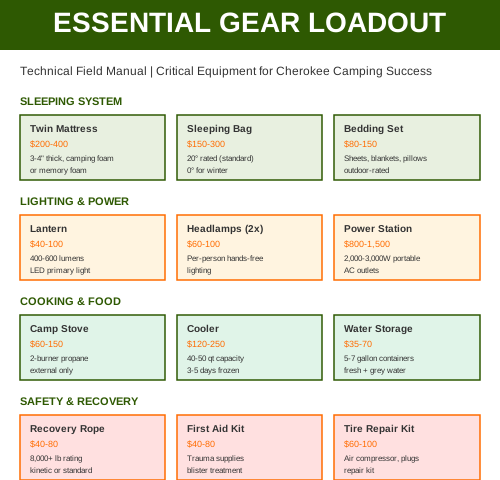
The Cherokee's factory electrical system includes two 12-volt power outlets (one in the cargo area, one in the cabin) that provide auxiliary power for small devices, but extended camping loads quickly exceed what the factory battery can sustain. The most practical approach for Cherokee camping uses an auxiliary battery system combined with a portable power station: a secondary 100-amp-hour AGM or lithium battery ($400-800) installed with a battery isolator ($200-300) in the engine compartment charges while you drive and provides dedicated power for camping loads without draining the main battery. This system costs $1,000-1,500 installed and provides substantial improvement in off-grid capability. A portable power station (2,000-3,000 watts, $800-1,500) positioned in the cargo area bridges between the auxiliary battery (providing 12V DC power) and household-style AC outlets for charging devices, running small appliances, or powering emergency equipment. The combination of auxiliary battery and portable power station enables 3-5 days of moderate camping use (LED lighting, small fridge operation, device charging) without external power sources. LED lighting integrated into the Cherokee's cargo area provides work light and creates ambient environment: flexible LED strips ($20-40) mounted under platform edges or storage areas provide subtle lighting without excessive power draw, while a portable lantern (400-600 lumens, $40-100) provides bright area lighting for evening activities. Headlamps for each camper ($30-50 per unit) enable hands-free lighting and become essential for nighttime activities outside the vehicle. The critical insight is planning for extended camping without daily recharging: if you're visiting established campgrounds with power hookups, the auxiliary battery system alone suffices; if you're planning extended off-grid trips, adding the portable power station and considering solar supplementation becomes important. Many Cherokee campers add a flexible 100-200 watt solar panel ($300-600) positioned on a roof rack or tonneau cover, connected through a charge controller ($150-250) to the portable power station. This system requires weatherproof wiring and professional installation ($300-500) but enables indefinite off-grid camping with adequate sunlight. The practical reality is that a $2,000-3,000 investment in auxiliary power (battery system plus portable power station) supports most typical camping scenarios, while adding solar ($500-1,000) extends capability to multi-week remote expeditions. Cable routing and weatherproof connections deserve attention because the Cherokee's modern interior doesn't tolerate jury-rigged electrical installations: proper conduit, marine-grade connectors, and professional routing prevent shorts, fires, and equipment damage.
Ventilation, Climate Control, and Moisture Management in Enclosed Cargo Space
Moisture accumulation represents the primary challenge in the Cherokee's enclosed cargo configuration: four people breathing, temperature differentials, and any interior cooking create a moisture-rich environment that can exceed the vehicle's natural ventilation capacity, leading to condensation on windows and mildew development on surfaces. The most effective solution is installing one or more roof vents designed for vehicle camping—options like Maxxair or Dometic roof fans (costs $300-600 installed) provide active ventilation that removes humid air from the cargo area. These roof vents draw substantial volume (4,000+ CFM capacity) and can operate on batteries or auxiliary power systems, maintaining air circulation even when parked. The placement of roof vents matters significantly: positioning a vent above or near the sleeping platform creates positive air circulation that draws fresh air in through cracked windows and exhausts stale air through the vent, effectively preventing moisture accumulation. Many Cherokee campers run a roof vent continuously while sleeping, consuming minimal power (20-30 watts) while providing enormous benefit to air quality and comfort. Beyond mechanical ventilation, practical moisture management requires source control: minimize cooking inside the vehicle, use established campground facilities for showers rather than improvised interior systems, and wipe down any wet gear before storing it in the cargo area. Window inserts designed for vehicle camping (typically custom-fitted pieces of reflective or insulating material) reduce cold surface area where moisture condenses while providing additional privacy and temperature regulation. The Cherokee's dual-zone climate control (available on higher trims) provides superior comfort compared to single-zone systems because you can maintain warm feet while keeping the head area cool, reducing the temperature differential that drives condensation. For winter camping (which presents unique challenges), supplemental heating becomes necessary: catalytic heaters (Mr. Buddy style, $40-80) provide 4,000-8,000 BTU of safe heat in enclosed spaces, though proper ventilation remains essential even with ventless heaters to prevent CO buildup. Running the heater for brief periods (30-60 minutes before sleep) reaches comfortable temperature, then reducing to minimal operation maintains warmth throughout the night. Window condensation in winter peaks in early morning but typically doesn't become problematic with proper heating and ventilation. The combination of roof vent, strategic window ventilation, proper heating for cold weather, and source control creates a genuinely comfortable environment even in challenging conditions. Real Cherokee campers report that with adequate ventilation, moisture becomes a solved problem rather than an inherent limitation.
Gear Organization and Storage: Maximizing Limited Cargo Space Through Strategic Planning
The Cherokee's 76.5 cubic feet of usable cargo space (with rear seats folded) requires thoughtful organization because every cubic foot represents precious real estate. The sleeping platform with underbed storage creates the organizational foundation: removable plastic storage bins on slides, compartmentalized drawer systems, or open shelving underneath utilize the 12-15 cubic feet of platform space for organized gear storage. Designating specific underbed zones—one section for sleeping-related items (extra blankets, pillows), another for tools and recovery equipment, a third for food and cooking supplies—enables quick location of items without unpacking everything. The remaining cargo space (40-50 cubic feet after platform installation) requires modular organization: a weatherproof cargo box designed to fit the Cherokee (typically 36-48 inches long, 24 inches wide) provides lockable storage for valuables or sensitive equipment while occupying a defined footprint. Hanging organizers mounted to the side walls keep frequently accessed items (headlamps, first aid kit, cooking utensils) within reach without consuming cargo floor space. Many successful Cherokee campers use a vertical storage approach: tall narrow storage bins stacked against one wall provide more organization than a single large container, improving accessibility and making efficient use of limited width. The weight distribution consideration becomes important in the Cherokee because of the vehicle's payload limit (4,500 pounds): heavier items should sit as low and central as possible, so auxiliary batteries, fuel containers, and gear clusters should occupy cargo floor or lower shelving areas. Lighter items (bedding, clothing) can occupy higher shelves or upper positions without creating handling problems. Accessibility is crucial: camping essentials used daily (bedding, cooking setup, lanterns, first aid kit) should be immediately reachable, while seasonal items or backup equipment can occupy less convenient positions. Many experienced Cherokee campers maintain a permanent gear box that lives in the vehicle year-round, containing core equipment always ready for spontaneous trips. This approach requires initially establishing what stays permanently versus what gets loaded for specific trips: cooking equipment, recovery gear, first aid supplies, and safety items typically stay permanent, while personal clothing and perishable food get packed per trip. Cable organization and storage of loose items create dramatic improvements in functionality: cable ties securing power cords, organized pouches for small items, and clear containers for related gear prevent the scattered feeling that emerges when loose items accumulate. Many campers use color-coded storage systems where specific gear categories live in specific colored bins, enabling quick identification even in low light. The weight management practice of actually weighing your fully loaded Cherokee on a public scale periodically (monthly for frequent campers) ensures you stay within the 4,500-pound payload limit and prevents overloading situations that cause tire failure or handling problems.
For those needing even more room, the Jeep Wagoneer camping guide offers insights on maximizing space in a larger SUV.
Cooking Setup and Meal Planning: External Kitchen Systems and Food Management
The Cherokee's enclosed cargo area makes interior cooking problematic from multiple angles: moisture and odor accumulation, fire risk when operating stoves in confined spaces, and the psychological discomfort of cooking where you're sleeping creates a suboptimal experience. The smart approach uses exclusively external cooking: a portable camp stove (either propane or canister fuel) positioned on a simple camp table outside the vehicle creates a complete kitchen that lives outside the Cherokee except during transport or severe weather. A basic two-burner propane camp stove ($60-150) mounted on a folding prep table ($40-80) provides complete cooking functionality without requiring inside-vehicle modifications or modifications. Fuel storage becomes important with external cooking: a single propane canister (typically 16 ounces) provides 3-4 hours of cooking time, so multi-week trips require multiple canisters or a refillable system. Many Cherokee campers pre-plan menus to minimize cooking time (one-pot meals, minimal preparation items) and reduce fuel needs accordingly. Water access for cooking and cleaning becomes critical: a 5-7 gallon fresh water container positioned accessibly in the cargo area (or on an external rack) provides water for drinking, cooking, and basic hygiene. Greywater management uses a separate collection container for used water, emptied at appropriate disposal areas or evaporated during the trip. For dishes and cleaning, biodegradable soap is essential for backcountry camping; many campers use disposable plates or minimal-wash strategies (pre-packaged foods, limited cooking) to reduce water consumption. Food storage in the Cherokee's enclosed cargo area benefits from cooler placement: a 40-50 quart cooler positioned in a lower cargo location keeps food accessible without obstructing workspace or sleeping area. Pre-freezing water bottles as ice replacements (rather than ice cubes) maintains cooler temperature longer. Refrigeration for extended trips beyond the cooler's viable range (3-5 days) becomes important: a portable electric cooler or small fridge powered by the auxiliary battery system ($300-800 including installation) maintains food safety for week-long trips. The weight of a fridge (30-50 pounds) fits within the Cherokee's payload capacity but should sit in a lower position for weight distribution. Meal strategy should emphasize simplicity and pre-preparation: cooking complete meals at home and simply reheating during trips reduces fuel consumption, simplifies camp cooking, and minimizes food waste. Many experienced Cherokee campers prep proteins, chop vegetables, and assemble meal components at home, then simply assemble during camping, dramatically reducing cooking time at camp. Kitchen organization in under-bed storage or dedicated storage containers keeps cooking equipment (stove, fuel, utensils, cookware) accessible without requiring unpacking of main storage. A dedicated cooking box containing all kitchen basics enables complete meal preparation while maintaining organization. The reality of Cherokee camping cooking is that external systems work best, simple meals work better than complex preparations, and pre-trip food preparation reduces camping workload considerably.
The Cherokee's Trail Rated designation carries genuine significance: the formal rating certifies the vehicle meets specific capability standards in articulation, ground clearance, water fording depth, and approach/departure angles. This engineering enables legitimate off-road access to remote camping locations that standard SUVs cannot reach, fundamentally changing what camping experiences become possible. The Cherokee's 26.5-degree approach angle, 32.2-degree departure angle, and 8.6 inches of ground clearance (with factory suspension) position it well for forest service roads, rough trail approaches, and creek crossings that transform camping from established-campground-only to genuine expedition capability. Integrating off-road capability into camping requires deliberate gear selection and preparation. Recovery equipment becomes essential: a quality recovery rope (8,000-12,000 pound minimum rating, $40-80), D-ring shackles ($20-40), and an anchor point for recovery ($200+ if requiring frame installation) occupy modest space but provide crucial capability if you get stuck in remote locations. Many Cherokee campers run dedicated recovery gear secured in underbed storage or mounted to the vehicle frame, checked before every trip for functionality. Tire selection matters significantly: all-terrain tires (like Goodyear Wrangler Trailrunner or BFGoodrich All-Terrain T/A) cost $600-900 for all four and provide dramatically better traction on rough roads, sand, and rocky surfaces compared to highway tires. The tire upgrade fundamentally changes what terrain is accessible to your camping rig. A spare tire mounted appropriately plus tire repair supplies (tire plugs, portable air compressor $40-60, puncture repair kit) complete the tire management system. Navigation equipment supports remote access: detailed topographic maps and a GPS unit ($200-400 combined) or smartphone GPS with offline mapping prevent getting lost on rough forest roads. Many experienced campers carry redundant navigation (maps and GPS) ensuring capability even if electronics fail. Communication equipment gains importance in remote camping: a satellite messenger device (like Garmin inReach, $200-400 plus monthly service) or personal locator beacon provides emergency communication where cell service fails, potentially lifesaving in genuine wilderness situations. Approach to remote camps requires different mindset than established campground camping: arriving before dark becomes critical, understanding seasonal road conditions is essential, and having backup camp locations in case the primary site is inaccessible adds resilience. The psychological satisfaction of accessing remote locations—setting up camp where few people venture, hiking pristine backcountry, experiencing genuine wilderness—represents the genuine value proposition of Cherokee ownership combined with proper preparation. Your gear configuration should support this ambition while maintaining safety and comfort at the actual campsite.
Real-World Camping Scenarios: Weekend Escapes, Extended Expeditions, and Seasonal Planning
The Cherokee's moderate cargo space enables success across different camping styles, though each requires specific configuration adjustments. A weekend escape (Friday evening through Sunday morning) represents the simplest scenario: sleeping platform with quality mattress, basic lighting, external cooking setup, cooler with food, and water storage occupy the cargo area completely, leaving minimal space for personal gear (which fits in the Cherokee's cabin). This minimal setup costs almost nothing if you already have the core sleeping system and highlights the Cherokee's advantage—even with limited space, you can execute comfortable weekend camping. Many Cherokee owners take spontaneous weekend trips with just a sleeping bag, cooler, and camp stove, leveraging the vehicle's low barrier to entry. Extended trips (one to two weeks) require deliberate planning because the Cherokee's modest cargo space constrains what you can carry. The sleeping platform stays permanent, but gear selection becomes critical: choosing essential-only items, limiting clothing changes, and pre-prepping meals dramatically improves what's feasible within space constraints. Recovery gear, navigation tools, and communication equipment move from optional to essential because you're potentially operating remote where self-sufficiency becomes important. Food and water storage plans shift from casual cooler management to systematic organization with planned refill locations. Weather protection becomes important: backup tarps, supplemental covers, and ready-access emergency supplies ensure adaptability to unexpected conditions. Multi-week expeditions (three weeks or longer) often shift the Cherokee's role from primary sleeping vehicle to basecamp with auxiliary structures: many experienced campers establish a Cherokee-based camp, then set up a tent nearby or use the Cherokee primarily for storage and kitchen operations, with sleeping in tents or under stars. This configuration reduces pressure on the Cherokee's compact sleeping space and improves morale on extended trips through psychological variety. Seasonal variations dramatically affect Cherokee camping strategy: summer camping typically embraces open windows and natural ventilation completely, with emphasis on shade management (canvas exterior shade structures, strategic parking positioning) and cooling strategies (elevation selection, nighttime operation of roof vents). Spring and fall camping often uses windows cracked slightly for ventilation, with flexible weather adaptation as temperatures fluctuate. Winter camping in a Cherokee is possible but requires serious preparation: the enclosed cargo area provides better insulation than open truck beds, but factory climate control isn't designed for all-night heating while parked, so supplemental heating (catalytic heaters) becomes essential. Cold-rated sleeping bags (0-20 degree range) are non-negotiable for winter camping. Winter camping works best in regions with mild winters and dry conditions; extended winter camping in areas with significant snow requires either migrating to enclosed shelters or upgrading to full RV infrastructure. Real Cherokee campers frequently modify their annual rhythm around seasonal variations: planning winter trips to milder regions, spring and fall expeditions to mountain regions, and summer trips to anywhere with elevation advantage for temperature moderation. This approach leverages the Cherokee's capability while aligning with realistic comfort parameters. The key insight is that successful Cherokee camping requires conscious seasonal planning and acknowledging the vehicle's modest cargo space as a constraint that shapes trip duration and scope, not as a reason to abandon camping ambitions.
To enhance your camping experience, consider our tips on car camping essentials that fit any budget.
Essential Gear, Product Recommendations, and Proven Equipment for Cherokee Camping Success
Building the complete Cherokee camping system requires deliberate gear selection that respects the vehicle's 4,500-pound payload capacity while ensuring you have everything necessary for successful trips. Starting with core camping equipment: a quality sleeping bag rated for your target temperature range ($150-300), a sleeping pad appropriate for the Cherokee's platform or elevated surface ($80-150), and bedding specific to camping (sheets, blankets, pillows rated for outdoor use, $80-150 total) create the foundation. The sleeping bag rating deserves careful attention: a 20-degree-rated bag works for most non-winter camping, while 0-degree bags are necessary for winter expeditions. The mattress selection (discussed in sleeping section) should prioritize comfort and water resistance, as the Cherokee's enclosed environment means condensation risk differs from exposed truck beds. Lighting equipment includes a primary lantern (400-600 lumens, $40-100), multiple headlamps for each person ($30-50 per headlamp), and backup lighting options like pen lights or emergency flashlights ($15-30). LED strip lighting integrated into underbed storage areas ($20-50) dramatically improves nighttime functionality without excessive power draw. Ventilation systems (roof vent, $300-600 installed) and portable battery-powered fans ($20-40) manage moisture and temperature. Temperature regulation items include supplemental heating (catalytic heater, $40-80) for cold nights and cooling strategies (strategic parking, shade structures, elevation selection) for warm weather. A quality cooler (40-50 quart, $120-250) keeps food fresh, with pre-frozen water bottles extending cooling capacity. First aid supplies should be comprehensive: a proper first aid kit ($40-80) with trauma supplies, pain management, and blister treatments. Navigation equipment (topographic maps and GPS unit, $200-400 combined) supports remote access. Recovery equipment includes recovery rope (8,000+ pounds rating, $40-80), shackles ($20-40), tire repair supplies ($60-100), and basic tools ($100-200). Cooking supplies include a two-burner stove, fuel canisters, quality cookware (titanium or aluminum for light weight), utensils, and organized utensil storage. Water storage requires a 5-7 gallon fresh water container ($20-40) and greywater collection ($15-30). Communication equipment (satellite messenger, $200-400 plus service) provides emergency communication where cell fails. Personal items include layers for temperature adaptation, waterproof rain gear, and sturdy footwear for rough terrain. Many Cherokee campers maintain a permanent gear box living in the vehicle year-round, keeping core equipment always ready for spontaneous trips, which encourages adventure by removing setup barriers.
If you're considering other vehicles for your camping adventures, the Chevrolet Colorado camping guide offers valuable insights.
🏅 Looking for Gear Recommendations?
Check out our tested gear guides for products that work with this setup:
Experienced car camper and automotive enthusiast sharing practical advice.
Frequently Asked Questions
Can you sleep comfortably in a Jeep Cherokee without adding gear storage modifications?
Yes, but with significant limitations. The cargo floor is hard and uncomfortable after a few hours, making even short naps unpleasant. The Cherokee's 70-inch length and 40-inch width creates tight dimensions, requiring careful mattress selection. Most experienced Cherokee campers invest in at minimum a twin-size sleeping pad or camping mattress ($150-300) and basic flooring protection ($100-150 in materials). Adding quality bedding and a sleeping bag-rated for your season transforms the experience from barely tolerable to genuinely comfortable. The investment of $400-600 is considered essential rather than optional by experienced campers.
How much does installing an auxiliary battery system cost for a Cherokee?
A quality dual-battery setup costs $1,000-1,500 installed, including the secondary 100-amp-hour battery ($400-800), battery isolator ($200-300), and professional installation labor. Adding a portable power station ($800-1,500) provides AC outlets and extends capability significantly. The complete system ($2,000-3,000) supports 3-5 days of moderate use (lighting, device charging, small fridge operation) without external power. DIY installation is possible for mechanically skilled individuals, reducing cost to parts only ($800-1,200), though professional installation ensures reliability and warranty protection. The investment is worthwhile for extended off-grid camping.
Is the Cherokee's climate control system adequate for camping comfort?
The factory climate control system (available on higher trims) works well for comfort while the vehicle is running and the engine is on, but it's not designed for all-night operation while parked. Running the climate system overnight dramatically drains the battery unless you have an auxiliary battery system. Most Cherokee campers run the climate system for an hour before sleep to reach comfortable temperature, then rely on sleeping insulation and supplemental heating (like a catalytic heater) for the night. The dual-zone system (available on some models) provides superior comfort by maintaining different zones independently.
How much weight can you carry camping gear in a Cherokee without overload issues?
The Cherokee's 4,500-pound payload capacity limits total weight of passengers, fuel, and gear. A typical camping setup (platform, mattress, water, food, cooking, recovery gear) weighs 400-550 pounds, leaving about 3,500-3,950 pounds for passenger weight. Two people plus a full camping setup stays well within limits for most scenarios. The safe practice is weighing your fully loaded Cherokee on a public scale periodically to ensure you're staying within limits, as payload overload causes tire failure and handling problems. Monitor actual weights rather than estimating.
What's the maximum duration you can camp in a Cherokee without external power?
With just the factory battery and standard 12V outlets, realistically 6-8 hours of moderate use before risking battery drain. An auxiliary battery system extends this to 2-3 nights of moderate use (lighting, device charging). Adding a portable power station and solar panels extends capability to 5-7 days comfortably for most camping loads. The practical sweet spot for Cherokee camping is a dual-battery system supporting 3-4 days without external charging, sufficient for typical weekend and extended-weekend trips.
Will moisture and condensation be problematic in the Cherokee's enclosed cargo area?
Yes, moisture accumulation becomes problematic without mitigation because you're creating a moisture-rich environment (breathing, cooking, showers) in a sealed space. However, a roof vent running while sleeping essentially eliminates the problem by moving humid air outside. Window inserts and careful source control (wiping down wet gear, external cooking) reduce condensation further. Real Cherokee campers report that with a functioning roof vent, condensation becomes a non-issue even in damp climates, making this a solved problem rather than an inherent limitation.
Can you tow a small trailer with your Cherokee while camping?
Yes, the Cherokee's 3,500-pound towing capacity allows towing small utility trailers or boat trailers. The key consideration is total weight: the combined weight of passengers plus interior cargo plus trailer tongue weight shouldn't exceed the 4,500-pound payload limit. For most camping scenarios with reasonable trailer selection, this isn't a constraint. Towing extends your practical capacity considerably for multi-week off-grid trips by allowing dedicated water, fuel, or equipment trailers. Calculate actual weights to ensure you stay within limits.
What tires are best for Cherokee off-road camping access?
All-terrain tires (like Goodyear Wrangler Trailrunner or BFGoodrich All-Terrain T/A) cost $600-900 for all four and provide dramatically better traction on rough roads, sand, and rocks compared to highway tires. Mud-terrain tires provide superior grip in really difficult conditions but increase road noise and reduce fuel economy more substantially. For general off-road forest service road access to remote camps, all-terrain tires provide excellent capability with acceptable highway performance. Spare tire and tire repair supplies ($60-100) complete the setup.
Is it safe to camp in remote locations with a Cherokee?
Safety depends entirely on preparation and realistic assessment of your capabilities. The Cherokee's Trail Rated capability enables legitimate off-road access, but access without proper recovery equipment, communication systems, and navigation tools is genuinely risky. Essential safety elements include: proper tire preparation, recovery equipment (rope and shackles), satellite communication or personal locator beacon, navigation tools (maps and GPS), comprehensive first aid kit, vehicle maintenance knowledge, and realistic trip planning (arriving before dark, backup locations). With these systems in place, remote camping becomes manageable adventure rather than reckless risk.
What sleeping surface works best in the Cherokee's compact cargo area?
A quality twin-size camping mattress (3-4 inches thick, $200-400) fits the Cherokee's 40-inch width perfectly and provides comfort comparable to home beds. Alternative approaches include inflatable air mattresses (lightweight but less comfortable, $80-150) or closed-cell foam pads (durable but less luxurious, $40-100). Temperature rating matters because summer comfort differs from cold-weather sleeping. Adding a sleeping bag rated for your climate and a 1-2 inch memory foam topper creates remarkable comfort in limited space. The mattress should have a removable, washable cover to manage spills.
How do you handle cooking safely in the Cherokee?
The safest approach is exclusively external cooking: position a two-burner camp stove on a folding prep table outside and away from the vehicle, preventing fire risk and cooking residue from spreading to sleeping areas. Keep water accessible for fire suppression, maintain 10 feet of clearance, and never leave cooking unattended. If interior cooking becomes necessary in extreme weather, use only single-burner stoves rated for enclosed spaces and maintain exceptional ventilation. Most experienced Cherokee campers never cook inside because external cooking is safer, cleaner, and more comfortable.
What recovery equipment is essential for Trail Rated Cherokee off-road camping?
Minimum essential equipment includes: a kinetic or recovery rope rated for 8,000+ pounds ($40-80), D-ring shackles ($20-40), a defined anchor point (either frame-mounted recovery points or proper anchor system, $200+ if installing), and traction aids like sand ladders ($150-300). A portable air compressor ($40-80) and tire repair kit ($40-80) enable self-rescue from low-traction situations. Organization and regular inspection of recovery equipment is critical—equipment that's corroded or incorrectly stored won't function when needed. The investment ensures genuine off-road self-sufficiency.
A
Auto Roamer
Experienced car camper and automotive enthusiast sharing practical advice and tested gear recommendations.