
Why Your Fist Will Not Break a Car Window
In a real emergency - a crash that jams the doors, a fire, or a car going into water - the instinct is to punch, kick, or shoulder the window until it gives. It almost never gives. The side windows of a car are usually tempered glass, and tempered glass is engineered to resist exactly the kind of broad, blunt force a fist or elbow delivers. People hit it again and again, hurt their hands, and lose the seconds that matter most.
The good news is that the same property that makes tempered glass shrug off a punch also makes it shatter almost instantly when you hit it the right way: with a small, hard point at the corner. A cheap spring-loaded window punch does this with a flick, no big swing required, which is why first responders and survival researchers keep coming back to it. The technique is simple once you know it - but it depends entirely on one thing most drivers have never checked: what kind of glass their car actually has.
That is the catch this guide leads with, because it can be the difference between an exit and a trap. A rising number of new cars use laminated side glass that an escape tool cannot break at all - the same glass your windshield is made of. This article covers how tempered glass breaks and the tool that does it, exactly where to strike, how to tell tempered from laminated before you ever need to, what to do when the glass will not break, and the step-by-step protocol for getting out of a sinking car while the clock is running. If you would rather compare specific devices, our car escape tool guide ranks them; this page is about the method.
Know Your Glass First: Tempered vs. Laminated
Before any technique matters, you have to know which of two very different kinds of glass you are facing, because one breaks easily with the right tool and the other does not break at all. This single fact decides whether your escape plan works, and most drivers have never checked it.
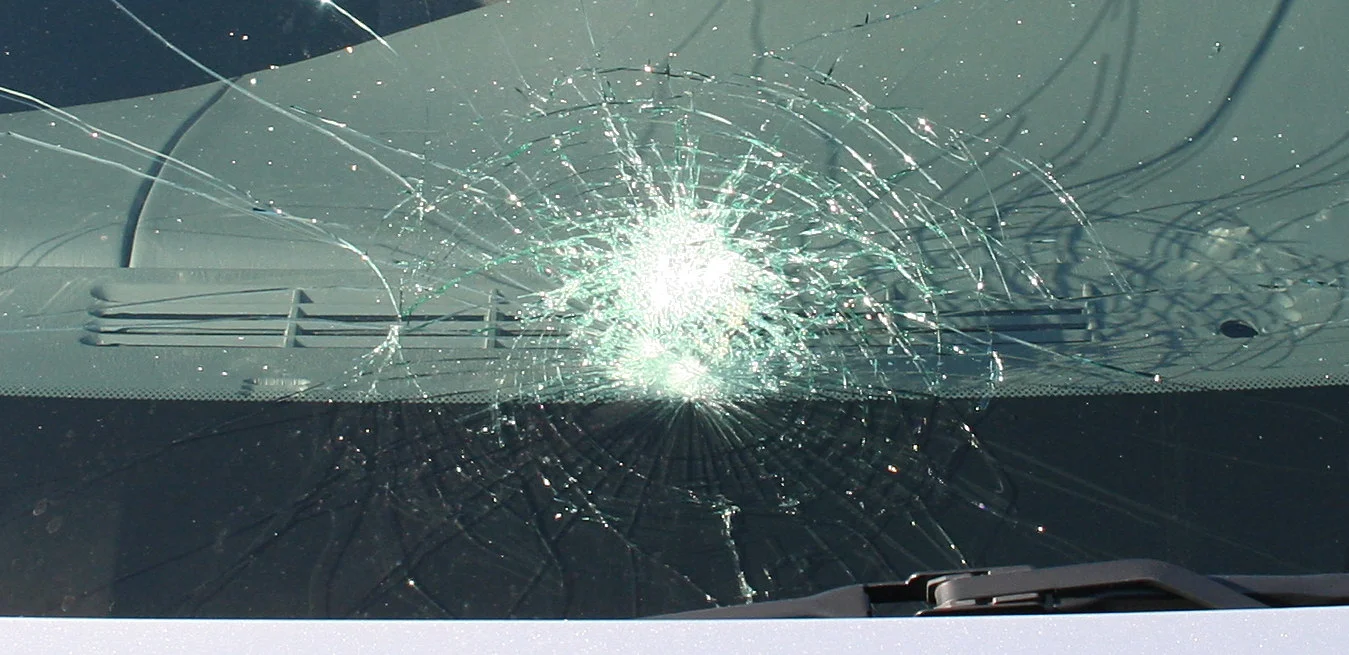
Tempered glass is heat-treated so the surface is squeezed in compression while the inside is held in tension. That locked-in stress is a loaded spring: breach the surface at one tiny point and the whole pane releases at once, collapsing into small, relatively blunt cubes. Side and rear windows have traditionally been tempered for exactly this reason - in a crash they crumble rather than forming large blades. This is the glass an escape tool is designed to defeat.
Laminated glass is two thin sheets of glass bonded to a tough plastic (PVB) interlayer, like a sandwich. Strike it and the glass may crack, but the plastic holds every piece in place - it does not fall out of the frame. Your windshield is laminated by law, which is why it never showers you in a collision. The problem for escape is that carmakers have increasingly moved laminated glass to the front side windows too, for a quieter cabin and to reduce the chance of occupants being thrown out in a wreck. AAA found that about one in three 2018 model-year vehicles already used laminated front side glass, and that share has only grown since.
Why this matters before an emergency: a glass-breaking tool that works perfectly on a tempered rear window can be useless on a laminated front one in the same car. Many vehicles mix the two - laminated up front, tempered in back. Knowing your car's layout in advance tells you which window to aim for when there is no time to experiment, and it is the reason every reputable escape tool now ships with the same warning: it will not break laminated glass.
How to Check What Glass Your Car Has
You can settle this in your driveway in two minutes, and it is worth doing for every window you might need as an exit. Roll a window partway down and look at the bottom corner of the glass. There is a small etched or printed label there - the same panel that lists the manufacturer and safety markings - and it will tell you the type.
Look for the words themselves: many windows simply read 'Tempered' or 'Laminated.' If yours uses the American safety codes instead, AS2 or AS3 generally indicates tempered glass, while AS1 indicates laminated glass (AS1 is the windshield code, so seeing AS1 on a side window is the tell that it is laminated). When the label is faded or you are unsure, your owner's manual, the automaker's customer line, or a quick search of your exact year and model will confirm it.
Check each side window separately, because cars commonly mix glass types - laminated front doors and tempered rear doors is a frequent combination. The practical takeaway is to identify, today, which window in your car is breakable tempered glass and treat that as your designated escape route. If every side window in your vehicle turns out to be laminated, that is vital to know now, not in the water, because your escape plan has to change completely - covered later in this guide. Once you know your glass, the breaking technique itself is quick to learn.
The Tool That Works: A Spring-Loaded Window Punch
The reason a fist fails and a small gadget succeeds comes down to how force is delivered. A punch or a flat hammer spreads its energy over a wide area, and tempered glass is built to absorb exactly that. To set off the shatter you need to concentrate force onto a single hard point - and that is precisely what a spring-loaded window punch does.
Inside the tool, a spring is compressed and then released to drive a hard carbide tip into the glass with a sharp, focused strike. You press the tip against the window and the mechanism fires automatically; there is no winding up, no big swing, and almost no force from your arm required. That matters enormously in a car, where you are belted, cramped, possibly upside down or underwater, and have no room to throw a real blow. The punch turns a near-impossible task into a one-handed press. The same carbide-tip mechanism is built into most combination car escape tools, usually alongside a seatbelt cutter for the other thing that traps people.
AAA's published escape-tool testing backs this up. When researchers tried six devices, the spring-loaded punch-style tools broke tempered side windows more reliably than hammer-style breakers - and they noted that a hammer is far harder to swing usefully underwater, where there is water resistance and no leverage. A keychain-sized spring punch needs none of that. The one limit, again, is glass type: even the best punch does nothing to laminated glass, which cracks but will not let go.
Where to Strike: Aim for a Corner, Not the Center
Once you have the right tool, placement does the rest of the work. The center of a tempered pane is the strongest part and the springiest - it can flex and absorb a hit. The edges and corners are where the locked-in stress is most concentrated and the glass is most eager to release. So aim your punch or the carbide tip at a corner of the side window, an inch or two in from the frame, rather than smacking the middle.
With a spring-loaded punch the motion is almost gentle: brace the window if you can, press the tip firmly into the corner, and let the mechanism fire. The pane will typically craze into a sheet of small cubes in an instant. If the first strike does not go, move to a different corner and try again - you are not relying on power, so a missed spot is more likely than a too-weak hit. If you are using a pointed manual tool or an improvised hard point, the same rule holds: corners over center, sharp point over flat face.
Keep your face turned away as it breaks, and once the glass crazes, push the sheet out and away rather than pulling it toward you. Aim for the largest side window you can reach so the opening is big enough to climb through - and never the windshield, which is laminated and will not clear. The corner-strike technique is the entire skill; the rest is knowing when your particular window simply will not cooperate.
When You Have No Tool: Headrests and Improvised Options
If you have no escape tool - and most people do not, when it counts - your options narrow, and it is worth being honest about how well they work. The best-known trick is the headrest method: on many cars the front headrest can be pulled all the way up and lifted out of its seat, exposing two stout steel posts. Those posts can be wedged into the gap between the top of a lowered window and the door frame and used as a prying lever, or, with effort, jabbed at a corner of the glass as a hard point.
Treat this as a genuine last resort, not a plan. Not every headrest removes - many modern seats lock them in or have no posts to expose - and even when it works, prying or jabbing through tempered glass in a panic is awkward and slow compared with a tool that fires in a fraction of a second. Crucially, the headrest does nothing against laminated glass either; against a laminated side window there is no improvised tool in the cabin that will get you out through that pane.
Other improvised hard points - the metal tang of a seatbelt buckle swung on its webbing, a steering-wheel lock, or any small, dense, pointed object you can grip - work on the same principle as a punch: concentrate force on a corner. They are unreliable and a poor substitute for the real thing. The honest conclusion is that a five-to-fifteen-dollar spring punch kept within reach is worth far more than any trick, which is why keeping one in the car at all is the single highest-value step here. If you are building out broader preparedness, fold it into your car emergency kit so it is always on board.
Escaping a Sinking Car: Seatbelts, Windows, Out
A car going into water is the scenario where breaking a window is most likely to save a life, and where panic does the most damage. Survival researcher Gordon Giesbrecht, whose Operation ALIVE studied exactly this, distilled the entire response into four words that are worth memorizing: Seatbelts, Windows, Out - and, when passengers are aboard, children first.
The sequence matters because of the clock. Seatbelts come off immediately - you can do nothing while strapped in, and people waste precious seconds fumbling for a buckle that should already be undone. Windows are next: open one any way you can, right now. Power windows typically keep working for the first 30 to 60 seconds after the car hits the water, before the electrical system shorts out, so the fastest exit is simply to press the switch the instant you land. If the window will not go down, that is when you break it - corner of a tempered side window, spring-loaded punch, exactly as above. Out is the last step: go through the window and swim up, helping the oldest child out first so they can assist from outside while you free the younger ones.
One instinct to override completely: do not spend those first seconds shoving on a door. While the cabin is still mostly dry, the water outside presses the doors shut with far more force than you can overcome, and they generally will not open until the car has flooded and the pressure equalizes - which can take longer than you have. The window is the reliable exit. A spring-loaded punch is ideal here precisely because it needs no room to swing and works underwater, but it still cannot defeat laminated side glass - the final, decisive reason to know your glass type before you ever need this. If your fronts are laminated, your plan in the water is to get a window down electrically in the first seconds, or to reach a tempered rear window.
When the Glass Won't Break: Laminated Side Windows
If you have checked your car and found laminated side glass - or you are striking a window and it cracks but stubbornly refuses to clear - you need a different plan, because no handheld punch will get you through that pane. Laminated glass is doing exactly what it was designed to do: hold together. AAA's testing and independent VERIFY checks both confirm that escape tools simply do not break it.
Your first move is to find a window that is tempered. Because cars so often mix glass, the rear side windows may be breakable even when the fronts are not, so redirect to a back window if you can reach one. The rear hatch or tailgate glass on many SUVs and wagons is also tempered and can be an exit. This is, again, why identifying every window's type ahead of time pays off - in the moment you go straight to the pane that works instead of wasting strikes on one that never will.
If every side window is laminated and you are not in water, the doors are still your best option: as long as the car is not submerged, work each door - including the rears - and check whether power locks or a child-lock have simply jammed a single exit rather than all of them. In a fire or a wreck, sometimes another occupant's door, the trunk pass-through from folding rear seats, or simply more force on a stuck-but-not-locked door is the way out. The hard truth is that an all-laminated car removes the break-the-window option, which makes getting a window down in the first seconds, and keeping doors operable, that much more important. For broader breakdown and stranded-vehicle situations, our guide on what to do when your car breaks down with no cell service covers staying safe while you wait for help.
After the Glass Breaks: Get Out Safely
Breaking the window is the hard part, but the seconds right after it deserve a plan too, because broken glass and a narrow opening cause their own injuries. Tempered fragments are small and comparatively blunt - that is the whole point of tempering - but thousands of cube edges can still nick skin, especially on hands and forearms as you push through.
First, clear the frame. Knock or sweep the loose glass clinging to the bottom and sides of the window out of the way before you climb, so you are not dragging across a row of shards. If you have a jacket, sleeve, floor mat, or bag, lay it over the bottom edge of the frame to protect the skin that will bear your weight on the way out. Lead with your head and shoulders through the largest opening you can make, and keep moving - in a fire or a flood, speed beats caution about a few cuts.
If you are helping others, get yourself to stable ground or to the surface first when you can, then assist from a position of leverage rather than trying to push everyone out from inside a tilting or sinking cabin. With children, the established advice is oldest first so an able child can then help from outside while you free the younger ones and anyone restrained. Once everyone is clear, move well away from the vehicle - away from traffic on a roadway, or toward the nearest shore in the water - before you stop to check injuries and call for help.
Keep the Tool Where You Can Actually Reach It
Everything above is useless if the tool is in the trunk when the car is in the water. An escape tool only counts if you can put your hand on it in the 30-to-60-second window that decides the outcome, which means its location is as important as owning it at all. The glovebox is a common and poor choice: in a hard crash it can jam shut or its contents can scatter, and reaching across the cabin underwater is slower than you think.
Mount or clip the tool within arm's reach of the driver's seated position. A spring-loaded punch on the keychain travels everywhere with you. A combination tool clipped to an air vent, attached to the visor, or seated in a center-console holster stays put and stays reachable belted in. If more than one person regularly drives the car, or you carry passengers who might need to act, consider a second tool for the rear. The goal is that anyone in the vehicle can reach a breaker without unbuckling.
Finally, make it real before you need it. Read the instructions so you know whether your punch fires on contact or needs a press, confirm it is the spring-loaded type rather than a flimsy hammer, and physically check your glass labels so you already know which window is your exit. A tool you have never handled, mounted somewhere you cannot reach, on a car whose glass you have never checked, is a false sense of safety. Five minutes of preparation converts it into a real one. It belongs alongside the rest of your roadside emergency kit, the gear you hope to never open.
The Bottom Line: Right Tool, Right Glass, Right Corner
Breaking a car window to escape is not about strength - it is about overcoming a piece of engineering with the small, sharp, concentrated force it was never built to resist. Your fist spreads force and fails; a spring-loaded window punch focuses it onto a carbide tip and shatters tempered glass in an instant, no swing required. Aim for a corner, not the center, where the stored stress wants to let go, and turn your face away as it crazes.
But the technique only works on the right glass. Side and rear windows have long been breakable tempered glass, yet a growing share of new cars use laminated side windows that no handheld tool can clear - the same glass as your windshield. Check the label in the bottom corner of each window now, learn which pane is your exit, and remember that many cars mix the two. If your fronts are laminated, your real escape plan is a window lowered in the first seconds and doors kept operable, not a punch.
And if the car is going into water, let four words run the show: seatbelts off, a window open or broken, out - children first - and never waste those seconds fighting a door the water is holding shut. Keep a spring-loaded breaker, ideally with a seatbelt cutter, within arm's reach and know how it works. The whole point of this knowledge is that you will have it before the moment arrives, because in the moment there is no time to learn it.