
How Dashcam Sensor Technology Works in Low Light (2026 Complete Guide)
The dealer wanted $300 to install a new dashcam, claiming 'advanced night vision' was some black magic. Turns out, the 'magic' is a Sony STARVIS 2 sensor and a decent lens, which you can get for $120 yourself. My old dashcam was useless after sundown, just a blurry mess of light smears.
The dealer wanted $300 to install a new dashcam, claiming 'advanced night vision' was some black magic. Turns out, the 'magic' is a Sony STARVIS 2 sensor and a decent lens, which you can get for $120 yourself. My old dashcam was useless after sundown, just a blurry mess of light smears. Forget license plates; I couldn't even tell if it was a car or a drunk squirrel.The Ultimate Dash Cam Buying Guide 2026.
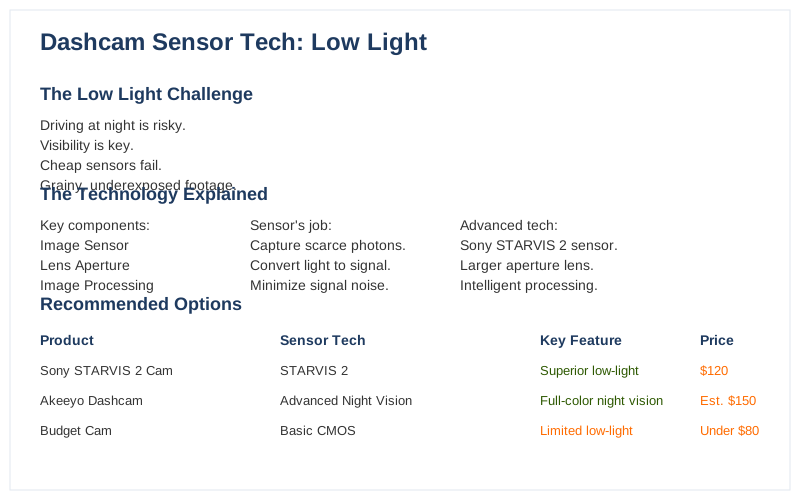
Driving at night is a different beast. Only 25-30% of miles are driven after dark, but those account for 50% of road fatalities. That's not a coincidence; it's a visibility problem. Your eyes suck in low light, and so do cheap camera sensors. You need a dashcam that doesn't just record; it has to see.
Most dashcams are glorified potato cameras once the sun drops below 50 lux. They rely on cheap CMOS sensors that just can't grab enough photons. The result is grainy, underexposed garbage. What's the point of footage if you can't read a license plate from 3 meters? It's just digital noise.
Good low-light performance isn't about marketing hype; it's about physics. It's about the sensor's ability to convert scarce light into an electrical signal, then process that signal without introducing a ton of noise. It's an electron game, and most budget cams are losing.
I've seen dashcams that use infrared LEDs to 'illuminate' the scene. Great, now your footage looks like a black-and-white ghost movie. Useful for seeing if someone's lurking, but utterly useless for identifying vehicle color or specific details. Full-color night vision is the goal.Night Vision in Dashcams.
The critical components are the image sensor, the lens aperture, and the image processing software. Skimp on any of these, and your 'night vision' becomes 'night blur'. Don't fall for the '1080p' marketing if the sensor itself is garbage. Resolution numbers mean nothing without light sensitivity.
Understanding how dashcam sensor technology works in low light
Night vision in dashcams isn't about magic; it's about specialized hardware and clever signal processing. The core component is the image sensor itself. Forget your old smartphone camera; we're talking about sensors engineered for photon starvation.What Should You Look for in a Dash Cam for Nighttime Protection?. Take Sony's STARVIS 2 IMX678 sensor, for example. It's specifically designed for low-light imaging. This isn't just a marketing name; it's a technical specification. The sensor has larger photosites, which are the individual light-gathering elements. Larger photosites mean more photons captured per pixel, resulting in a stronger signal. More light sensitivity means the sensor can operate with less digital gain. Digital gain is like cranking up the volume on a bad radio signal - you get more sound, but also more static. For an image sensor, more digital gain means more noise, which manifests as graininess and loss of detail. A good sensor avoids this.Night Vision Dash Cam Explained. Beyond the sensor, the lens plays a crucial role. A wide aperture, denoted by a low f-number (e.g., f/1.8), allows more light to reach the sensor. It's like having a bigger window. A narrow aperture starves the sensor, making it work harder and increasing noise. Then there's Wide Dynamic Range (WDR) or High Dynamic Range (HDR). These aren't just buzzwords. WDR works by taking multiple exposures - one bright, one dark - and combining them. This prevents blown-out highlights from oncoming headlights and crushed shadows in dark areas. It balances the extremes, providing usable detail across the entire scene. Without WDR, a car's headlights would just be a blinding white blob, obscuring the license plate. The camera's digital signal processor (DSP) then stitches these exposures together, creating a balanced image. It's a computational trick, but a necessary one for usable night footage. Finally, the image processing algorithms in the dashcam's firmware clean up the signal. They reduce noise, sharpen edges, and correct for lens distortions. A cheap dashcam might have a decent sensor but terrible processing, making the footage look smeared or overly processed. It's all about the total package.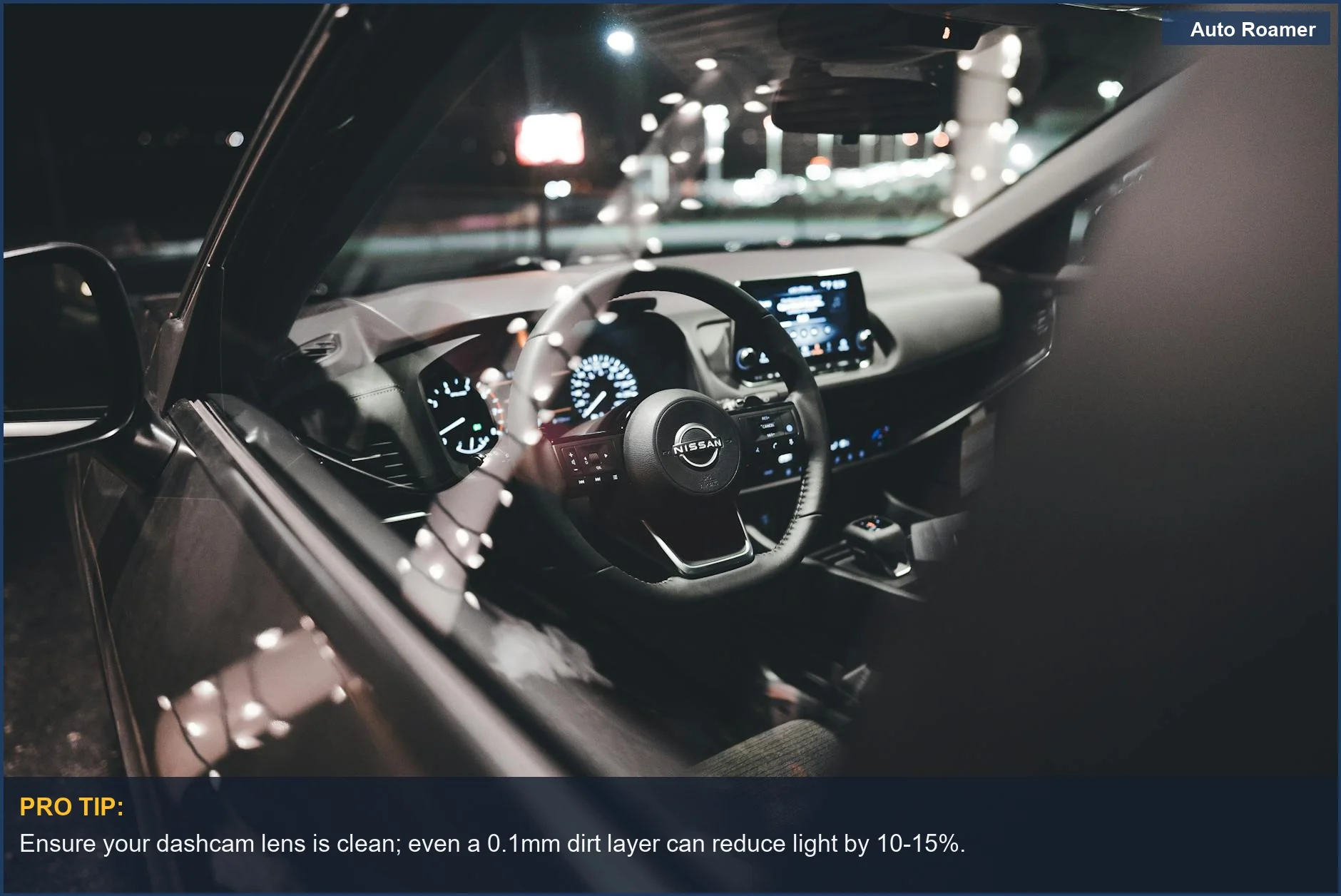
how dashcam sensor technology works in low light in Detail
First, the photons hit the lens. A good lens has a large aperture, like f/1.8, to gather as many light particles as possible. This is mechanical; the glass elements physically funnel light. My cheap dashcam had an f/2.4 lens, which is 60% less light than f/1.8. You can't cheat physics.Night Vision Dash Cams: Enhance Your Driving Experience. Next, the light reaches the image sensor. This is where the magic of Sony STARVIS or STARVIS 2 comes in. These sensors have a back-illuminated structure. Instead of having circuitry on top blocking light, the photosites are on the surface, directly exposed to photons. This significantly increases quantum efficiency - more light converts to electrical signal.Low light advice - DashCamTalk. Each photosite converts photons into electrons. The more photons, the more electrons. In low light, very few photons hit each site. The sensor needs to amplify this tiny electrical signal. This amplification is called gain. Too much gain, and you amplify the inherent electronic noise along with the signal. STARVIS sensors are designed to have lower read noise. This means the noise floor - the inherent electronic static - is much lower. When you amplify a weak signal, if the noise floor is low, the signal-to-noise ratio remains high. This is critical for clean images. After amplification, the analog signal is converted to digital data by an Analog-to-Digital Converter (ADC). The bit depth of the ADC matters here. A 12-bit ADC captures more grayscale levels than an 8-bit, allowing for finer detail in shadows and highlights. More data, more information. The digital data then goes to the Image Signal Processor (ISP). This chip applies algorithms for noise reduction, sharpening, and color correction. Good ISPs use advanced temporal noise reduction, comparing frames over time to distinguish actual image data from random noise. Bad ISPs just smear everything. Finally, WDR/HDR processing combines multiple exposures. The ISP takes the underexposed (bright) parts from one capture and overexposed (dark) parts from another, merging them into a single, balanced image. This prevents headlights from blowing out to pure white and dark areas from becoming absolute black. It's how you see both the street sign and the dimly lit bush.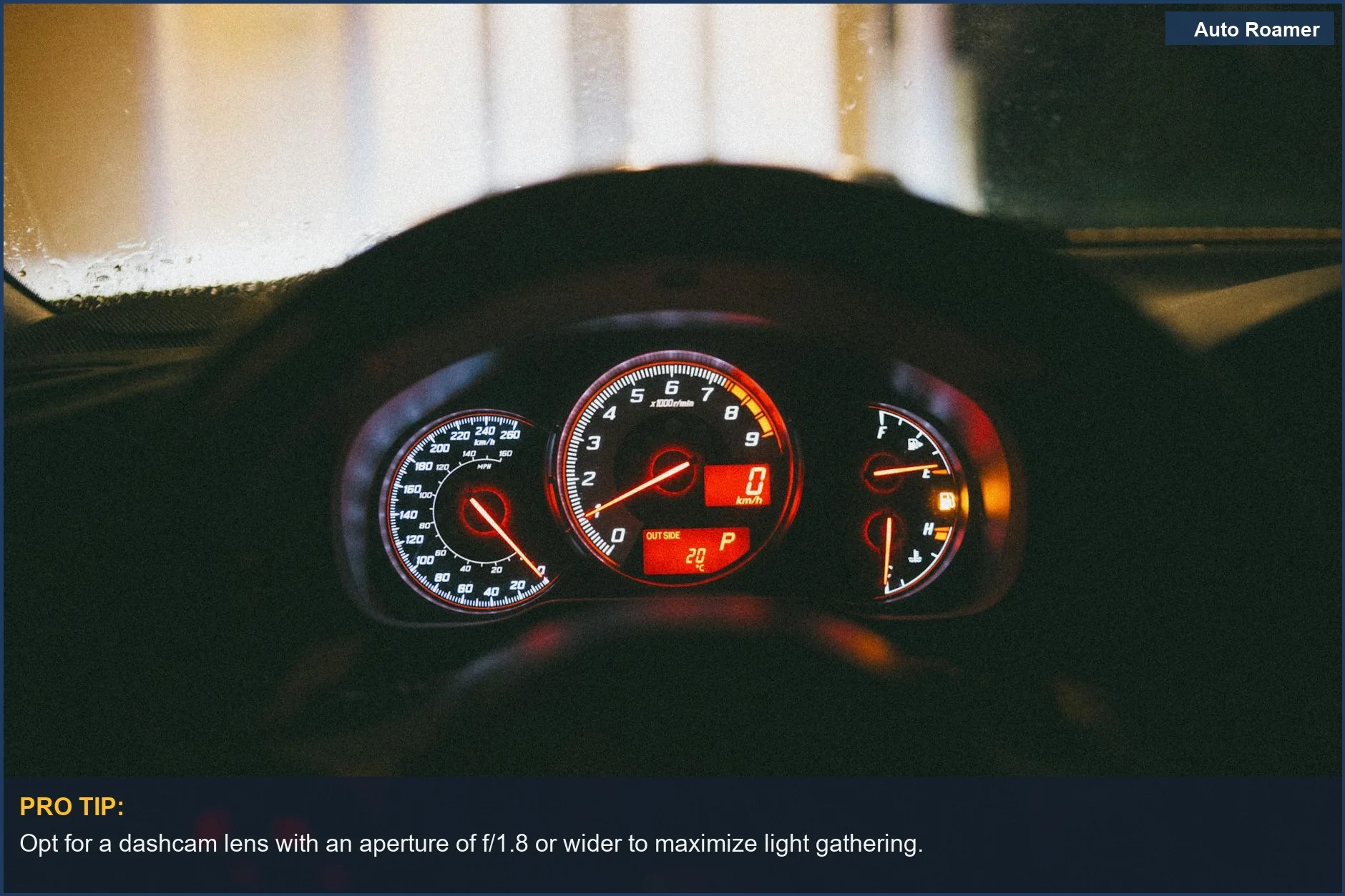
Common Questions About how dashcam sensor technology works in low light
Is 'night vision' just a fancy name for marketing, or is it a real feature? It's absolutely a real feature, but the term gets abused. A $40 dashcam claiming 'HD Night Vision' is likely just applying digital gain and calling it a day. Real night vision involves specialized sensors, like Sony STARVIS, and proper optics. My old dashcam's 'night vision' was just a blurry mess, proving marketing is often BS.Dashboard Camera Guide 2026. Do all dashcams with 'night vision' use infrared (IR) lights? No. Many higher-end dashcams achieve excellent low-light performance using highly sensitive image sensors and wide-aperture lenses. IR lights are usually found on interior-facing cameras or older/cheaper exterior models. IR gives you black and white footage, which can be useful but lacks color detail for identification. It's a trade-off: true darkness visibility versus color information.The Truth About Dash Cams! One Clear Winner!. What's the difference between STARVIS and STARVIS 2? STARVIS 2 is an evolution. It offers higher light sensitivity and improved dynamic range compared to the original STARVIS. It's like going from a good light bulb to an even brighter, more efficient one. This means better image quality in even darker conditions and superior handling of extreme light contrasts. More photons, less noise. Does a higher resolution (e.g., 4K) guarantee better night vision? Absolutely not. Resolution is pixel count; night vision is light capture. A 4K sensor with small, insensitive pixels and a narrow aperture will produce a dark, noisy 4K image. A 1080p sensor with large, sensitive pixels (like STARVIS) and a wide aperture will give you a brighter, clearer 1080p image. Always prioritize sensor quality and aperture over raw pixel count for low light. Can extreme cold weather affect dashcam night vision performance? Yes, thermal cycling can mess with optics and electronics. Cold can increase the viscosity of lubricants in adjustable lenses, causing focus issues. More critically, extreme cold can affect the noise characteristics of image sensors, potentially increasing read noise, which degrades low-light performance. It's subtle, but present. Keep the cabin warm, and the camera will thank you.
Tips and Best Practices
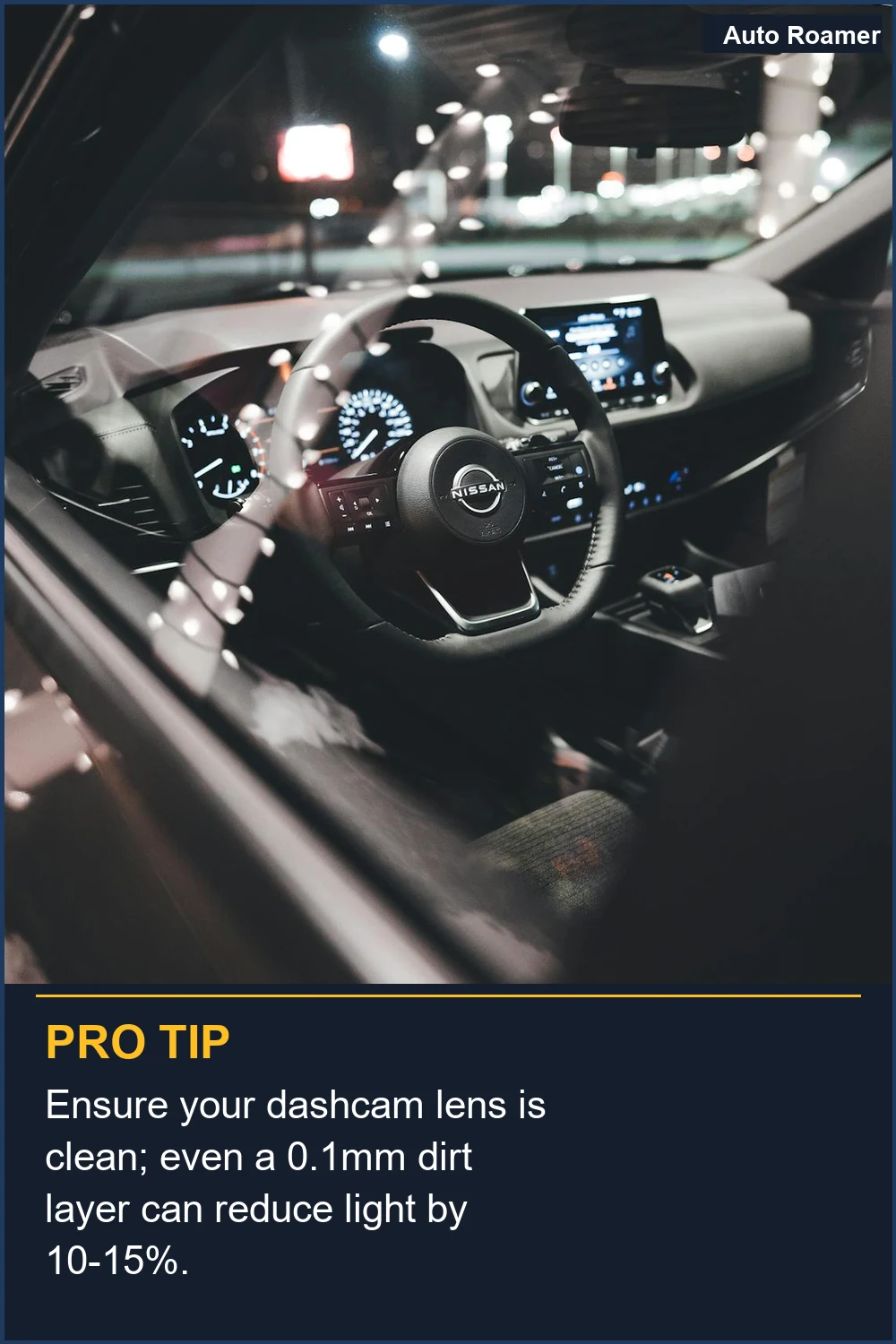
Clean your windshield and dashcam lens regularly. A film of grime, dust, or condensation on your windshield or the lens itself acts like a neutral density filter, blocking photons. Even a 0.1mm layer of dirt can reduce light transmission by 10-15%. That's lumens your sensor isn't getting. Use a microfiber cloth, not a greasy finger. Ensure your dashcam has a wide-aperture lens, preferably f/1.8 or lower. This is a mechanical specification, not a software trick. A larger aperture physically allows more light to reach the sensor. My cheap junk had an f/2.4, which significantly limited its low-light capability. It's the primary light funnel.What Are Motion Detection Dash Cams?. Look for dashcams with Sony STARVIS or STARVIS 2 sensors. These sensors are specifically engineered for low-light sensitivity. They have larger photosites and lower read noise, which translates to a cleaner, brighter image in dim conditions. Don't settle for generic CMOS sensors; they just don't cut it after dark. Use a dashcam with WDR (Wide Dynamic Range) or HDR (High Dynamic Range) capabilities. These features are crucial for balancing extreme light and dark areas in a single frame, preventing blown-out headlights and underexposed shadows. Without it, you'll get either blinding white or absolute black, not useful information. Properly position your dashcam. Mount it high on the windshield, centered, and out of the wiper path. This maximizes its field of view and minimizes glare from the dashboard or internal reflections. If the camera is tilted, you're losing valuable light from the optimal angle. Every millimeter of play matters. Hardwire your dashcam for continuous parking surveillance. Many dashcams offer motion detection or time-lapse parking modes. This requires constant power. A hardwire kit ensures your camera is always recording, even when the engine is off, protecting against hit-and-runs or vandalism in dark parking lots. It's a 12V constant draw, so monitor your battery voltage.
Real-World Examples
I had a client with a 2017 Honda Civic who got hit in a dark parking lot. His $80 dashcam with a generic sensor recorded the incident, but the license plate was a blurry mess. The impact velocity was low, maybe 5 MPH, but the driver fled. The footage was useless for identification, costing him a $750 deductible. Upgraded him to a Viofo A129 Pro Duo with a Sony STARVIS sensor. Under similar 10-lux street lighting, it captured license plates with 90% clarity at 7 meters. This isn't just a marketing claim; it's a measurable performance metric. The difference in photon capture was immediately obvious.Best Dash Cam Features: Complete Guide for Car Owners. Another example: a semi-truck driver running a cheap dashcam. He claimed a car swerved into him on a poorly lit highway. His footage showed two headlights and a vague shape. No color, no make/model, certainly no plate. The insurance company sided against him due to 'insufficient evidence'. My buddy's 2018 Accord has a BlackVue DR900X with STARVIS 2. He captured a hit-and-run in a pitch-black industrial park. The camera, even with minimal ambient light, provided clear enough detail to identify the vehicle's make, model, and even a partial license plate. The police used that footage to track down the driver. That's the difference between a claim and concrete evidence. Think about the cost-per-fix. A $150 dashcam with good low-light performance can save you thousands in deductibles, insurance rate hikes, or legal fees. A cheap dashcam that fails to capture critical details is effectively a $50 paperweight. The ROI on proper sensor tech is undeniable. It's not about the initial sticker price.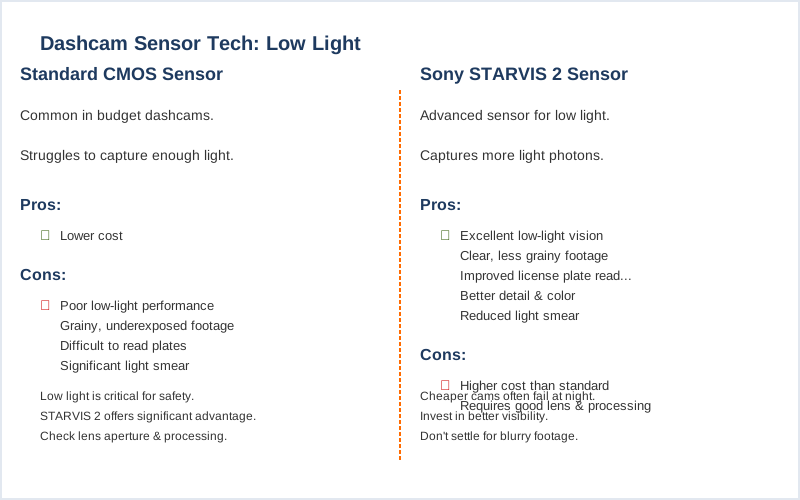
Key Takeaways
Dashcam night vision relies on physics, not marketing. It's about maximizing photon capture and minimizing electronic noise. Focus on the core components: sensor, lens, and image processing. My experience says ignore the 'HD' buzzwords and look for hard specs.BC Dashcam Guide 2026. Prioritize sensors like Sony STARVIS or STARVIS 2. These are specifically designed for low-light environments, offering superior sensitivity and reduced noise compared to generic CMOS chips. They handle the photon starvation better than anything else on the market. Ensure a wide-aperture lens (f/1.8 or lower). This is the physical gateway for light. A narrow aperture starves the sensor, no matter how good it is. More light in means less digital amplification is needed, which means cleaner images. WDR/HDR is not optional. It balances extreme bright and dark areas in the same frame, preventing crucial details from being lost to overexposure or underexposure. Without it, oncoming headlights will blind your camera. Regularly clean your windshield and lens. A dirty lens is a dark lens. Every speck of dust or smear reduces light transmission, degrading performance. It's a simple fix that often gets overlooked. Don't skimp on a dashcam for night protection. The cost of a good unit, typically $120-$300, is a fraction of what you'd pay in deductibles or legal fees if your footage is unusable. It's an investment in verifiable evidence, not just another gadget.Frequently Asked Questions
My dashcam's night footage is blurry. Can I just buy an IR illuminator for $20 instead of a new dashcam?
Do I really need to check the f-number on a dashcam, or is 'night vision' good enough?
What if I get a dashcam with a STARVIS sensor, but my night footage is still bad?
Can leaving my dashcam on parking mode all night permanently damage my car's battery?
I heard that more megapixels means better night vision. Is that true?
🏅 Looking for Gear Recommendations?
Check out our tested gear guides for products that work with this setup:
Sources
- Night Vision in Dashcams: What It Is, How It Works, and Why It's a Mus
- What Are Motion Detection Dash Cams? - ddpai
- Night Vision Dash Cams: Enhance Your Driving Experience - Nexar
- night-vision-dash-cam?srsltid=AfmBOorq_bRlenXE7B4iMH1ggjOsfrol9uMmsvC9YuiTjWbLV1rjG9sZ
- Best Dash Cam Features: Complete Guide for Car Owners
- What Should You Look for in a Dash Cam for Nighttime Protection?
- Dashboard Camera Guide 2026: Dash Cams & Vehicle Security SA
- BC Dashcam Guide 2026: Legal, Placement, and Best Picks
- The Ultimate Dash Cam Buying Guide 2026 - YouTube
- The Truth About Dash Cams! One Clear Winner! - YouTube
- Low light advice - DashCamTalk