
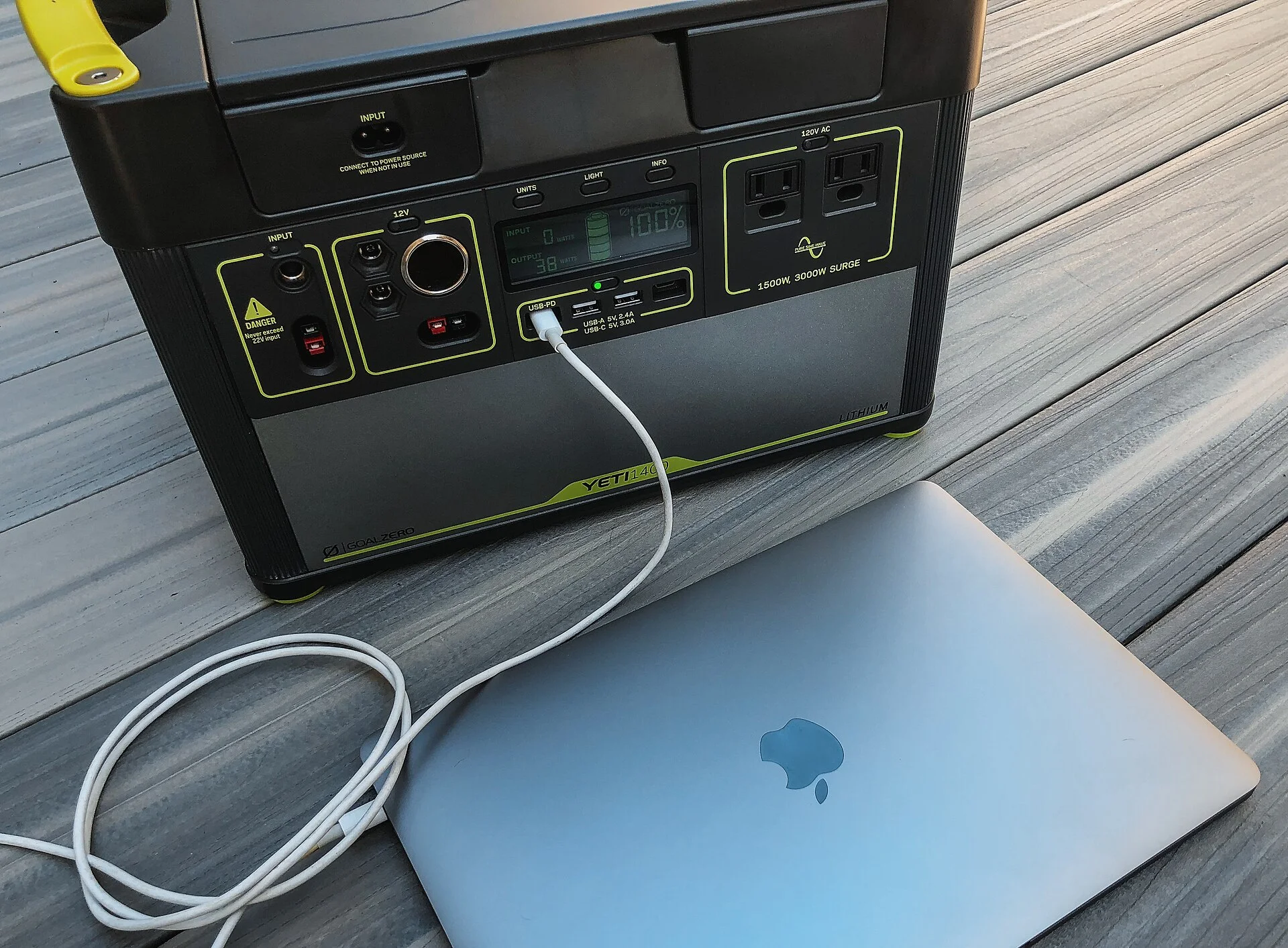
The Short Answer, and the Catch
Yes, you can charge a portable power station while driving — the catch is how slowly, if all you use is the cable that came in the box. That cable plugs into your 12V cigarette-lighter socket, and the socket was never built to move serious power. It is protected by a small fuse and fed by thin wiring, and those two facts cap how many watts can flow into your battery no matter how big or fancy the station is.
The number that matters is input wattage. A typical 12V car-charge cable feeds your station around 100 watts. Charging time is just the energy you need divided by the watts going in, so a 1000-watt-hour battery topped up at 100 watts gains only about 100 watt-hours an hour — meaning a full recharge from empty would take ten hours or more of driving. On most trips, the car cable is a top-up that offsets last night's use, not a way to refill a big battery from flat.
The good news is that the socket cable is only one of three ways to charge while you drive, and the other two are much faster. This guide walks all of them: the simple math that sets the socket's speed, how long a real drive actually adds for different battery sizes, the USB-C option most people overlook, the dedicated alternator charger that can push 400 to 800 watts, and the one question everyone worries about — whether any of this hurts your car battery. By the end you will know exactly how to plan a recharge around your drive instead of hoping it works out.
The Three Ways to Charge While Driving
Every method of charging a station from a moving vehicle comes down to one of three input paths, and they differ enormously in speed. Knowing which one you are using is the difference between a meaningful recharge and a trickle that barely registers.
- The 12V socket cable (slow, ~100 watts). The cable that ships with most stations. It plugs into the cigarette-lighter or accessory socket and is limited by that socket's fuse. Convenient, universal, and gentle on the car — but the slowest of the three.
- USB-C Power Delivery (medium, 60-100 watts). Many modern stations accept charge in through a USB-C port. A good 100-watt USB-C car charger can match or beat the 12V cable on some units, using nothing more than a USB-C cable.
- A dedicated alternator charger (fast, 400-800 watts). Also called a DC-DC charger. It hardwires the station to the vehicle's battery and pulls real power from the alternator while the engine runs. This is the only car method that actually refills a large battery on a normal drive.
The first two need no installation — you just plug in. The third is a wiring project, and it draws heavily enough that it has to be done correctly. Most people start with the socket cable, discover it is slow, and then decide whether USB-C or an alternator charger is worth the upgrade. The rest of this guide gives you the numbers to make that call.
The Math: Why the 12V Socket Is So Slow
One equation explains the socket's speed limit, and it is worth keeping in your head: power equals voltage times current, written P = V × I. In a car the voltage is roughly 12 volts, so every amp of current is worth about 12 watts. The socket's fuse fixes the maximum current, and that fixes the maximum watts.
Most accessory sockets are fused at 10 or 15 amps. Multiply by 12 volts and you get a theoretical ceiling near 120 watts on a 10-amp circuit and 180 watts on a 15-amp one. But you cannot run a fuse at its rated current all day, so manufacturers build their 12V charge cables to pull a safe 8 to 10 amps — about 100 to 120 watts — to avoid nuisance-tripping the fuse on a long drive. That is the real input you get, regardless of the station's headline charging spec.
Then subtract efficiency. Storing energy in a battery is not free; roughly 10 to 15 percent is lost as heat in the conversion, so 120 watts arriving at the station adds closer to 100 to 110 watt-hours of usable charge each hour. The takeaway is blunt: through the cigarette socket, plan on gaining about 100 watt-hours per hour of driving, and no expensive cable will change that — the limit is the car's fuse and wiring, not the station.
It helps to see the socket's pace next to a wall outlet, because the gap is what surprises people most. A home charger that fills the same station at 600 or 1000 watts is running at six to ten times the socket's rate, which is exactly why a battery that takes barely an hour on the wall can crawl for most of a day in the car.
The socket is not broken when it does this; it is doing precisely what a 10-to-15-amp circuit allows.
Once you accept that the car cable's job is maintenance rather than a full fill, the rest of your planning gets a lot simpler — you stop waiting for a refill that the circuit was never able to deliver and start charging full before you leave instead.
How Long Will a Drive Actually Recharge It?
Abstract watts are easy to wave away, so let us put real batteries on real drives, all through the standard 12V socket at about 100 usable watt-hours per hour. The pattern that emerges is the single most useful thing to internalize: small stations car-charge well, large ones barely move.
- A 300Wh station fills from empty in roughly 3 to 4 hours. A long highway day genuinely refills it — car charging is realistic here.
- A 500Wh station needs around 5 to 6 hours. A full day of driving tops it up; a short hop does not.
- A 1000Wh station takes on the order of 10 to 12 hours. No single drive refills it from empty; you are offsetting use, not refilling.
- A 2000Wh+ station would need 20-plus hours from the socket. Car charging is essentially a maintenance trickle at this size.
This is why the honest answer to "can I just recharge it in the car?" depends entirely on your battery size. If you are still deciding what to buy, it pays to work out how many watt-hours you actually need first, because a smaller station you can refill on the drive may serve you better than a giant one you can never top up without a wall outlet. For anything 1000Wh or larger, treat the socket as a supplement and plan to charge full before you leave.
Put it on a real itinerary and the picture sharpens. Say you drive four hours to a campsite, run a fridge and some lights overnight, and use about 250 watt-hours by morning. Those four hours of driving added roughly 400 watt-hours on the way in, so you arrived with more than you left with — the socket comfortably covered an overnight draw like that. Now scale it up: a fridge running hard plus device charging that burns 600 watt-hours a night will outpace a four-hour hop, and the battery slowly loses ground over a multi-day trip. The deciding factor is never the station's headline capacity; it is the balance between what you spend each night and what your typical drive puts back. Work that one subtraction out for your own trip and you will know instantly whether the socket is enough.
The Fast Lane: Alternator and DC-DC Chargers
If the socket's 100 watts will not keep up with how you use power, the real solution is to stop going through the socket at all. A dedicated alternator charger — sometimes sold as a DC-DC charger or a charging enhancer — connects the station directly to the vehicle's battery with heavy cable, bypassing the fuse and thin wiring entirely. While the engine runs, it can push 400 to 800 watts into the station, four to eight times what the cigarette cable manages.
The difference is transformative. At 600 watts, that same 1000Wh battery that needed ten hours on the socket fills in under two hours of driving. For people who run a fridge, charge multiple devices, or camp several nights between wall outlets, this is the method that makes a large station practical as a car-charged system rather than a thing you haul to a campground hookup.
It comes with real requirements, though. At 400 to 800 watts the charger draws roughly 35 to 70 amps from the 12V side, so it needs three things done right:
- Appropriately heavy-gauge cable.
- A proper connection at the battery.
- Ideally an ignition-sensing switch so it only runs with the engine on.
On a small car with a modest alternator, that extra load is significant, and it is worth confirming the alternator and wiring can handle it. This is a deliberate upgrade for heavy users — not something you bolt on casually — but it is the only car method that truly recharges fast.
USB-C Power Delivery: The Overlooked Middle Option
Between the slow socket cable and the involved alternator charger sits an option many people forget their station even has: charging in through USB-C. Power Delivery, the fast-charge standard behind modern laptops and phones, also works in reverse for stations that support it, commonly accepting 60 or 100 watts of input over a single USB-C cable.
Here is the quietly useful part: a quality 100-watt USB-C car charger plugged into the socket can match or even beat the bundled 12V charge cable on some units, while being smaller, more flexible, and dual-purpose — the same charger tops up your laptop and phone too. If your station accepts 100 watts over USB-C and your bundled cable only delivers 100, you have lost nothing and gained a tidier setup.
The limits are real, though. USB-C input is still capped well below an alternator charger, and a 100-watt USB-C car charger pulls close to 10 amps from the socket, so it lives under the same fuse ceiling as everything else plugged in there. It will not transform a 2000Wh battery. But as a no-installation way to charge at the socket's practical maximum with a cable you probably already own, USB-C deserves a look before you assume the 12V cable is your only easy choice.
Will It Drain or Hurt My Car Battery?
This is the worry that stops people from charging in the car at all, and the answer is reassuring once you separate two situations: engine running versus engine off.
They are completely different electrically.
With the engine running, your alternator is actively generating current to power the car and recharge its own battery. When you charge a station at the same time, that current comes from the alternator, not from the starter battery's reserve. The 100 watts a socket cable draws is trivial next to what an alternator produces, so charging a station on a drive does not deplete your starting battery — the engine is doing the work. Even a hungry alternator charger is supplied by the alternator while you drive, which is exactly why it is built to run only with the engine on.
The danger is charging with the engine off. Some cigarette sockets stay live with the key out, and feeding a station from one of those pulls straight from the starter battery — a battery built for short cranking bursts, not slow drains. Leave it long enough and you may not be able to start the car. Fortunately, many accessory sockets are switched and die with the ignition, which protects you automatically. The rule is simple: charge while the engine runs, and never leave a station charging from the car overnight. If you need overnight power without idling, that is the job of a dedicated second battery or the station's own reserve, not the starting battery.
Heat, Voltage Drop, and Why Charging Mysteriously Stops
Plenty of people plug in, drive for hours, and find the station gained far less than expected — or stopped charging entirely. Usually nothing is broken; the socket circuit is simply showing its limits, and two effects do most of the damage.
The first is heat at the plug. A cigarette-lighter plug carries current through a spring-loaded side contact and a tip, both of which have real contact resistance. Under a sustained 8-to-10-amp charge they warm up, and a loose fit, corrosion, or a worn spring concentrates that heat. A hot, high-resistance connection delivers less power and, in bad cases, can soften the plastic. If the plug is uncomfortably hot to touch after a long run, clean the contacts and make sure it seats snugly.
The second is voltage drop. The thin wire feeding an accessory socket loses a little voltage along its length when current flows, and the springy plug adds more. Pull 10 amps through it and the station may see noticeably less than the 12-plus volts at the battery. Many stations protect themselves by throttling or pausing 12V charging when input voltage sags — so a perfectly healthy car can still make the station 'stop charging' simply because too much voltage was lost between the battery and the plug. Running the engine, which raises system voltage to around 14 volts, often revives it. The deeper message is the familiar one: the socket circuit is thin by design, and if you keep hitting these limits, the load belongs on a heavier, direct connection.
Stacking Inputs and the Truth About Solar While Driving
If one input is slow, can you use several at once? On many stations, yes — and it is a genuinely useful trick. A lot of units accept multiple charge inputs simultaneously, for example the 12V car cable plus a solar panel, or car plus wall. The wattages add together, so a 100-watt car cable and a 100-watt panel can charge at roughly 200 watts combined — but only up to the unit's maximum rated input, so check the manual for the combined ceiling before assuming it all stacks.
That raises the obvious idea of charging from solar while you drive. Be realistic about it. A panel on the roof or dash while the car is moving faces the sun at a constantly changing angle, often through glass, with limited area — so it produces only a small, inconsistent trickle, nothing like its rated output. Solar earns its keep as a fixed panel aimed at the sun while you are parked at camp, where it can run for hours at a stable angle. As a charge source while actually driving, it is a minor bonus at best, not a plan.
The smarter stack is car-charging on the move to keep the battery from dropping, then deploying solar properly once you stop. Combined with a full charge before you left home, that three-part rhythm — wall before, car during, solar at camp — is how most people actually keep a station alive on a multi-day trip without ever finding a hookup.
A Practical Playbook: Top-Up vs Full Recharge
Put the numbers together and a simple operating plan falls out, one that saves you from the two classic mistakes: expecting a drive to refill a big battery, and accidentally draining the starter battery. The plan changes a little with how much power you actually use.
- Start full from the wall before you leave.
- Match the charging method to how much power you draw.
- Protect the starter battery: charge only while the engine runs.
Always start full from the wall. An AC wall outlet at home is several times faster than any car method and costs almost nothing. Charging full before you leave means the drive only has to maintain the battery, which the socket can do, rather than refill it, which it cannot. This single habit solves most car-charging frustration.
Match the method to your draw. If you mostly charge phones, lights, and a laptop, the 12V cable or a 100-watt USB-C car charger keeps a small-to-mid station topped up fine. If you run a fridge or camp several nights between outlets — and it helps to know roughly how much power a 12V fridge draws before you decide — the socket will fall behind, and an alternator charger becomes worth the install. And if you are tempted to also run an inverter off that same socket while charging, remember the fuse is shared: you cannot pull big loads and charge fast through one 15-amp circuit at the same time.
Protect the starter battery. Charge while the engine runs, unplug when you park, and never leave a station drawing from the car overnight. Follow those three lines and car charging becomes a quietly reliable part of your trip instead of a gamble.
The Bottom Line
Can you charge a portable power station while driving? Yes — the real question is how fast, and that depends entirely on which of the three inputs you use. The 12V socket cable everyone starts with is the slowest, capped near 100 usable watts by the car's fuse and wiring, which means it adds only about 100 watt-hours an hour. For a small station that is a genuine recharge; for a 1000Wh battery it is a top-up; for a 2000Wh battery it is barely a trickle.
To charge meaningfully on the move, step up the input. USB-C Power Delivery offers 60 to 100 watts with no installation and a cable you may already own. A dedicated alternator charger wired to the battery delivers 400 to 800 watts and is the only car method that truly refills a large station — at the cost of a proper install and respect for your alternator's limits. And whatever you use, charge while the engine runs so the alternator does the work, not the starter battery.
The clean way to think about it: fill it at the wall before you go, use the drive to keep it topped up, and deploy solar when you are parked. Size your station to the recharge you can realistically get, match the input method to how much power you draw, and car-charging stops being a hopeful guess and becomes a dependable part of how you keep the lights, the fridge, and the phones running mile after mile.