
Yes — and the Bronco Sport is the only one in this class Ford built for it
Short answer: yes, you can sleep in a Ford Bronco Sport, and it’s the most camping-minded vehicle in its whole compact class — because Ford engineered it that way on purpose. Where a RAV4 or a CR-V is a commuter you adapt for sleeping, the Bronco Sport ships with features that read like a packing list: an available 400-watt cargo inverter, LED flood lights built into the rear liftgate, MOLLE strap points on the seatbacks, a rubberized cargo floor you can literally hose out, and a flip-up rear glass for ventilation and grabbing gear without opening the whole gate.
The honest catch runs the other way. The Bronco Sport’s cargo floor is short and tall, not long and low: you get roughly 72 to 75 inches of length only with the front seats slid forward, the 60/40 seat doesn’t fold perfectly flat, and the upright box that gives you great sit-up headroom costs you some stretch-out room. So the Bronco Sport is a brilliant solo basecamp and a genuine trail rig — just not the roomiest place in the class to lie down.
You won’t find a road trip I didn’t take on this page. The numbers come from Ford’s published specs, U.S. News interior data, and the Bronco Sport owner forum where people post their own measured cargo platforms. If you’re deciding whether the Bronco Sport is the right rig for how you camp versus a roomier rival, our RAV4 sleep guide walks the same fit math on a longer-but-tamer alternative.
The framing throughout is the same one: here is what Ford put in the truck, here is what owners report once they actually try to sleep in it, and here is the gap between the two. On the Bronco Sport that gap is the most interesting in the cluster — it gives you more useful camping hardware than anything else here, and less raw floor — so the whole setup is about playing to the strengths Ford built in.
The factory camp kit: what Ford actually gave you
Start with the gear that’s already in the truck, because it changes what you need to buy and how you set up.
- Available 400W cargo inverter. A real AC outlet in the cargo area — not a household 1,500W, but enough to charge a laptop, run a small fan, or top off camera batteries without a separate power station. Most compacts in this class give you only a 12V socket.
- Rear-liftgate LED flood lights. Built-in overhead light when the gate’s up — you cook and set up the bed without a headlamp in your teeth.
- MOLLE attachment points + rubberized hose-out floor. Strap gear to the seatbacks instead of piling it on the bed, and rinse mud, spilled coffee, or a wet dog straight out of the cargo bay.
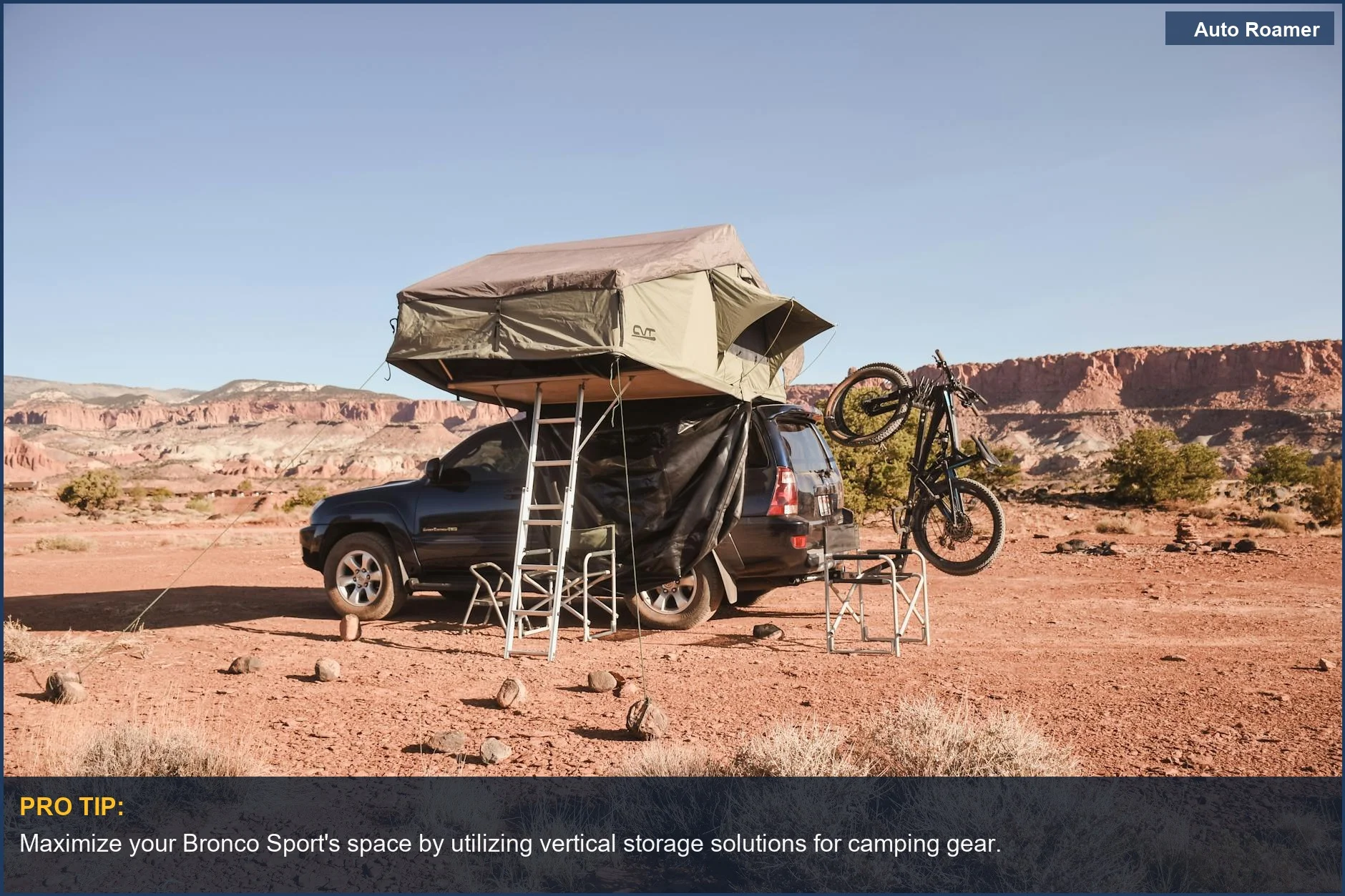
- Flip-up rear glass + available Safari roof rails. Open just the glass for cross-flow ventilation without unlatching the gate, and rack a cargo box or rooftop tent overhead to free the whole floor.
Not every trim has all of it — the Badlands and Outer Banks lean hardest into the camp features, and the inverter is an option box — so confirm what your specific Bronco Sport carries. But even a mid-trim gives you more camping-ready hardware out of the box than any rival here, which is exactly why the Bronco Sport punches above its size for this use.
The floor: short and tall, not long and low
Three measured numbers decide whether your body fits, and the Bronco Sport’s shape makes them read differently than a long, flat wagon.
- Flat-load length, seats folded: ~72–75 in (forum-measured usable platform closer to ~68 in). You reach the high end only with the front seats slid forward. A 5'10″ sleeper fits; a six-footer is right at the edge and usually sleeps a touch diagonally.
- Width: ~42 in. Wider than a twin (38 in), short of a full (54 in) — comfortable for one, snug for two.
- Cargo volume: ~32.5 cu ft behind the seats, ~65.2 cu ft folded (the Badlands trades a little of that — ~29.4 / ~60.6 — for its off-road hardware). The tall, upright box means that volume buys you sit-up headroom, which a long low wagon can’t match.
The trade is the whole story. The Bronco Sport’s boxy, upright cargo area is a real comfort win for living in — you can sit up to read, change, or cook in the tailgate — but it spends interior space on height instead of length, so the floor is on the shorter side. The 60/40 seat also folds with a slight step rather than dead flat, so as always, measure your own truck with the front seats where you’d sleep; the real number is a little under the brochure figure.
A 30-second honesty check before you spend a dollar
The Bronco Sport’s strengths and limits pull in different directions, so answer three things honestly and the setup falls out.
How tall are you, and one or two? Under about 5'10″ solo, the Bronco Sport is genuinely comfortable, and the upright box gives you room to move a compact can’t. A six-footer fits diagonally; two adults fit snugly.
How rough is the access? This is where the Bronco Sport earns its keep — with GOAT terrain modes and available twin-clutch AWD it gets to dispersed sites a RAV4 or CX-5 would turn around at. If your camping means real forest-service roads, this is the rig.
How many nights, and how much power? The available 400W inverter covers a weekend of phones, a fan, and a laptop without extra kit; for a week off-grid with a fridge you’ll still want a power station. Answer ‘solo or two, rough access, a few nights’ and the Bronco Sport is squarely — maybe ideally — your camper.
Building a bed that bridges the seat step in a tall box
Your sleeping surface is the biggest single comfort upgrade, and in the Bronco Sport it has to level the slight seat-fold step across a floor that’s on the shorter side.
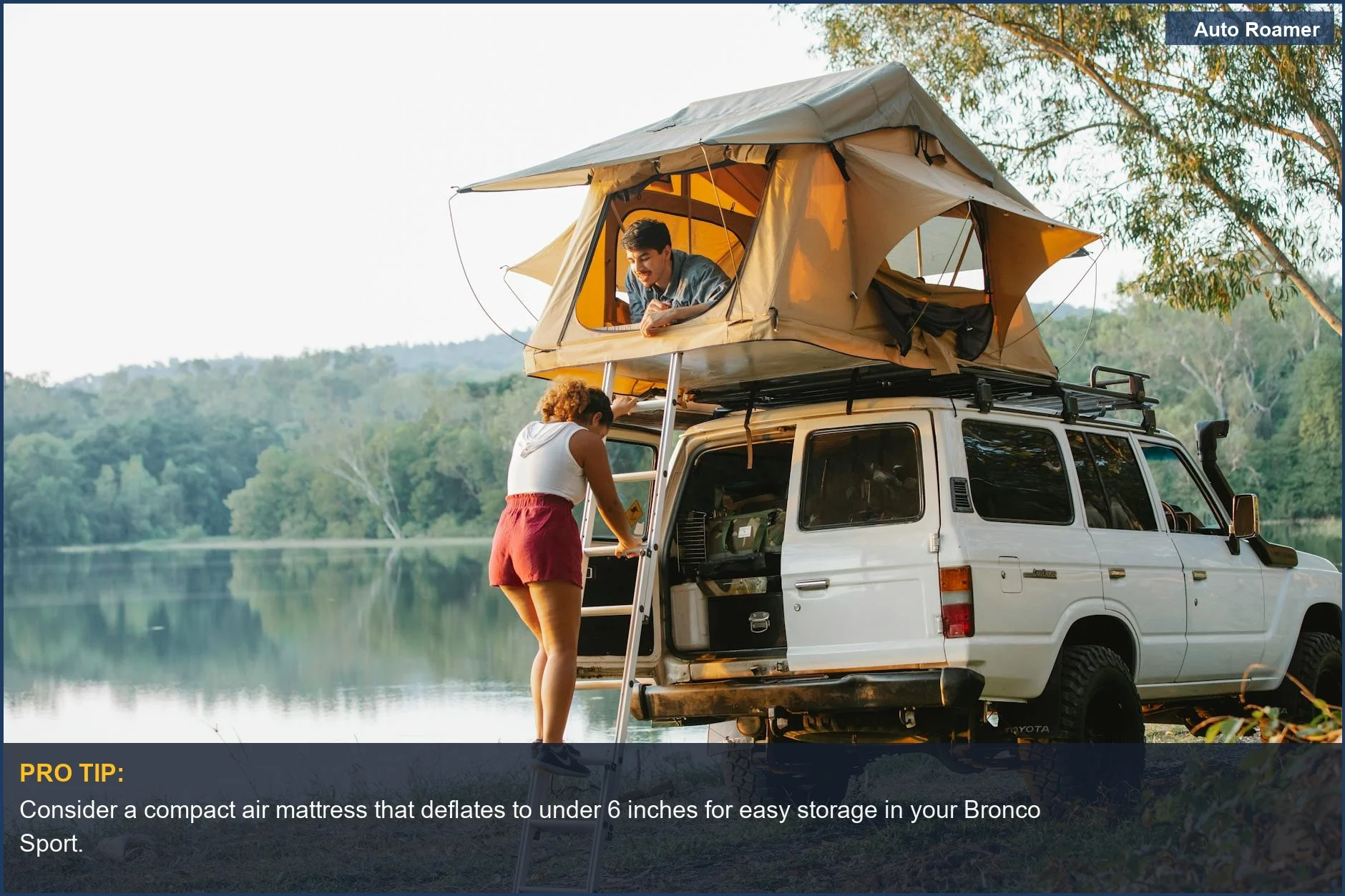
For weekenders, a cut-for-SUV air mattress is the easy default. It inflates to fill the footwell behind the seats and float over the step, turning the ~72-inch floor into one flat surface in about a minute, then deflates into a bag for the drive home. Bring a 12V pump — or run a small one off the 400W inverter if your truck has it.
If you want firm support with no bounce, a trimmable foam slab cut to the cargo footprint sits dead flat across the folded seats and tucks around the wheel wells — no pump, no leaks, just bulkier.
And the Bronco Sport’s upright box makes a low platform especially worthwhile: the deck spans the seat step, the MOLLE points and the space underneath turn into real organized storage, and you keep enough headroom to sit up comfortably — something the long, low compacts can’t offer. Keep a platform modest in height and removable, level the floor first, and add a fitted sheet and a real pillow.
In a rig this camp-ready, a made bed is the last ten percent that makes it feel like a basecamp rather than a parked car. The hose-out floor means you can be casual about a bit of dirt under the bed and rinse it all out at the end of the trip, which is exactly the kind of small freedom that makes the Bronco Sport pleasant to live in.
Power: the 400W inverter is the Bronco Sport's quiet edge
The available 400-watt cargo inverter is the Bronco Sport’s real camping advantage. It’s not a 1,500W household outlet like a plug-in RAV4’s, but it’s a genuine AC outlet in the cargo bay — enough for a laptop, a small fan, a string of lights, or topping off camera and drone batteries — which the CR-V, the gas RAV4, and the CX-5 simply don’t have.
Know its limits, though. The 400W ceiling won’t run a full-size fridge or a microwave, and like any onboard outlet it draws on the vehicle’s system, so don’t leave it pulling for hours with the engine off or you’ll flatten the starter battery. A dead battery at a remote trailhead turns a good trip into a recovery call.
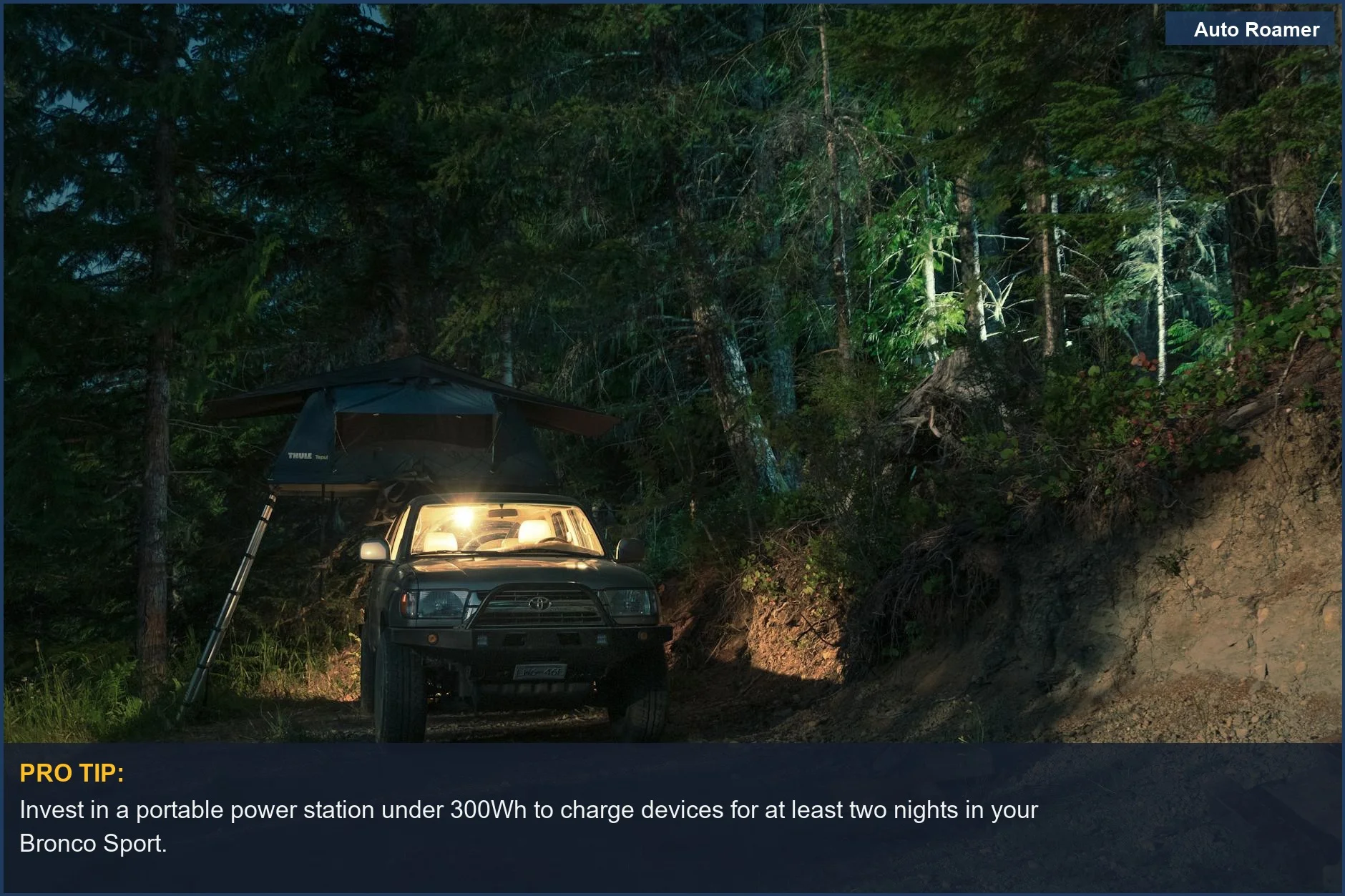
So for a weekend, the inverter alone often does the job — a real plus that means less gear to pack. For a week off-grid or anything with a cooler, bring a portable power station sized to your load (300–500 Wh covers lights and a fan; step up to the 1,000 Wh class for a fridge), and use the inverter for convenience on top. The Bronco Sport just gives you a head start most of its rivals don’t.
Ventilation: use the flip glass to beat condensation
The thing that ruins more compact-SUV nights than tight space is moisture. One or two people breathing for eight hours in a sealed truck exhale enough water to fog every window and leave the bedding damp — and on the first cold morning it can genuinely feel like it rained inside. The fix is to let a little outside air in, and here the Bronco Sport has a trick the others don’t.
The flip-up rear glass opens independently of the gate, so you can vent the cargo bay from up high — where warm, moist air collects — while keeping the gate latched and most of the weather out. Pair that with two side windows cracked an inch and a small battery fan, and air actually crosses the cabin instead of stagnating.
On the worst nights — cold and still, when condensation peaks — run the fan on low all night and wipe the inside of the glass before bed. A small moisture-absorber tub in a footwell pulls the worst of the damp out by morning, and bug screens over the openings let you vent through the night without inviting mosquitoes in. None of it is expensive, and it’s the difference between waking up clammy and waking up to a view.
Hot afternoons, cold nights, and never the engine
The Bronco Sport’s boxy metal body is a heat sink, and most of your comfort battle is the glass. Cover it and the cabin holds a temperature far longer.
In the cold, insulate underneath you first. You lose more heat to the floor and the windows than to the air, so a foam pad under your mattress does more than an extra blanket on top. Cover the windows to cut the radiant chill, and use a sleeping bag rated about ten degrees colder than the forecast low. In heat the priorities flip: park in shade, screen and crack the windows, use the flip glass up high, and let the fan do the work. The upright box actually helps in summer — hot air rises away from where you sleep and vents straight out the high rear glass.
One safety line worth repeating because people die doing it: never idle the engine to heat or cool the cabin while you sleep. Carbon monoxide can pool around a parked vehicle, and the Bronco Sport cannot safely climate itself overnight. Warm or cool the cabin before bed, then shut the engine off and rely on insulation, ventilation, and good bedding.
Two people in a Bronco Sport: snug, and the length is why
The most common follow-up to ‘can you sleep in a Bronco Sport’ is ‘can two of us?’ Yes, but snugly — and here the limit is length, not the camp features. The ~42-inch width sleeps two close, but the shorter floor means two tall adults are negotiating space, and the slight seat step has to be bridged so nobody sleeps in the dip.
Use one full-width SUV mattress rather than two pads so there’s no cold seam down the middle, strap gear to the MOLLE points and stash the rest up front so nothing eats the bed, and test the diagonal if either of you is near six foot. The upside is that the Bronco Sport’s upright box and rear LEDs make the two-person living — cooking, organizing, hanging out before bed — nicer than in a longer-but-lower rig. If you camp two-up every weekend and want to stretch out, a larger SUV like the Telluride sleeps a couple with room the Bronco Sport can’t match; for solo trips and the occasional second person on rough terrain, the Bronco Sport is hard to beat.
Leveling the Bronco Sport so you don't wake up with a headache
Every car-camping guide says ‘level your vehicle’ and then never says how. Here’s how: park nose-slightly-uphill so your head ends up higher than your feet. That’s the whole technique. You don’t need a bubble level — you need to not wake up with blood pooling in your skull and a dull headache.
The Bronco Sport’s real advantage here is access: with genuine ground clearance and its terrain modes, you can reach and settle onto flatter dispersed spots that lower crossovers can’t, so you’re often choosing from better ground to begin with. Still, on uneven sites a couple of stackable leveling ramps or a flat rock under one front wheel takes the side-tilt out; aim for ‘close enough that a water bottle doesn’t roll.’ Do the leveling before you make the bed — re-parking once you’re horizontal and the windows are fogged is a small misery you only need once.
A nice side effect of the Bronco Sport’s clearance: you’re less fussy about ground than a low crossover owner, so a slightly rutted but flat pullout that a sedan couldn’t reach is often the best bed you’ll find all weekend.
Five Bronco Sport sleeping mistakes that ruin the first night
The same handful of mistakes show up again and again on Bronco Sport owner threads. Knowing them ahead of time saves a miserable first night.
- Assuming the floor is as long as it is tall. The upright box is roomy to sit in but short to lie in; plan around ~72 inches, seats forward.
- Sleeping straight on the folded seats. You feel the step all night. An air mattress or foam pad is the whole fix.
- Counting on a 400W inverter for a fridge. It runs small loads; a cooler for several nights still needs a power station.
- Ignoring the flip glass for ventilation. It’s the best condensation tool the truck has — use it.
- Leaving the MOLLE points empty and piling gear on the bed. Strap it to the seatbacks and reclaim your sleeping space.
Notice the pattern: most are about using what Ford already built in. Plan for the shorter floor, bridge the step, vent through the rear glass, and put the camp features to work — do that and the Bronco Sport is one of the most genuinely capable little basecamps you can buy.
Spec snapshot: the Bronco Sport numbers your setup is built on
The figures a Bronco Sport sleeper actually plans around, from Ford’s published specs, U.S. News interior data, and owner-forum cargo measurements — with the measured (non-factory) items flagged honestly.
| Spec | Figure | Source / note |
|---|---|---|
| Flat-load length, seats folded | ~72–75 in | forum-measured usable platform ~68 in; high end needs seats slid forward |
| Width | ~42 in | wider than a twin (38), tighter than a full (54) |
| Cargo volume | ~32.5 / ~65.2 cu ft | seats up / folded (Badlands ~29.4 / ~60.6 with off-road gear) |
| Cargo box shape | tall, upright | trades length for sit-up headroom — great for living in |
| AC power | available 400W inverter | real cargo AC outlet most rivals lack — not a 1,500W household unit |
| Camp features | rear LEDs, MOLLE, hose-out floor, flip glass | factory-fitted; Badlands/Outer Banks lean in hardest |
| Off-road | GOAT modes, available AWD | real dispersed-site access a tame crossover lacks |
Read it as a build sheet: plan for the shorter floor, size the mattress to ~42 inches, bridge the seat step, use the 400W inverter and rear LEDs, and lean on the off-road access — the Bronco Sport is built to get you somewhere remote and live there, not to be the longest bed in the parking lot.
The bottom line: the class's most camp-ready rig, honest about its floor
So, can you sleep in a Ford Bronco Sport? Yes — comfortably for one, snugly for two — and what sets it apart isn’t the floor (which is on the short side) but everything around it. Ford built this truck for camping, and the available 400W inverter, rear-gate LEDs, MOLLE points, hose-out floor, and flip-up glass add up to a rig that does more out of the box than anything else in its class.
Get three things right and the Bronco Sport is a brilliant little basecamp: a full-width mattress to bridge the seat step and level the short floor, the 400W inverter (or a power station for longer trips) for off-grid power, and the flip rear glass plus a fan to beat condensation. Then let the off-road hardware take you where the tame crossovers turn around.
Match your trips to what the Bronco Sport honestly does — solo or two, rough access, a few nights at a time — and it’s arguably the most purpose-built camping vehicle in the compact class: real trail capability, real onboard power, and a boxful of camp features, in a truck you can also commute in come Monday. If you’re tall and camp two-up every weekend, look at something longer; for the adventurous solo or occasional-duo camper who actually goes off pavement, the Bronco Sport is hard to beat. Cross-shopping a tamer, roomier rival? Our RAV4 sleep guide shows the trade.