The value case: flagship features vs flagship price
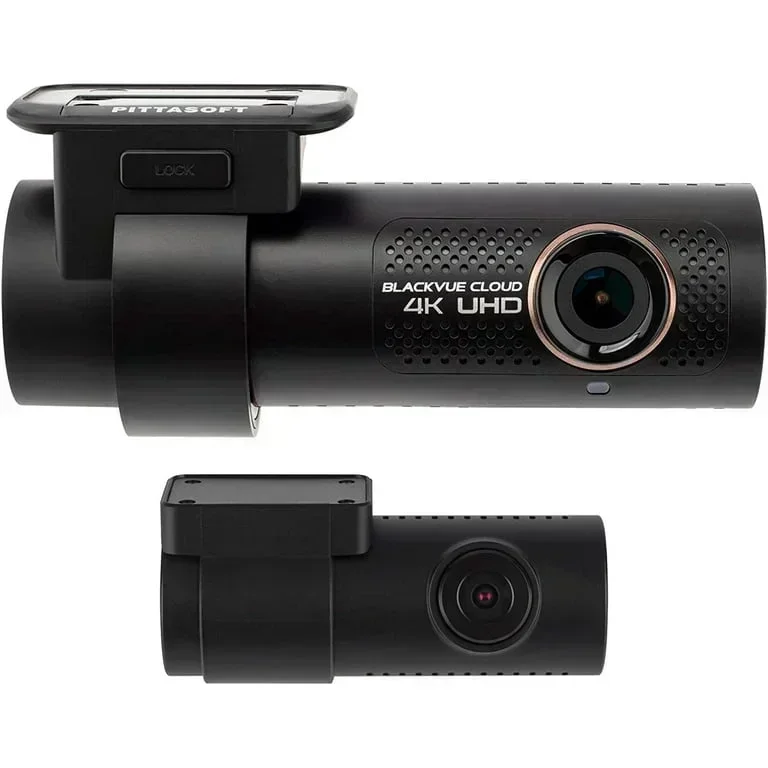
I stare at spec sheets the way other people stare at engine bays, and the BlackVue DR970X versus VIOFO A229 Pro matchup is the kind that separates a smart shopper from a marketing target. Both cameras put a Sony STARVIS 2 sensor behind a 4K front lens. Both do parking mode, GPS, Wi-Fi, and voice control. On paper, the footage that lands on your memory card is close enough that most owners could not pick the winner in a blind test of daytime clips.
So the question is not which camera records better. It is what the extra money on the BlackVue actually buys you. The DR970X-2CH Plus II runs around $399.99, per BlackVue North America. The VIOFO A229 Pro 2CH sits closer to $260. That is roughly a $140 gap before you plug anything in, and it grows the moment BlackVue's cloud service starts billing you monthly.
My job here is to name the false economy on both sides. Buying the cheap camera to save $140 is dumb if you actually need the feature the expensive one has. Paying flagship money for a cloud you will never open is worse. I care about the one spec that decides your purchase, and for most people it is not resolution. It is whether you will ever use the cloud.
The real question is not which camera records better footage. It is what the extra money on the BlackVue actually buys you.
Where the money goes on each camera
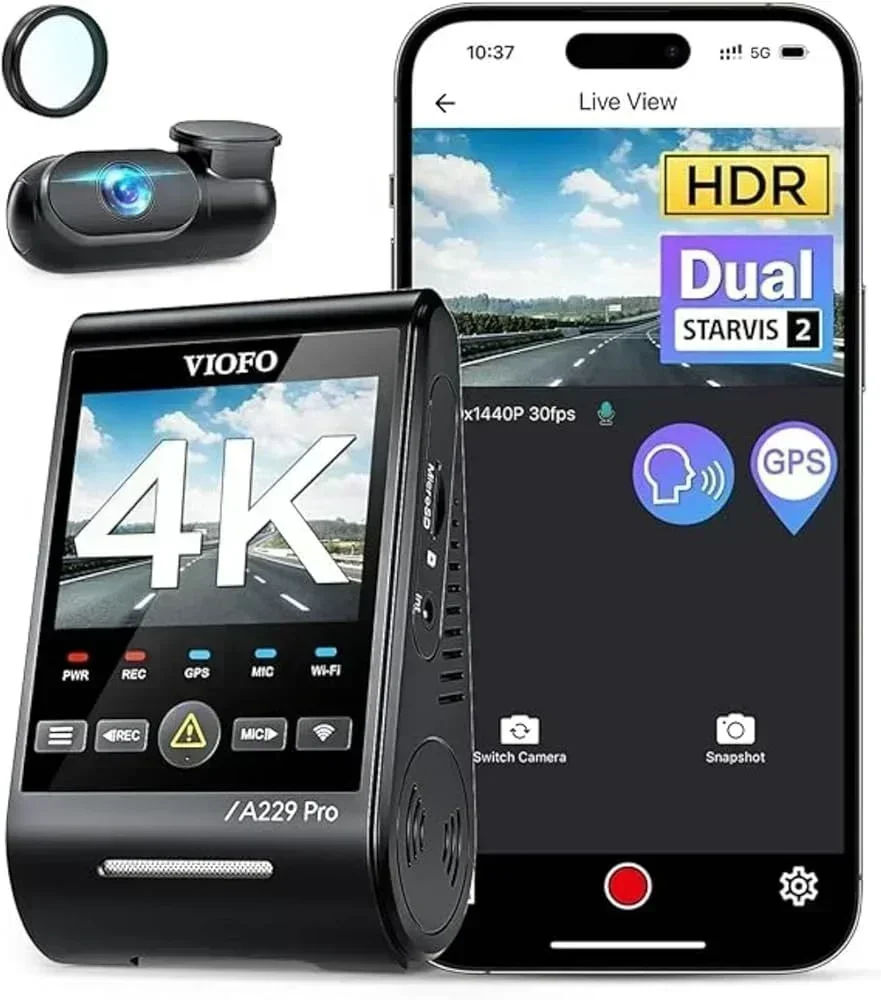
Follow the dollars and the two cameras tell different stories. On the VIOFO A229 Pro, nearly every cent goes into the parts that touch your footage: dual Sony STARVIS 2 sensors, HDR processing on both channels, dual-band Wi-Fi, and a capacitor-based build meant to survive a hot dashboard. VIOFO spends nothing on a subscription platform because it does not run one. What you pay at checkout is what you own, forever.
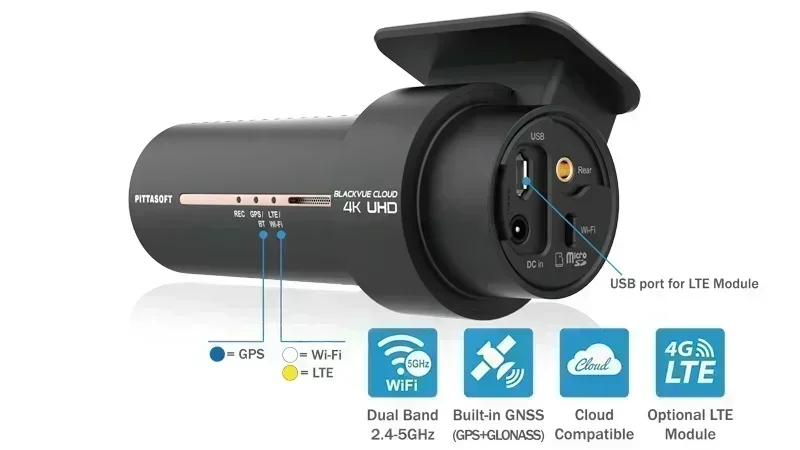
BlackVue splits its budget differently. A chunk of that $399.99 covers the same category of hardware, a 4K STARVIS 2 front sensor and a full parking suite. But a real portion pays for the cloud back-end, the app infrastructure, and the optional LTE connectivity that lets the camera phone home on its own. That is genuine engineering, not fluff, and it is why the sticker is higher.
- VIOFO A229 Pro: money buys sensors, HDR, local storage, and long-term reliability. No recurring cost.
- BlackVue DR970X: money buys comparable sensors plus a cloud ecosystem you access through a subscription.
The false economy trap sits on both sides. If you buy the BlackVue and never activate cloud, you overpaid for a platform you left in the box. If you buy the VIOFO and later wish you could check your car from a phone across the country, you bought the wrong tool. Match the spend to how you actually drive, not to the flashiest feature list, and the cheaper camera stops looking like a compromise.
Resolution and sensors: what you actually get
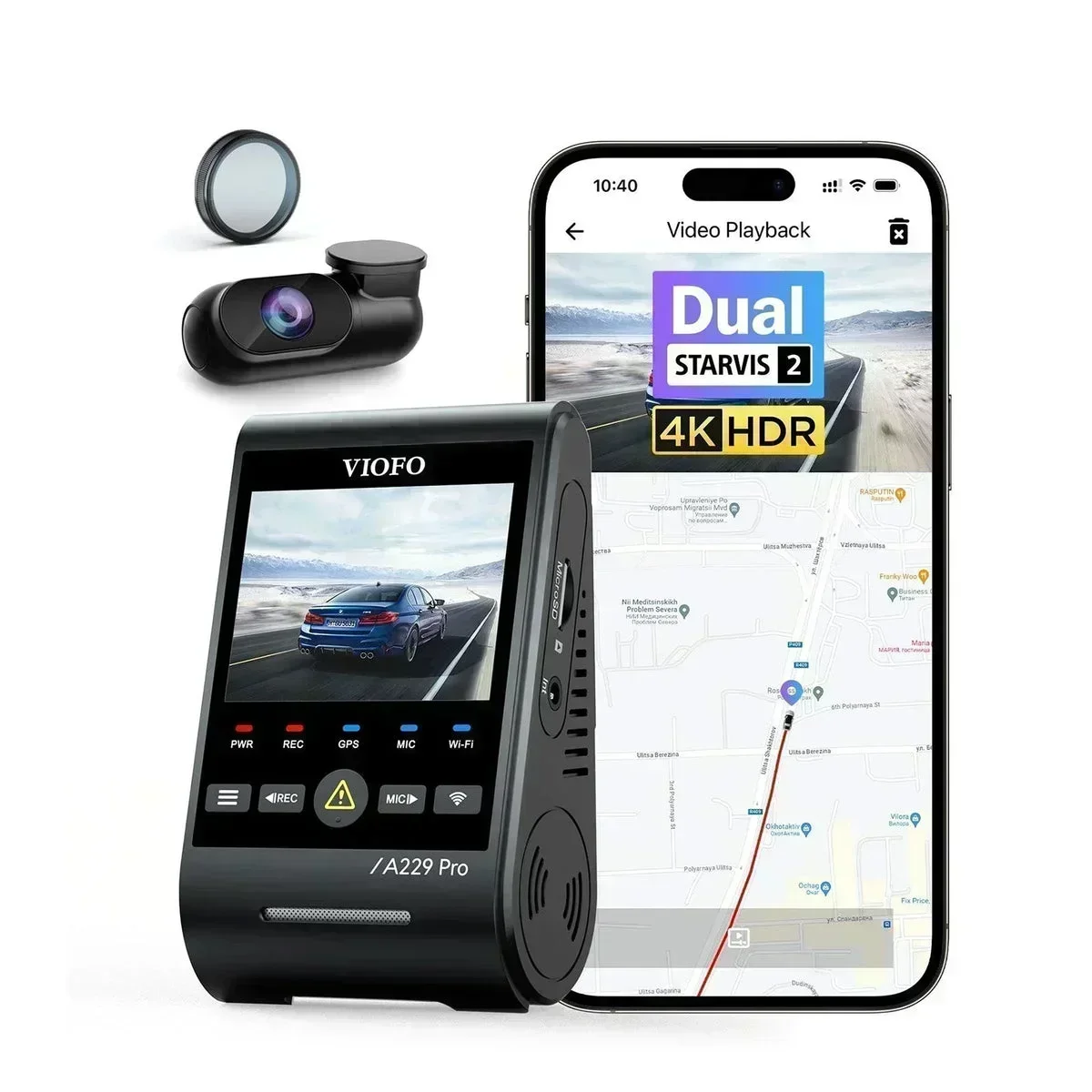
This is where buyers assume the flagship pulls ahead, and it mostly does not. Both cameras shoot 4K UHD up front. The VIOFO A229 Pro pairs a Sony STARVIS 2 IMX678 8MP sensor for the front with an IMX675 5MP STARVIS 2 sensor for the rear, so you get true 4K front and a sharp 2K rear, both with HDR. VIOFO documents this on its A229 Pro product page.
The BlackVue DR970X-2CH Plus II records 4K UHD at 3840x2160, 30fps, from an 8MP CMOS front sensor, also STARVIS 2. Its rear camera, however, is a 2.1MP Sony STARVIS sensor recording Full HD 1080p. So the front cameras are effectively even, but the rear channels are not. The VIOFO's 2K rear resolves more detail than the BlackVue's 1080p rear.
- Front: both 4K, both STARVIS 2, a genuine tie.
- Rear: VIOFO 2K vs BlackVue 1080p, edge to VIOFO.
Read that again, because it upends the assumption. The cheaper camera has the higher-resolution rear channel. If your priority is reading a plate on the car that rear-ended you, the A229 Pro's 2K rear is the more useful spec, and it costs you less. Resolution is not the reason to pay flagship money here. It is genuinely the reason not to.
Night footage and plate capture
Plates get read at night, in parking lots, under bad sodium lamps, which is exactly when a cheap sensor falls apart. Both cameras lean on Sony STARVIS 2, the sensor family built specifically for low-light dash cam duty, so both start from a strong position. STARVIS 2 improves dynamic range and light gathering over the original STARVIS, and it is the single most important spec for night plate capture on either camera.
VIOFO layers its own HDR and what it markets as Night Vision 2.0 processing on top of the IMX678 front sensor. In practice that means headlights blooming less and dark corners staying visible enough to catch a plate as a car rolls past. The BlackVue applies its own night processing to the same class of sensor, and results in daytime and well-lit night scenes are close.
- Decent light: both resolve plates well, and front footage is effectively even between the two.
- Rear plates: the VIOFO's 2K rear out-resolves the BlackVue's 1080p rear, a small but real edge.
Where the claims have to stay honest: this is a read on the sensor hardware and documented processing, not a personal side-by-side shoot-out in a driveway. Both benefit from STARVIS 2 in the dark, and neither is a weak-light disaster, so night performance is not the spec that justifies the price gap.
If a shop or a dealer promises you dramatically better night plates from the flagship, treat that as a sales line, not an official sensor spec, because both cameras draw from the same STARVIS 2 well.
Parking protection without the subscription trap
Parking mode is where a lot of buyers get quietly upsold, so read this part twice. The VIOFO A229 Pro does buffered parking recording completely on its own, with no cloud and no fee. It stores roughly 15 seconds before a detected event and 30 seconds after, so the moment of impact is never clipped off. It offers three modes, auto event detection, low-bitrate continuous, and time-lapse, and it writes everything to the local microSD card.
The BlackVue DR970X also does full parking surveillance, and here is where its cloud pitch lands: with LTE and a cloud plan, it can push a parking-event clip to the cloud automatically, so you get an alert even if someone steals the whole camera. That is a real capability the VIOFO cannot match locally.
But be honest about your needs. If your car sleeps in your own driveway or a covered garage, buffered local parking mode covers you completely, and the VIOFO does that for zero recurring dollars. The subscription trap is paying monthly for remote parking alerts you would check once a year. Solar-assisted setups can keep either camera powered longer for parking duty, and I get into that trade-off in my rundown on the benefits of solar-powered dash cams. For most driveways, local buffering is the honest answer.
The subscription trap is paying monthly for remote parking alerts you would check once a year.
The cloud premium: worth it or not
Here is the one spec that actually decides this purchase. BlackVue's cloud is the whole reason the DR970X exists as a flagship, and the whole reason it costs more. With a cloud plan you can watch a live view of your car from your phone anywhere, get push alerts on parking impacts, track the vehicle via GPS, and have important clips auto-backed-up so pulling the SD card is optional.
That platform is not free. BlackVue's own Cloud Plans page lists a Lite tier around $3.99 per month and a Smart tier around $7.99 per month for the first camera, and full remote features generally want the optional LTE module too. There is a free basic tier with limited storage, but the always-on remote experience people buy BlackVue for lives behind the paid plans and cellular data.
The VIOFO A229 Pro has no cloud at all. Zero. You connect over Wi-Fi when you are near the car, pull clips to your phone, and that is the ceiling.
So ask yourself one question: will you genuinely open a live view of your parked car from somewhere else? Fleet owners, rideshare drivers, people parking on rough streets, and anyone managing a car from a distance get real value. A commuter who parks at home and at work does not. If the honest answer is no, the cloud premium is the false economy, and you are done deciding.
And do the fee math honestly: even the cheap Lite tier is roughly $48 a year, every year, for as long as you own the camera. Add the LTE module hardware and a data connection for true anywhere-access and the annual bill climbs further. Recurring costs are sneaky precisely because each month looks small.
Build, storage, and the small stuff
The details that do not fit on a marketing banner still matter when a camera lives on a windshield through July heat. Both units use a capacitor rather than a lithium battery, which is the right call for surviving high dashboard temperatures without swelling. Both include GPS, Bluetooth, and voice control, so you can tell the camera to save a clip without taking your hands off the wheel.
Storage is one spot where BlackVue's flagship stretches its legs: the DR970X-2CH Plus II supports memory cards up to 1TB, while the VIOFO A229 Pro tops out around 512GB. For a 4K camera that continuously overwrites, either capacity is plenty for days of footage, but the higher ceiling is a genuine flagship perk if you rarely offload clips.
| Spec | BlackVue DR970X | VIOFO A229 Pro |
|---|---|---|
| Resolution | 4K front / 1080p rear | 4K front / 2K rear |
| Sensor | Sony STARVIS 2 (8MP front) | Sony STARVIS 2 (IMX678 / IMX675) |
| Parking | Buffered + cloud auto-backup (LTE) | Buffered, local, 3 modes |
| Cloud | Yes, subscription ($3.99+/mo) | None |
| Price | ~$399.99 | ~$260 |
Small stuff adds up: the VIOFO gives you the better rear resolution and no fees, the BlackVue gives you the bigger card ceiling and the cloud path. Mounting hardware, cable runs, and heat tolerance are a wash between them, so none of the small stuff tips the decision far enough to override the cost math I lay out next.
Total cost of ownership: the number that decides it
Sticker price lies, so let me do the real math over three years, which is a fair lifespan for a hard-working dash cam. The VIOFO A229 Pro starts at about $260 and never charges you again. Three years in, your total cost of ownership is still $260, plus whatever microSD card you chose. That is the entire ledger.
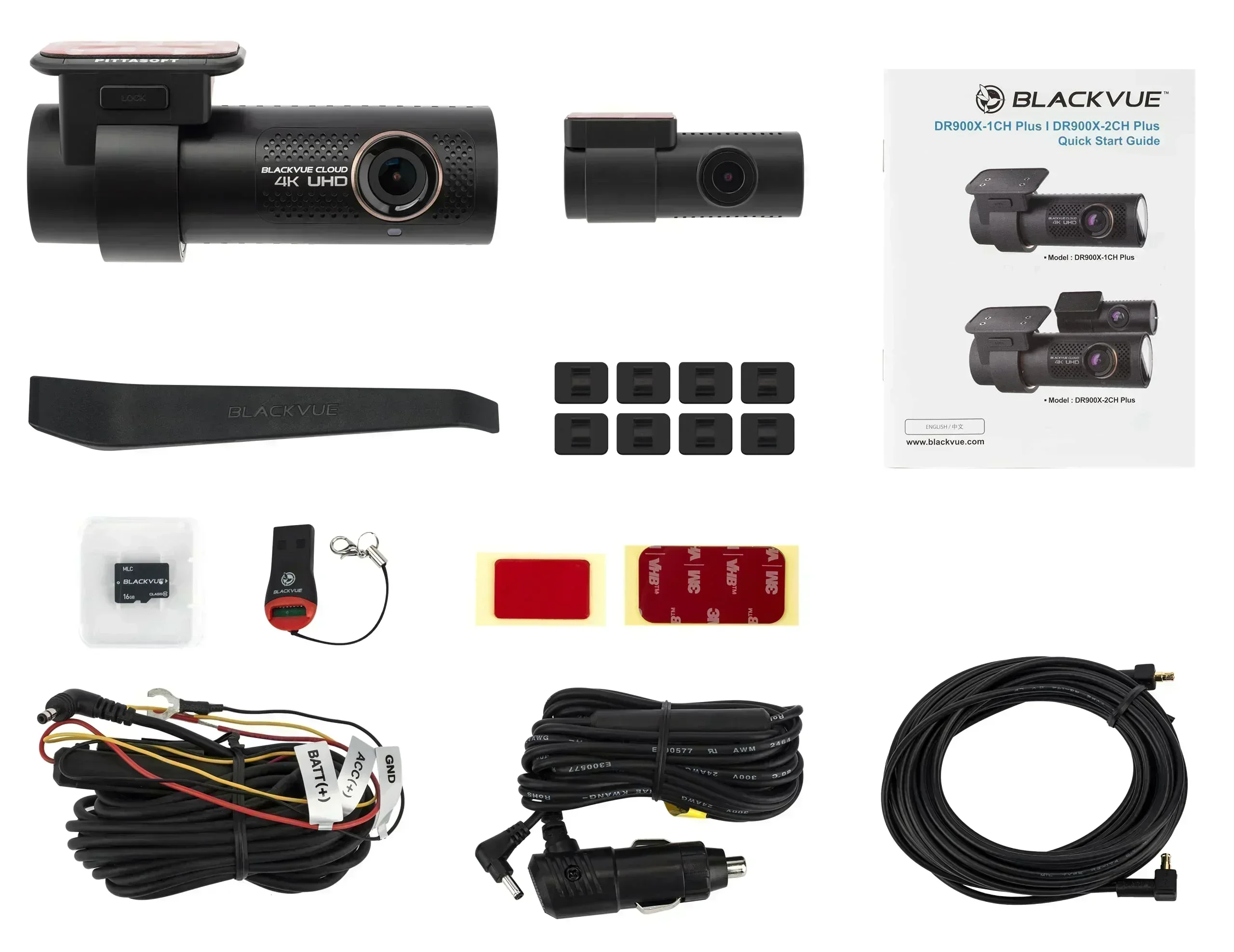
The BlackVue DR970X starts at about $399.99. If you actually use it as intended, you add a cloud plan. At the Lite tier of roughly $3.99 per month, that is about $48 a year, or $144 over three years. At the Smart tier near $7.99 per month, it is closer to $96 a year, or $288 over three years. And full remote function usually wants the LTE module and a cellular data line on top.
- VIOFO A229 Pro, 3 years: about $260, flat.
- BlackVue DR970X + Lite cloud, 3 years: roughly $544.
- BlackVue DR970X + Smart cloud, 3 years: roughly $688, before LTE.
So the real gap is not $140. Used the way BlackVue intends, it is $280 to $430 over three years. That is a whole second camera, or a decent set of tires. The number that decides your purchase is this three-year total, not the checkout price, and it only justifies itself if you use the cloud enough to earn it back in peace of mind.
One more accounting trick worth learning: cross off costs that appear in both columns. A quality high-endurance microSD card runs $40 to $60 for 256GB or 512GB, and both cameras need one. A hardwire kit for parking mode runs $25 to $40, and both cameras need that too. Those line items cancel each other out, which leaves exactly one recurring expense separating these two cameras: the cloud fee. When the ledger reduces to a single line, the decision gets easy.
Computed: each price this page states, divided across the 512GB it states. Nothing here is a spec-sheet import — it is arithmetic on figures this page already states ($688, $544, $430, $399.99, $288, $280, 512GB). The formula is the plain one: cost per GB = price ÷ 512GB.
| What the page states | Price | Per GB across 512GB |
|---|---|---|
| roughly $688 | $688 | $1.3 |
| roughly $544. | $544 | $1.1 |
| it is $280 to $430 over three years. | $430 | $0.8 |
| The DR970X-2CH Plus II runs around $399.99 | $399.99 | $0.8 |
| or $288 over three years. | $288 | $0.6 |
| it is $280 to $430 over three years. | $280 | $0.5 |
Read the last column: across the 512GB this page states, the dearest option works out at $1.3 per GB and the cheapest at $0.5 — the gap is $0.8 per GB.
Who should save, who should spend
Let me sort the buyers, because the right answer genuinely depends on how you park and drive. Save your money and buy the VIOFO A229 Pro if you park at home and at work, if your main worry is capturing a clean 4K clip of a crash or a hit-and-run, and if the idea of a monthly camera subscription makes you wince. You get the same front resolution, a sharper 2K rear, buffered local parking, and zero fees. For the majority of private drivers, that is the correct, unsexy answer.
Spend on the BlackVue DR970X if remote awareness is a real requirement, not a fantasy. Fleet managers, rideshare and delivery drivers, people who street-park in rough neighborhoods, and anyone who leaves a vehicle unattended far from home get concrete value from live view, LTE alerts, and cloud auto-backup. If someone walks off with the whole camera, only the cloud model already has the footage saved off-device.
- Buy the VIOFO if you park at home and at work and mainly want a clean 4K record of a crash or hit-and-run.
- Buy the BlackVue if remote awareness is a real requirement: fleet duty, rideshare shifts, rough street parking, or a car left far from home.
Run two quick scenarios to test yourself. Scenario one: you commute, park in a garage at work, and your car sleeps in the driveway. The cloud would alert you to an impact you would discover an hour later anyway, so the VIOFO saves you the full premium. Scenario two: you drive rideshare nights and leave a second car at an airport lot for a week at a time. Now a stolen-camera backup and a remote live view are worth real money, and the BlackVue's total cost buys something you will actually use.
The false economy cuts both ways here. A homebody who buys the BlackVue and never opens the app wasted the premium. A rideshare driver who buys the VIOFO to save $140 and then wishes he could check his parked car between shifts bought the wrong tool. For a broader survey of cameras that punch above their price, the guide to the best budget dash cams for 2025 rounds up the current value picks based on published specs and reviewer consensus.
The budget wrench's pick
For most people reading this, I pick the VIOFO A229 Pro, and it is not close. You get a 4K STARVIS 2 front sensor that matches the flagship, a 2K rear that actually beats the BlackVue's 1080p rear, buffered local parking mode, and a three-year cost of ownership that stays flat at around $260. The one spec that would flip my vote, the cloud, is a feature most private drivers open once and forget.
The BlackVue DR970X is not a bad camera. It is a genuinely good flagship carrying a genuinely useful platform. But you are paying $399.99 up front and, realistically, $144 to $288 more over three years for a cloud service. That math only pays off if you truly need to watch your car from somewhere else, and if you do, the DR970X earns every dollar. Fleets and rideshare drivers, spend the money with a clear conscience.
Everyone else: keep the difference. Put the roughly $280 you saved over three years into a good 512GB card, a hardwire kit, and maybe that solar parking setup. The false economy here is paying flagship price for a subscription you will not use, when the same 4K footage is sitting on the shelf for a lot less. Buy the tool that matches your driveway, not the one with the fanciest app. That is the whole trick, and it saves you real money every single time.