Why your glove box needs a gauge that reads true
Tire pressure is one of the few safety numbers on your car you can check yourself in two minutes, and almost nobody does it with a tool they trust. People lean on the gas-station gauge that's been run over a hundred times, the readout on a bargain inflator, or the dashboard light that only warns once a tire is already 25 percent low. By then the tire has been running hot, wearing unevenly, and costing you fuel for weeks.
Quick honesty note, because the internet is full of pages claiming hands-on trials they never ran: I have not bench-tested these five gauges. This is a spec comparison built from published manufacturer specifications, named third-party reviews — Car and Driver and TechGearLab both lab-test tire gauges — and NHTSA's tire-safety guidance, all linked at the bottom. Where I give a verdict, it's reasoning from the published numbers and reviewer consensus, not a claim that I ran any of them on a bead breaker myself.
The standards bodies are clear about something the marketing glosses over: under-inflation is the leading cause of tire failure, and the federal safety data ties chronic low pressure to blowouts, longer stopping distances, and faster tread wear. The TPMS light in your dash is a last-resort alarm, required only to warn at 25 percent below the placard pressure — far lower than you want to actually run. A dedicated gauge is the only way to set the number on your door placard with confidence.
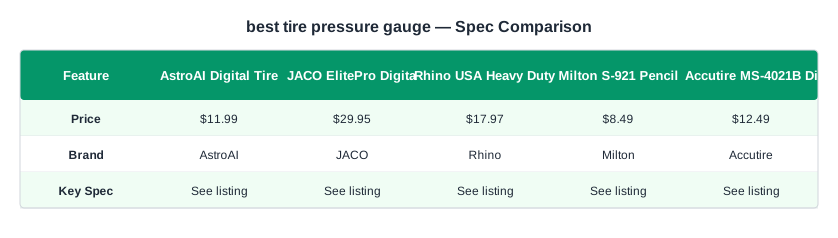
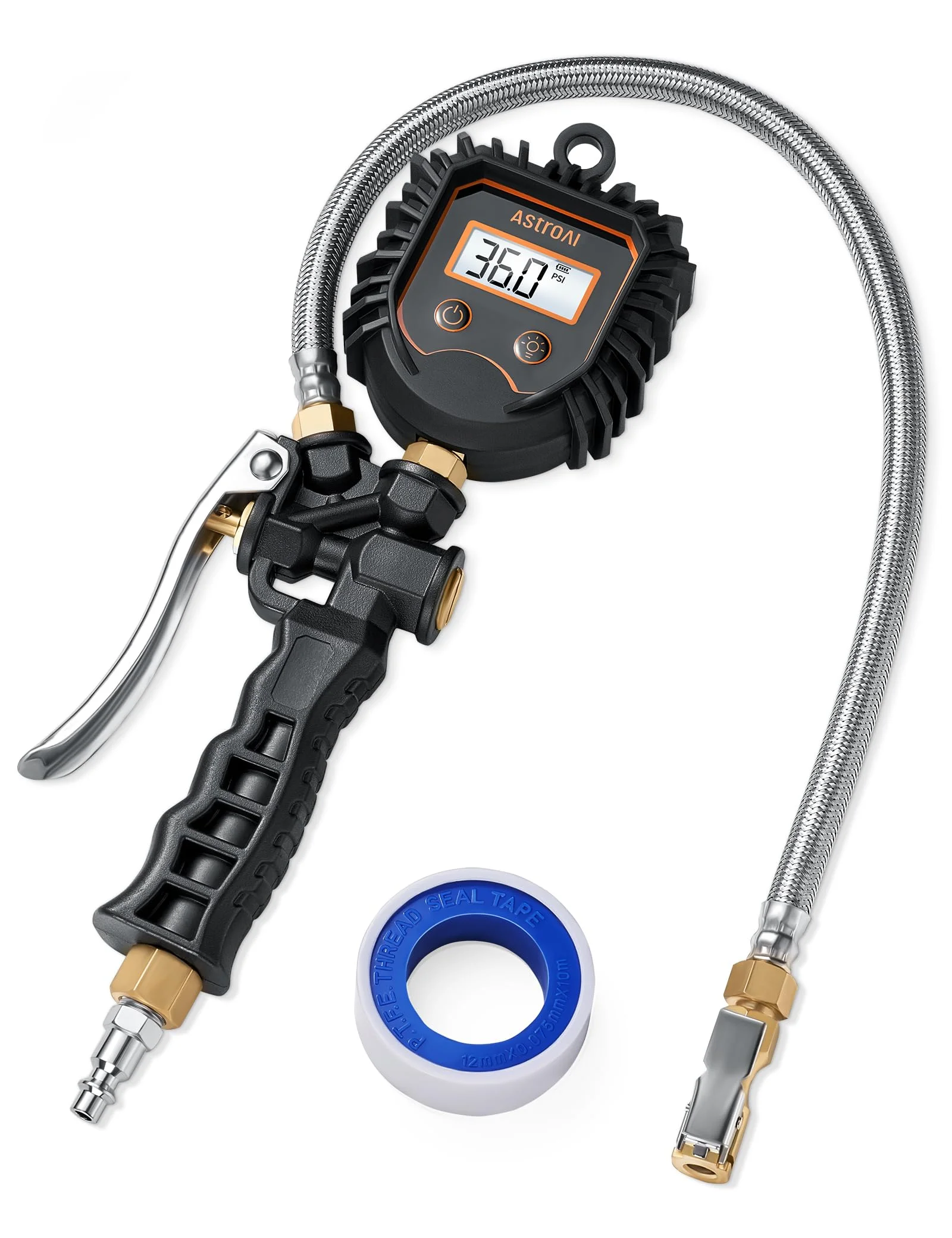
The road-trip and overlanding field comes down to five real picks across three designs: the digital AstroAI Digital Tire Pressure Gauge, the garage-grade digital JACO ElitePro Digital Tire Pressure Gauge, the battery-free dial Rhino USA Heavy Duty Tire Pressure Gauge, the cheap pencil Milton S-921 Pencil Tire Pressure Gauge, and the budget digital Accutire MS-4021B Digital Tire Pressure Gauge. The specs that decide between them are type, pressure range, accuracy, and whether it lights up for a cold pre-dawn check.
The short version: repeatability beats the printed accuracy claim, type decides whether a battery can strand you, range has to comfortably exceed your placard pressure, and a backlight is the feature you appreciate most at 6 a.m. in a driveway. Everything else is a footnote.
What to look for before you buy a tire gauge
A gauge is cheap, so people grab whatever's at the register. Here's what each spec actually means for an accurate read — so you're not buying on price alone.
Accuracy is a spec to read like a standard, not a slogan. The common claim is ±1 PSI or ±2% of reading. The distinction matters: ±1 PSI is a fixed window at any pressure, while ±2% grows with pressure — 2% of 35 PSI is 0.7 PSI, but 2% of an 80 PSI truck tire is 1.6 PSI. For passenger tires the two work out similar; for high-pressure truck or trailer tires, prefer a fixed-PSI spec. If you tow or run a truck, my guide to choosing the right PSI for your tires covers the placard numbers worth setting.
The pressure range has to comfortably exceed your placard number. Most gauges cover 0–60 or 0–100 PSI, fine for cars. Accuracy degrades near the very top of a gauge's range, so a 0–150 unit like the AstroAI leaves headroom for a high-pressure trailer tire where a 5–50 pencil gauge would be pinned.
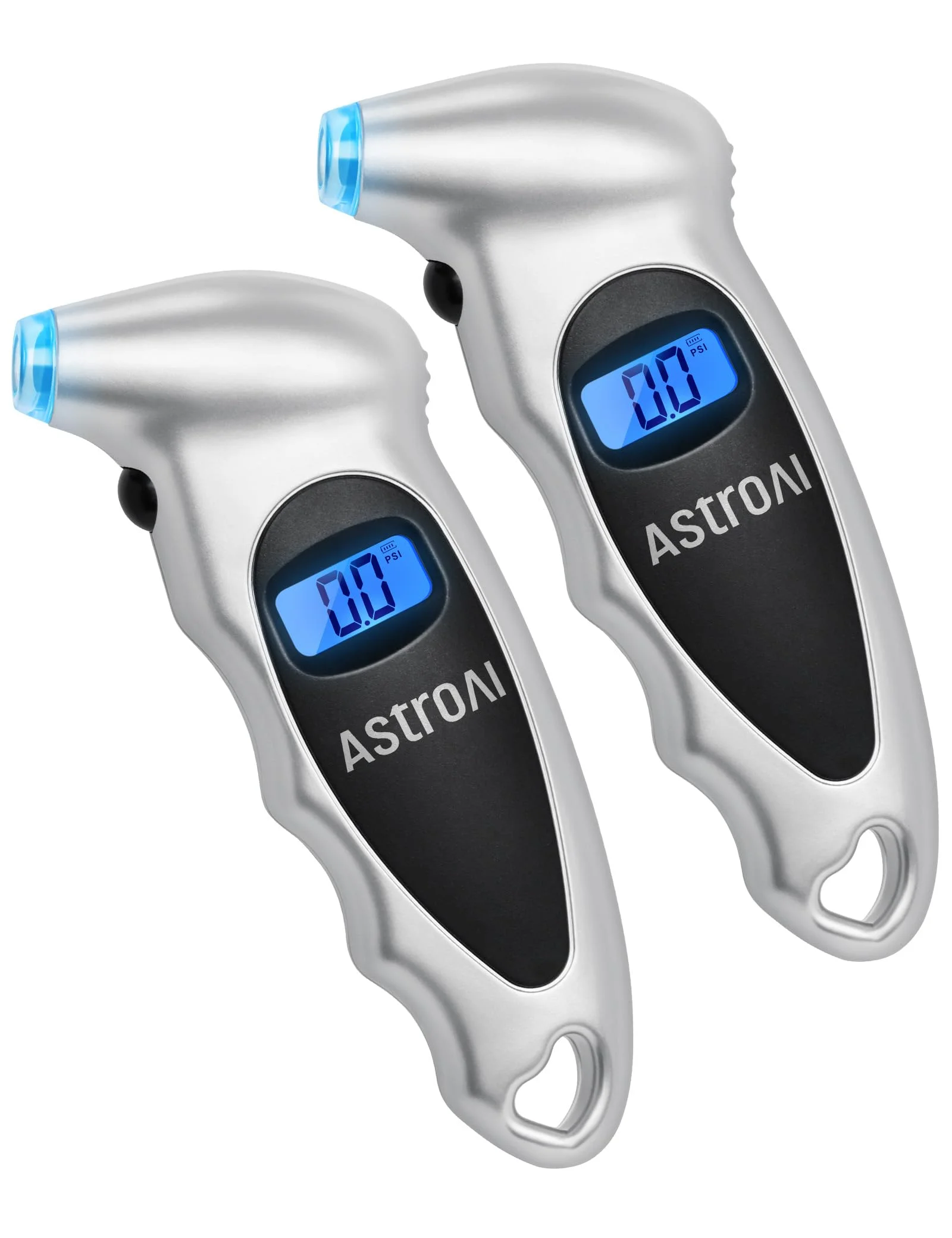
A lit nozzle and backlit display earn their keep on the cold-morning checks that matter most — and cold mornings are exactly when a tire reads low. The AstroAI and JACO both light up; a dial or pencil gauge wants good daylight or a flashlight in the other hand.
A solid valve-seating chuck and a hold function decide whether you get the real number. A gauge that hisses and bleeds pressure while you read it reads low every time; a hold function freezes the reading when you pull the chuck off the valve instead of dropping it the instant you break the seal.
- Accuracy: ±1 PSI fixed window; prefer fixed-PSI over % for high-pressure tires.
- Range: comfortably above your placard PSI — headroom keeps it accurate.
- Backlight: lit nozzle + screen for cold pre-dawn checks.
- Chuck + hold: clean one-press seal, frozen reading after you pull off.
Digital vs dial vs pencil: how each design actually works
There are three gauge designs on the shelf, and they trade accuracy, durability, and price differently. Understanding the mechanism tells you which compromise you're buying — here are all five laid out, pulled from published specs and named reviews.
Two things jump out of the table. First, only one of these needs no battery and no good light to read — the dial Rhino USA — which is exactly why it's the overlanding and cold-climate pick. Second, the accuracy claims cluster tightly around ±1 PSI / ±1.5%, so on paper they look alike; the real separation is repeatability and how each one fails, which the spec sheet never prints.
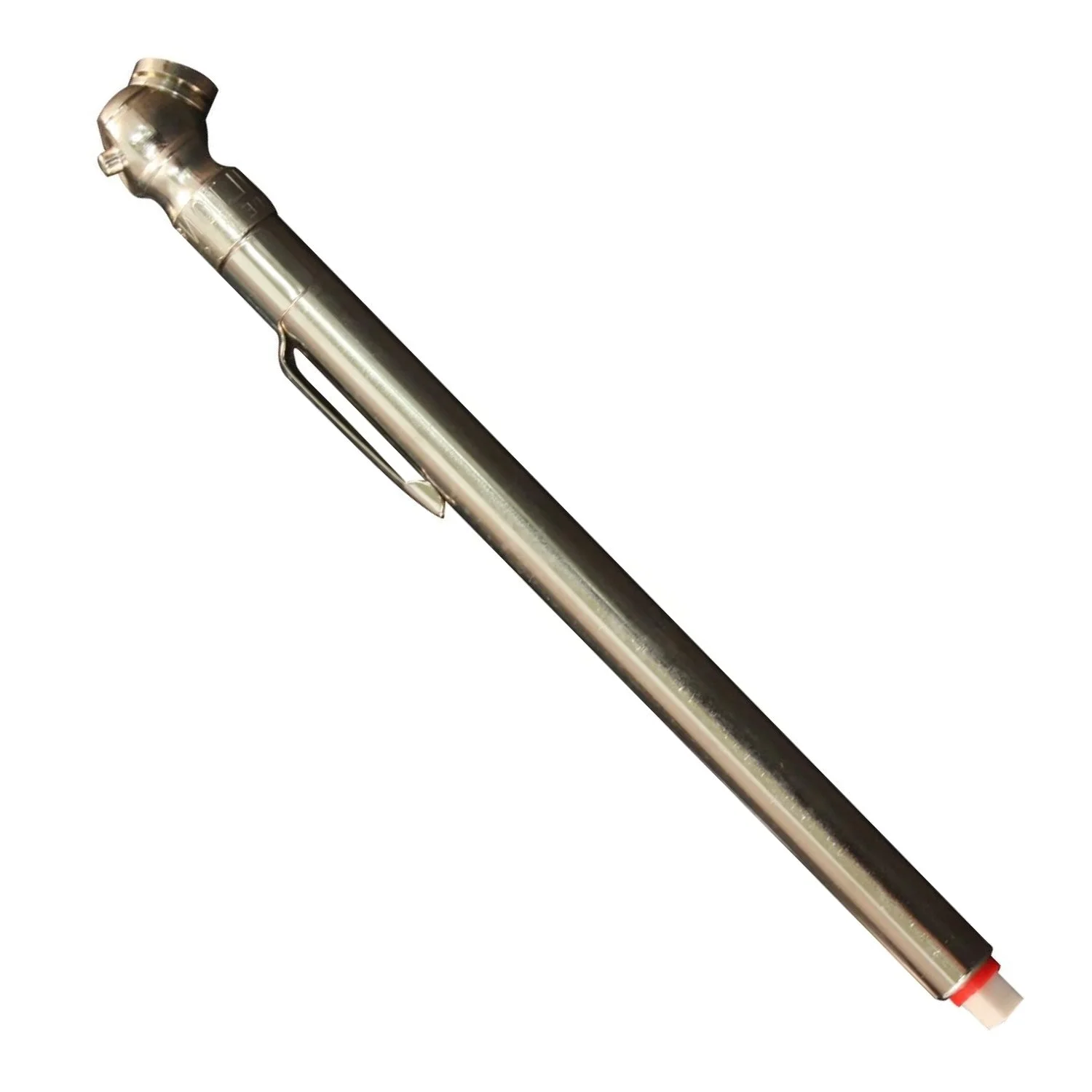
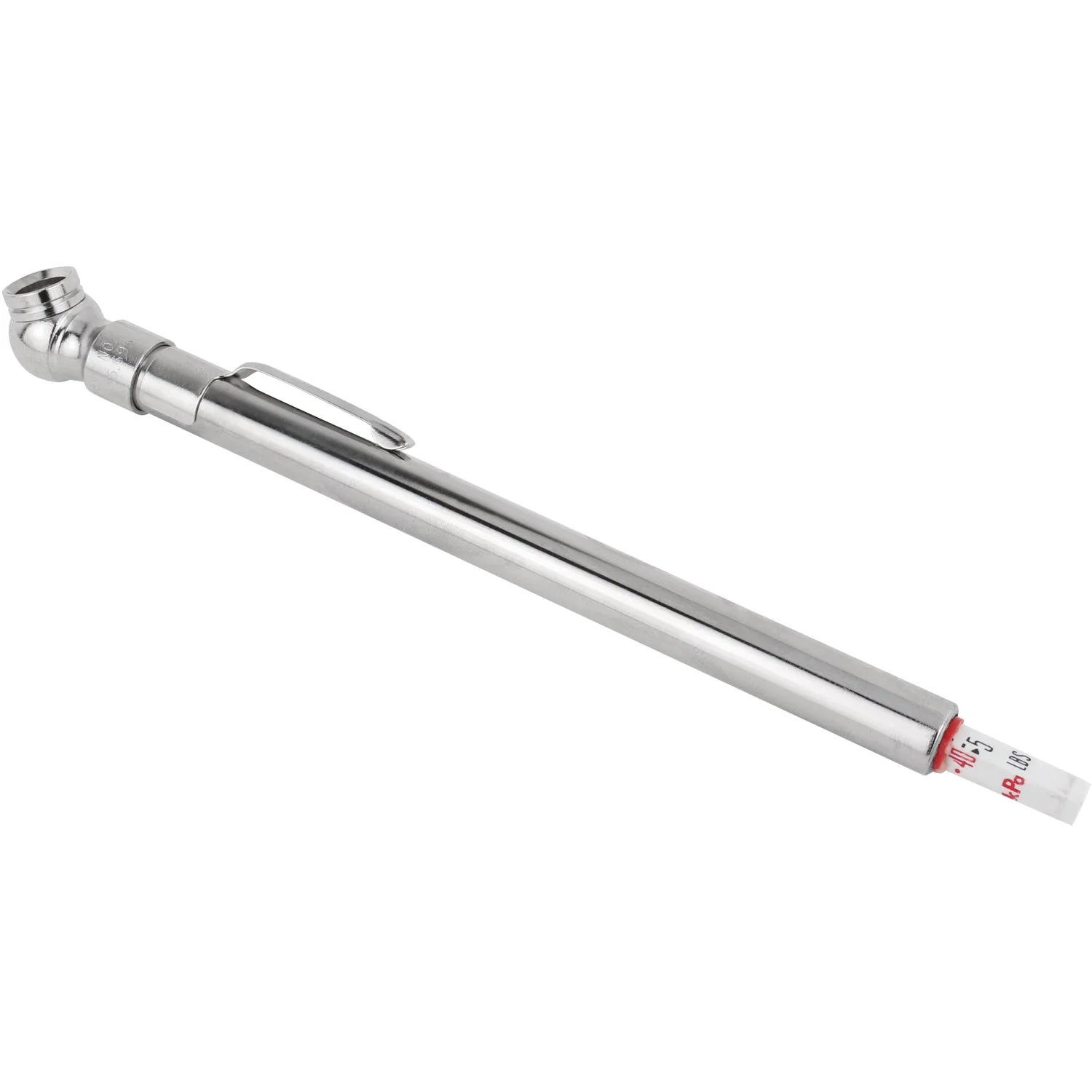
The pencil (stick) gauge — the Milton S-921 Pencil Tire Pressure Gauge — is the cheapest and simplest: a calibrated rod a spring pushes out of a metal tube under pressure. Nothing to break, no battery, and a good one is surprisingly accurate, but you read it off a small printed scale, so precision depends on your eyes and the light.
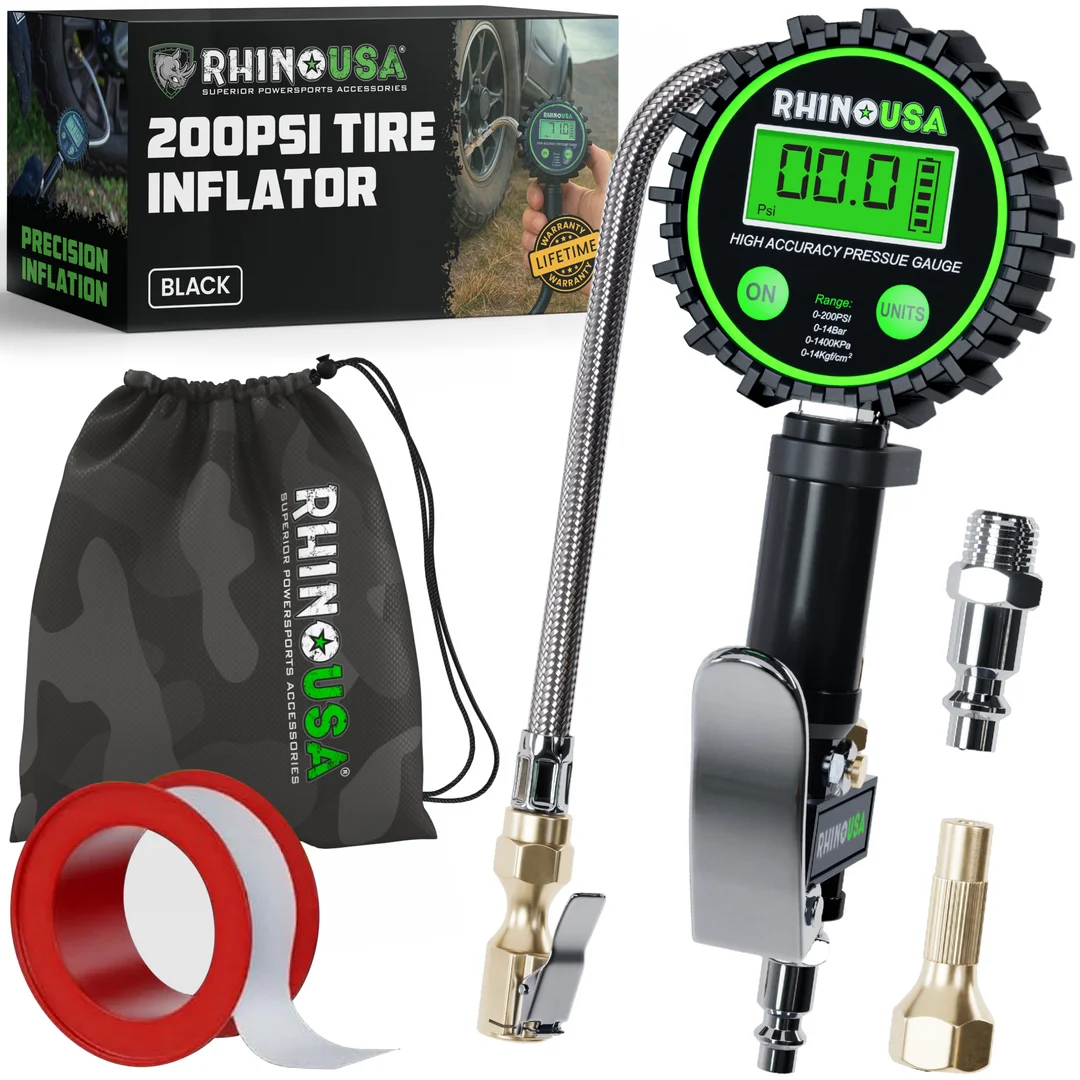
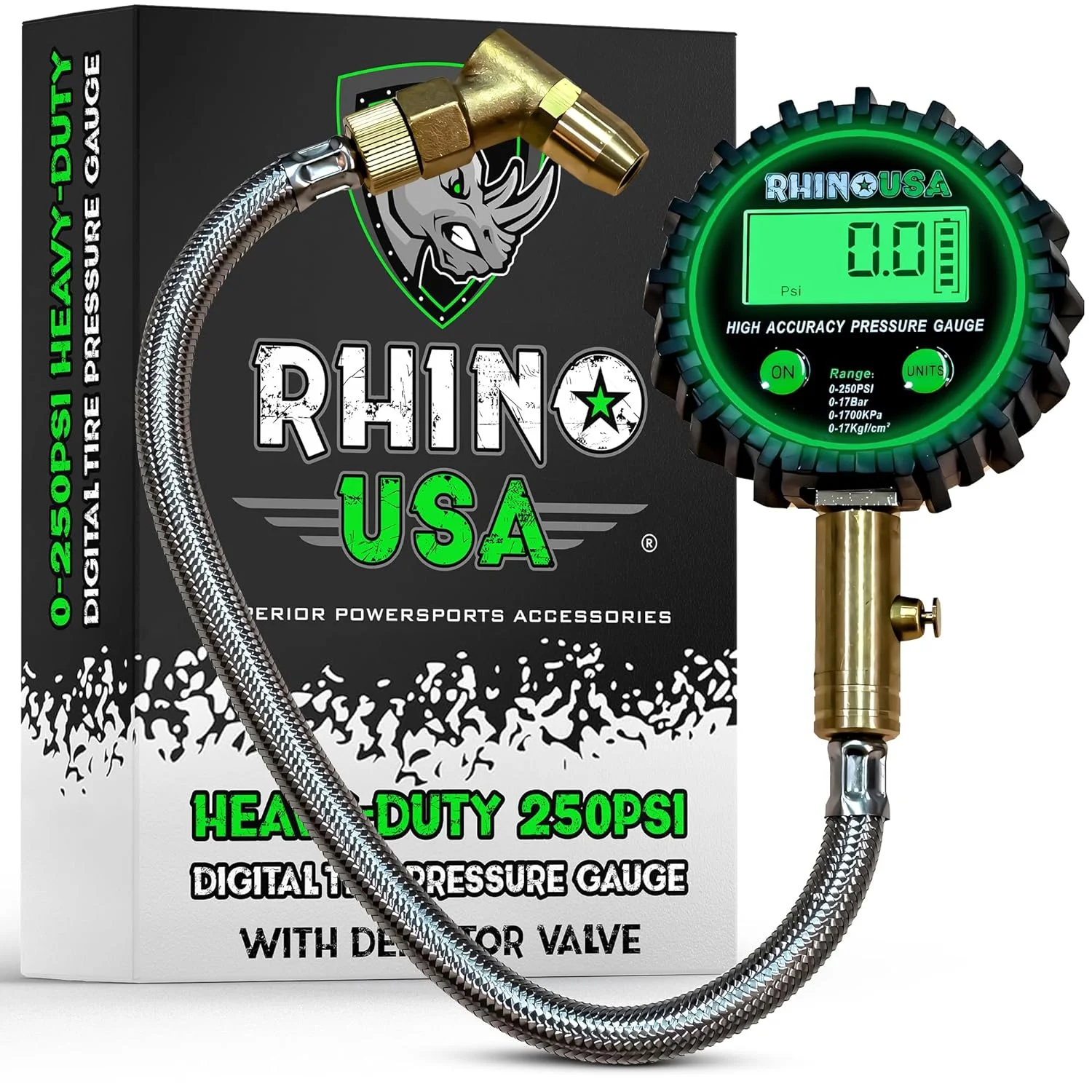
The dial (analog) gauge — the Rhino USA Heavy Duty Tire Pressure Gauge — drives a needle on a printed face, usually with a rubber-guarded body and a bleed valve; rugged, never needs batteries, holds calibration well if it isn't dropped, but you interpolate between marks.
The digital gauge — the AstroAI Digital Tire Pressure Gauge, the JACO ElitePro Digital Tire Pressure Gauge, and the Accutire MS-4021B Digital Tire Pressure Gauge — uses a sensor and an LCD for a precise numeric read, usually lit, and is the easiest accurate read for most people. The trade is a battery to die and a sensor that can drift if the unit is cheap.
The quick way to read it for the road:
- One gauge, easiest accurate read: AstroAI (value) or JACO (durable).
- Distrust batteries / deep cold / overlanding: Rhino USA dial.
- Cheap battery-free backup in every vehicle: Milton S-921 pencil.
- No-frills budget digital: Accutire MS-4021B.
AstroAI: the value pick that tops the field
If you make me pick one for most drivers, it's the AstroAI Digital Tire Pressure Gauge. It reads within about ±1 PSI, the lit nozzle and backlit screen make a cold-morning check painless, and it costs little enough that there's no reason to keep relying on the gas-station gauge. Its 0–150 PSI range leaves real headroom for a high-pressure trailer tire, where many car gauges run out of scale.
What earns it the top spot is the value-to-accuracy ratio. It's the pick the lab-test roundups keep landing on, and owners consistently report it still agreeing with a shop gauge after years in the glove box — the spec that matters is that it stays repeatable, not just that the box claims ±1 PSI. It isn't as bombproof as the garage-grade JACO and it does have a coin cell that will eventually die, and that's the honest trade. For about 90% of drivers and road trippers, this is the right answer.
Rule of thumb: if you want one gauge that nails the exact number with the least fuss and you're not working in deep cold, the AstroAI is the type and price to buy.
JACO and Accutire: garage-grade splurge vs honest budget digital
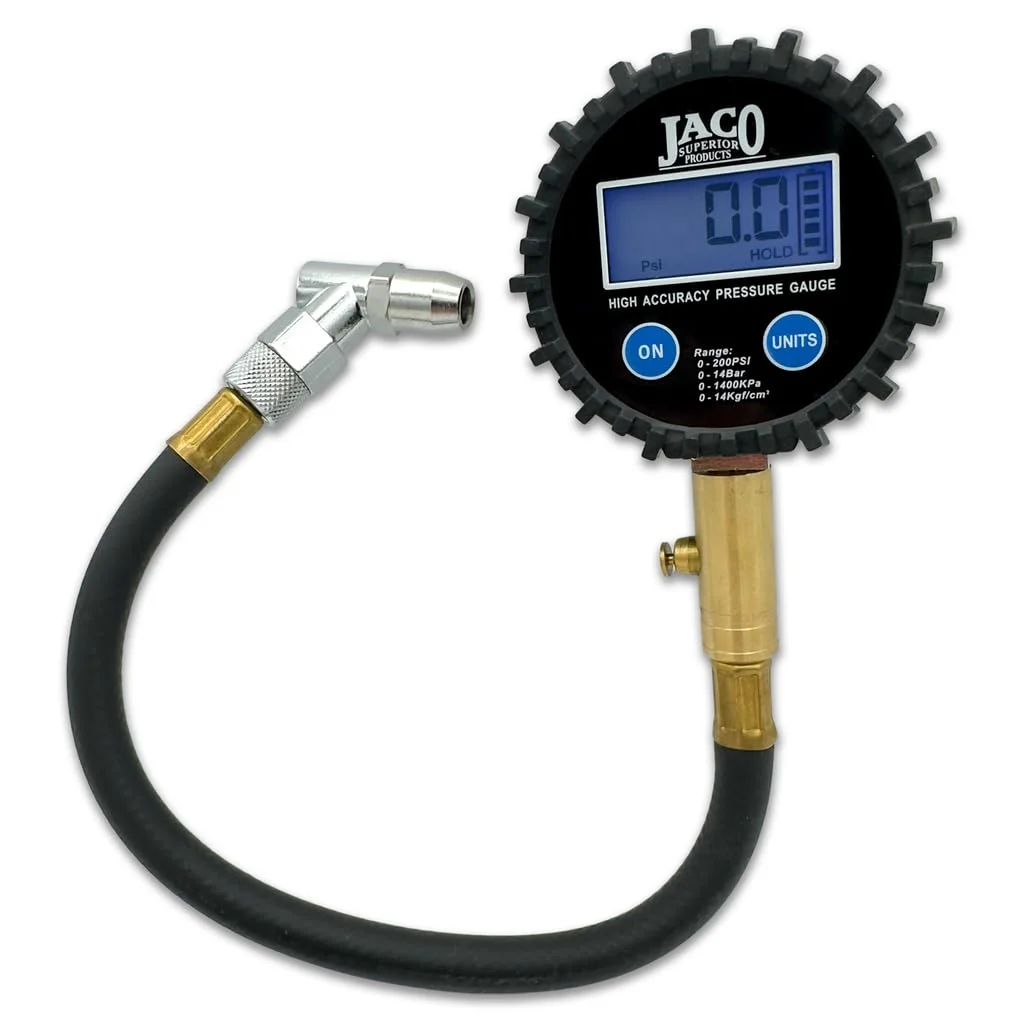
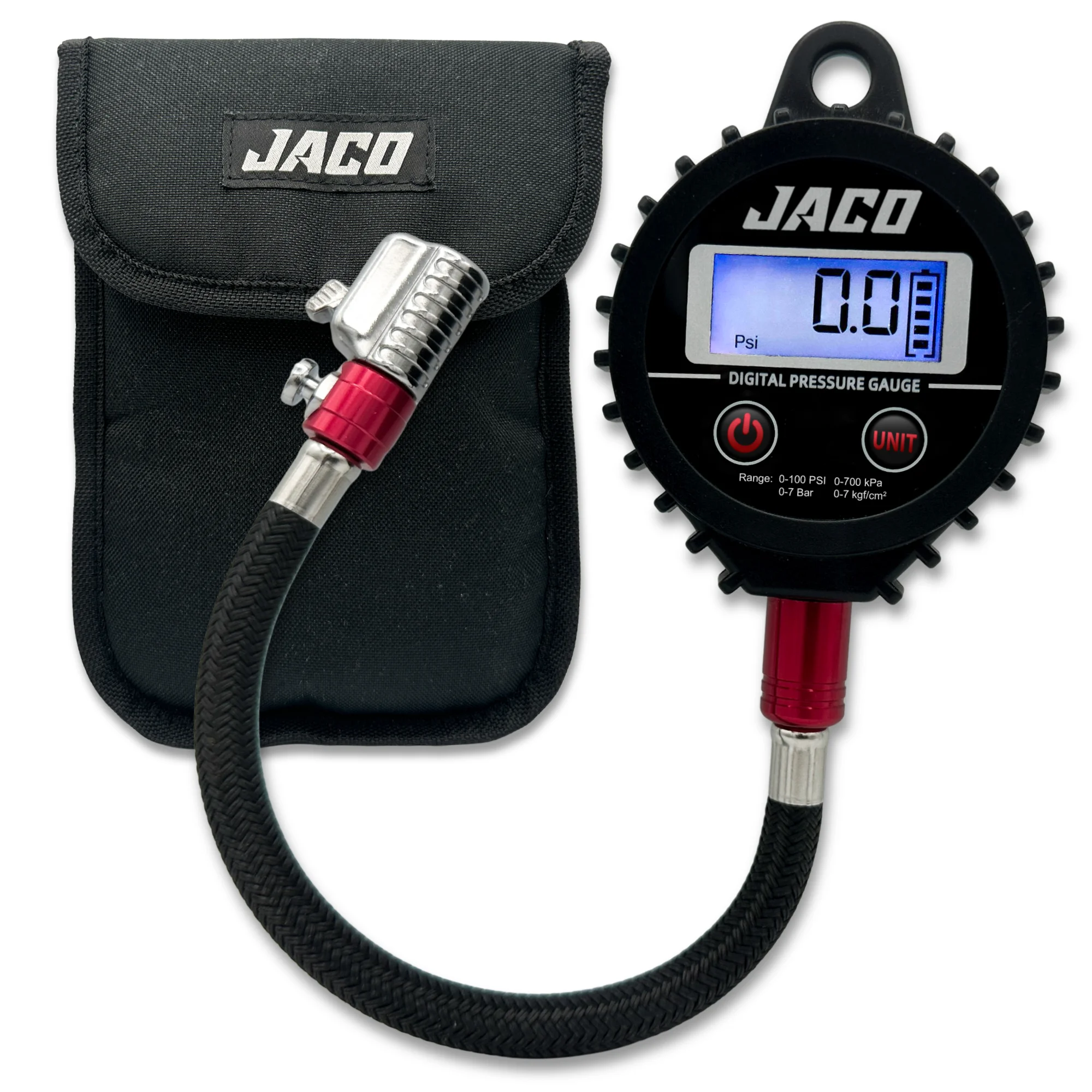
Want the sturdier, garage-grade step-up? The JACO ElitePro Digital Tire Pressure Gauge is the move. It holds the same ±1 PSI accuracy in a tougher body with a rubber-guarded housing and a braided hose, which is why it's a fixture in professional test garages — Car and Driver keeps one in their own garage not because its claim is better on paper but because it actually holds ±1 PSI across repeated reads. The trade is roughly triple the AstroAI's price for durability you'll only notice if the gauge takes real abuse.
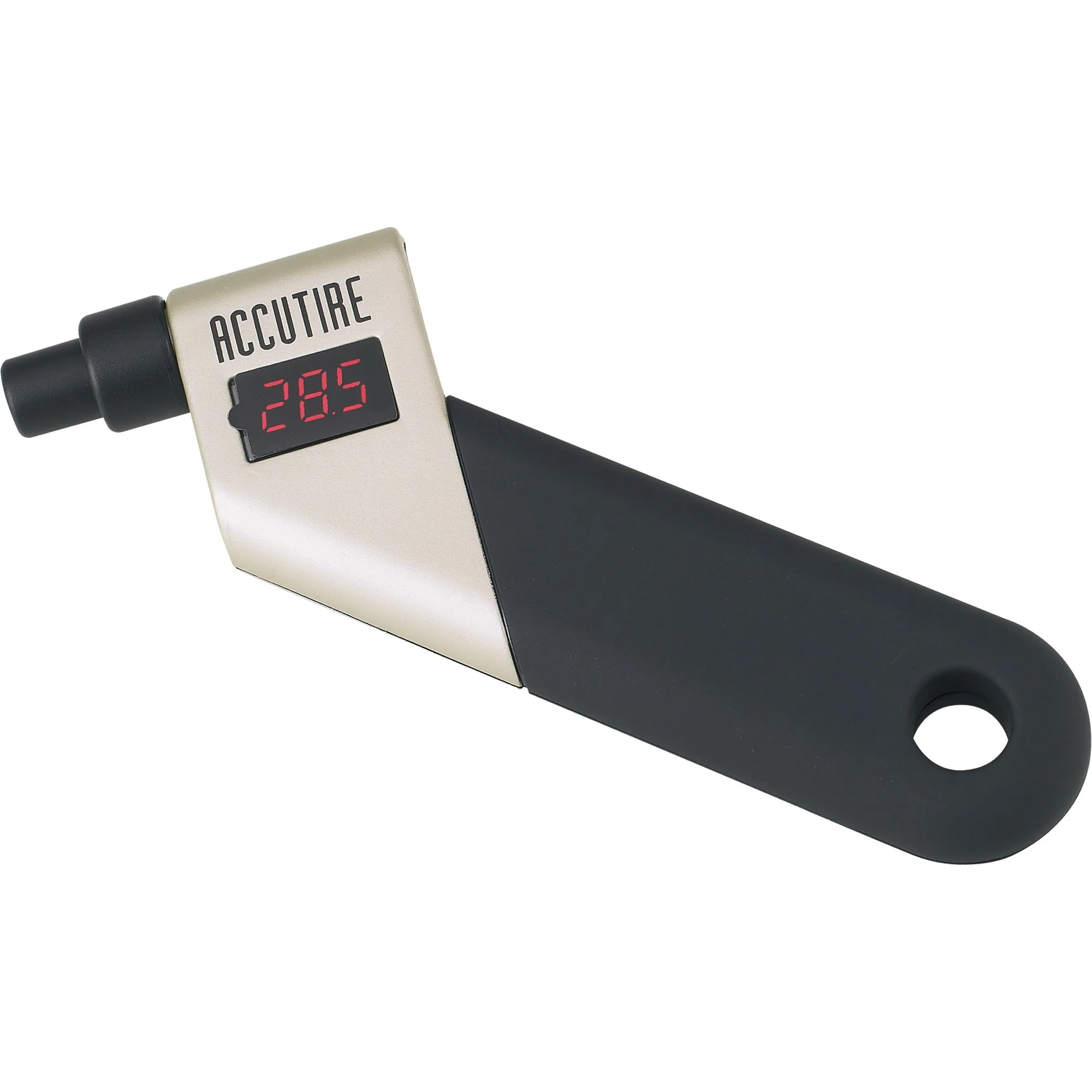
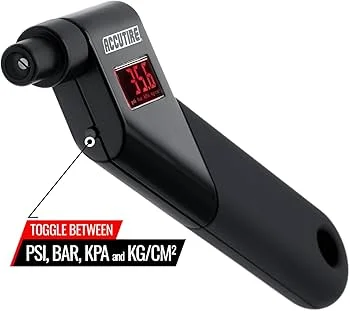
On the other end, the Accutire MS-4021B Digital Tire Pressure Gauge is the honest no-frills budget digital. It's a long-running, simple design that owner reports praise for lasting years, with a backlit display and a clear single-button read for under fifteen dollars. Fewer features — no fancy housing, a smaller range — but for someone who just wants a clear, repeatable number cheaply, it's good value. Buy it expecting garage-grade ruggedness or a 150 PSI range and you'll be disappointed; buy it knowingly as the simple budget digital and it's exactly that.
Rhino USA and Milton: when you distrust batteries
If your driving runs to cold that saps coin cells, or a gauge that lives in a truck, a toolbox, or an overlanding kit, a battery-free design is the call. The Rhino USA Heavy Duty Tire Pressure Gauge is the rugged dial pick: it never dies, shrugs off drops with its guarded face and a rubber boot, includes a bleed valve for airing down on the trail, and a quality dial holds calibration for years. The trade is that you read to the nearest pound by interpolating between marks. For anyone who airs down for sand or rock, my road-trip tire inflator guide covers the pump that pairs with it.
For a cheap battery-free backup to stash in every vehicle, the Milton S-921 Pencil Tire Pressure Gauge is the professional-shop standard — honest, accurate to ANSI B40.1, and cheap enough to keep one in each glove box and the trailer. It has nothing to break and no battery to fail; the only catch is reading the printed slide scale in bad light or at a bad angle, where parallax is a real error of a pound or two. Owners who've carried one for years report it still matching a digital on a cross-check, which is the whole point of a backup. Bought knowingly as the cheap, always-works second gauge, it's the best few dollars in the trunk.
- Cold climate or overlanding: a battery can strand you — go dial or pencil.
- Air down off-road: the Rhino's bleed valve lets you drop PSI and read in one tool.
- Keep the Milton as the cross-check that proves your main gauge still reads true.
Keeping a gauge accurate: calibration, storage, and technique
A gauge is only useful as long as it still reads true, and accuracy isn't permanent — it's a thing you maintain. The standards labs that test these instruments re-verify against a reference before every run; you don't need a calibration bench, but the same principle applies: a gauge you've never checked is a gauge you're trusting on faith.
The simplest verification is the two-gauge cross-check. When a new gauge arrives, read the same tire with it and with another gauge you trust, back to back. Agree within a pound or two and you're set; disagree by more than 2 PSI and one of them is wrong — the tiebreaker is a third gauge or a freshly verified shop gauge. Do this once at purchase and once or twice a year after, because gauges drift slowly and you won't notice the day one goes bad. This is exactly why the cheap Milton earns its spot: it's the disposable reference that tells you whether your main gauge still reads true.
Storage and design failures split by type. Digital gauges live and die by their battery — a weak coin cell can produce dim or erratic readings before it dies outright, so swap it at the first faint display. Dial and pencil gauges have no battery to fail but are the most sensitive to physical abuse: a dropped dial with a bent needle stop, or a pencil with a sticky slide, reads consistently wrong. A precision instrument that rattles loose in a hot trunk drifts faster than one in a padded case in the cabin. Treat the gauge like the measuring tool it is, not a throwaway.
Buy-once rule: cross-check a new gauge against a second one, re-check once or twice a year, store it padded, and set pressures cold to the door placard — and one good gauge stays trustworthy for years.
The mistakes that make a good gauge read wrong
Plenty of people own a perfectly accurate gauge and still set their tires wrong, because the gauge is only half the measurement — technique is the other half. The most common mistake is checking pressure warm. Driving heats the tires and raises pressure several PSI, so a reading after a drive looks higher than the cold pressure your placard specifies. Always check cold: first thing in the morning, or at least three hours parked.
The second is a sloppy valve seat. Press the chuck onto the valve stem at an angle and it hisses and bleeds air the whole time you read, giving a number lower than the real pressure — and dropping your actual pressure a little every check. Seat the chuck straight and firm in one motion; a clean seal reads instantly with no hiss. The third is trusting one read: a good gauge is repeatable, so take two; if they disagree by more than a pound, your seating technique is the culprit, not the gauge.
The fourth is the one that costs people tread: setting to the sidewall number instead of the placard. The big number molded on the tire sidewall is the maximum pressure, not your target. Your correct pressure is on the door-jamb placard, usually well below the sidewall max; set to the sidewall and you over-inflate, harden the ride, and wear the center tread. And remember pressure drops about 1 PSI for every 10-degree fall in temperature — pair a gauge with a quick tread-depth check and you catch the slow problems before they bite. Get the technique right and a fifteen-dollar gauge sets your tires as accurately as a hundred-dollar one.
Which tire pressure gauge should you buy? The verdict
Here's the short version, by how you drive:
- Most drivers / road trips / best value: the AstroAI Digital Tire Pressure Gauge. Reads ±1 PSI, lights up, costs less than a tank of gas.
- Want garage-grade durability: the JACO ElitePro Digital Tire Pressure Gauge. Same accuracy, tougher body, takes abuse.
- Cold climate / overlanding / distrust batteries: the Rhino USA Heavy Duty Tire Pressure Gauge. Battery-free dial with a bleed valve, never dies.
- Cheap backup for every vehicle: the Milton S-921 Pencil Tire Pressure Gauge. Pro-shop standard, the cross-check reference for under ten dollars.
- No-frills budget digital: the Accutire MS-4021B Digital Tire Pressure Gauge. A clear, repeatable number for under fifteen dollars.
There's no universal winner — match the type, range, accuracy, and backlight to your conditions, and do the one thing that separates a useful gauge from a dangerous one: verify it. Cross-check a new gauge against a second when it's new, re-check once or twice a year, and set your pressures cold to the door placard, not the sidewall. Do that and a two-minute habit with an eleven-dollar tool prevents the slow leaks, blowouts, and uneven wear that cost far more. And remember these verdicts are reasoned from published specs and named reviews, so sanity-check current prices and your own tire placard before you commit. — Dr. Lena Fox