
How Dashcam Power Draw Affects Car Battery Health (2026 Complete Guide)
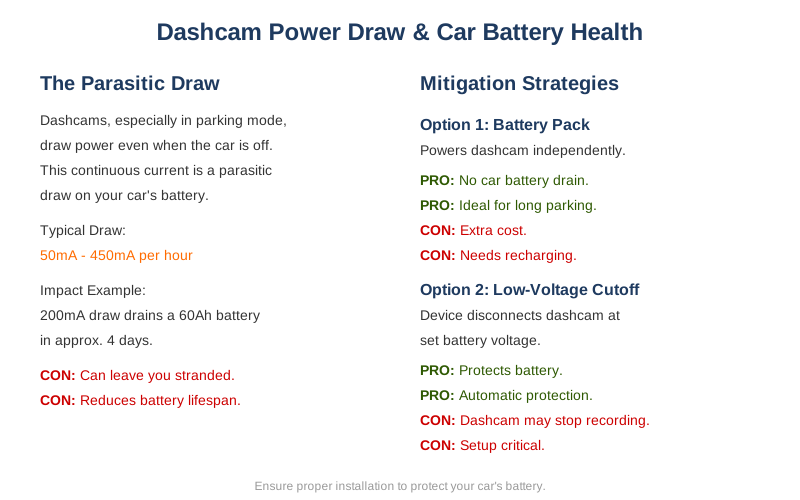
That new dashcam you just wired up might be draining your car's battery by 200mA every hour, leaving you stranded in 4 days. Most folks think a dashcam, especially one with 'parking mode,' is a set-it-and-forget-it deal. It's not. I've seen too many perfectly good batteries get cooked because of a few milliamps of parasitic draw.
That new dashcam you just wired up might be draining your car's battery by 200mA every hour, leaving you stranded in 4 days. Most folks think a dashcam, especially one with 'parking mode,' is a set-it-and-forget-it deal. It's not. I've seen too many perfectly good batteries get cooked because of a few milliamps of parasitic draw. The underlying physics are simple: energy in, energy out.
Redtiger explains that these devices are designed for low power, but 'low' is relative when your car is off. Your car's electrical system isn't designed for continuous aftermarket loads. The voltage regulator isn't active, and the battery is just a big chemical capacitor, bleeding charge. Safe Drive Solutions highlights the difference a few milliamps can make.
The Short Answer
The Reality Check
The real problem isn't the dashcam itself, but how it interacts with an already stressed 12V system. Modern cars have dozens of modules constantly drawing power. Your dashcam just adds another load to the system. DDPAI emphasizes that low power consumption is a design goal, but reality bites. Parking mode is the biggest offender. It keeps the camera awake, recording motion or impact events. This means the camera's processor, memory, and sometimes even the Wi-Fi module are active. Each of these components consumes milliamps, adding up to a significant continuous load. I've seen cheap cams pull 300mA just sitting there. Hardwiring kits often include a low-voltage cutoff (LVC) to prevent deep discharge. These typically cut power when the battery reaches 12.0V or 11.8V. While this prevents a no-start situation, it doesn't prevent the battery from entering a low state of charge, which still reduces its overall lifespan. A battery sitting at 12.0V is only about 50% charged. Vantrue also covers how battery-powered dashcams still draw power while charging. Factors like ambient temperature amplify the problem. Cold weather reduces battery capacity and increases internal resistance. Hot weather accelerates self-discharge and grid corrosion. Your battery's already fighting an uphill battle before you even add a dashcam. Redtiger suggests firmware updates can improve efficiency.| Component | How It Fails | Symptoms | Fix Cost |
|---|---|---|---|
| Car Battery | Sulfation, grid corrosion from deep cycling | Slow crank, no start, low voltage (below 12.4V) | $150 - $300 |
| Dashcam Hardwire Kit | Incorrect LVC setting, poor quality components | Battery drain despite 'protection' | $20 - $50 (replacement) |
| Wiring/Fuse Taps | Loose connection, undersized wire, poor crimp | Intermittent power, arcing, blown fuses | $5 - $15 (DIY materials) |
| Car Alternator | Overworked from constant low battery state | Premature bearing wear, rectifier diode failure | $400 - $800 |
How to Handle This
First step, measure your baseline. Disconnect the negative battery terminal and put a multimeter in series, set to amps. Wait 15 minutes for the car to 'go to sleep.' Note the parasitic draw. Anything over 50mA is suspicious. AutoRoamer states that continuous draw is the primary culprit. 1. Identify the always-on circuit: Use a test light or multimeter to find a fuse in your fuse box that has 12V even when the ignition is off. This is your 'always-on' source for parking mode. For switched power, find a fuse that only has 12V when the ignition is on. This is for driving mode. 2. Install a proper hardwire kit: Get a kit with adjustable low-voltage cutoff settings. Set it to 12.2V if you want to be safe, or 12.0V if you're feeling lucky. This ensures the dashcam cuts power before your battery is completely flat. Don't cheap out here. These kits are often just a buck converter and a voltage sensor. 3. Use an add-a-fuse: These are critical for maintaining circuit integrity. They allow you to tap into an existing fuse slot without cutting or splicing factory wiring. One slot for the original circuit, one for your dashcam. Use the correct fuse rating for the dashcam, usually 2A or 3A. Redtiger advises using correct power cables. 4. Ensure solid ground connection: A poor ground creates resistance, leading to voltage drop and heat. Find a factory ground bolt on the chassis, scrape away any paint, and secure the dashcam's ground wire. A loose ground connection will cause intermittent operation and potential circuit damage from inductive spikes. 5. Consider a dedicated battery pack: If you absolutely need 24/7 parking mode for weeks, a separate dashcam battery pack is the only reliable solution. These units recharge from the car's 12V system only when the engine is running and power the dashcam directly when the car is off. This completely isolates the dashcam from your car's main battery. Costly, but effective. AutoRoamer further explains that many modern dash cams are designed with low power consumption.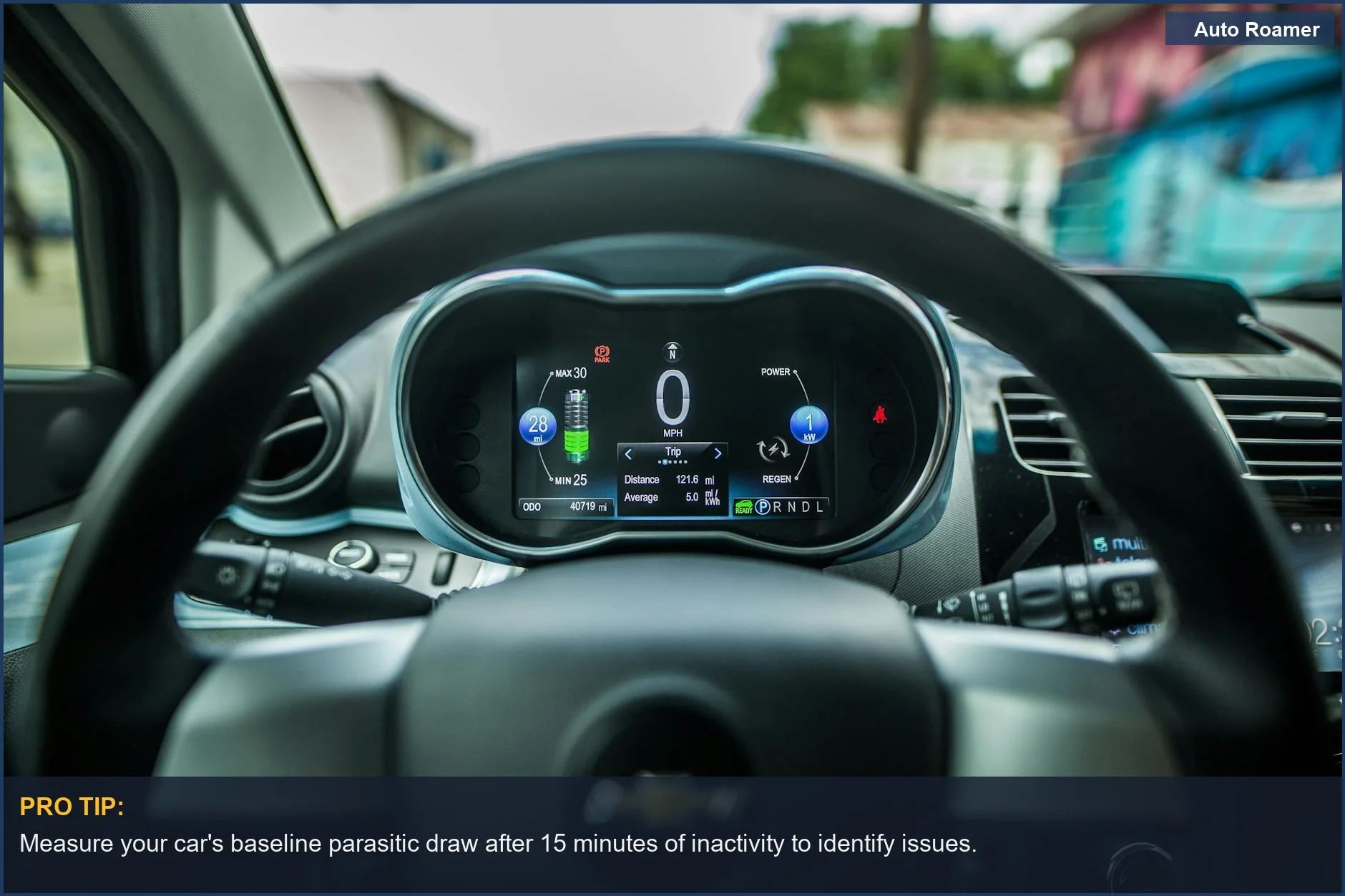
What This Looks Like in Practice
I've seen these issues pop up in all sorts of vehicles. A 2020 Honda Civic owner had their 60Ah battery die in 5 days because their cheap hardwire kit's LVC was set to 11.5V and the dashcam pulled 350mA in parking mode. The BCM alone drew 30mA. Another case: a 2018 Subaru Ascent owner reported no issues with a hardwired dashcam, but their vehicle was driven daily. This is key. The alternator had enough run time to recover the battery. Subaru Ascent owners confirm this. Conversely, a 2019 Toyota Highlander, parked for 3 weeks during vacation with a 200mA dashcam, cranked at 9.8V and needed a jump. The battery was permanently degraded. Thermal cycling wasn't even the primary issue, just pure ampere-hour depletion. Optima Batteries discusses dashcam power draw. Then there's the guy with a 2017 Ford F-150 who used the cigarette lighter adapter. The dashcam would lose power every time he hit a bump due to the loose socket tolerance. This constant power cycling caused flash memory corruption in the dashcam itself, making it unreliable. Circuit integrity matters more than you think. A Kia Seltos owner, as described by Safe Drive Solutions, got a Vueroid D20 Q2 dash camera that draws a mere 2 milliamps in parking mode. That's a game-changer. That low draw means it could sit for weeks without touching the vehicle's computer system draw. I've seen a Ford Transit work van, parked for 48 hours with a dashcam pulling 280mA, fail to start. The van's 80Ah battery was only 60% charged before parking. The dashcam was the straw that broke the camel's back.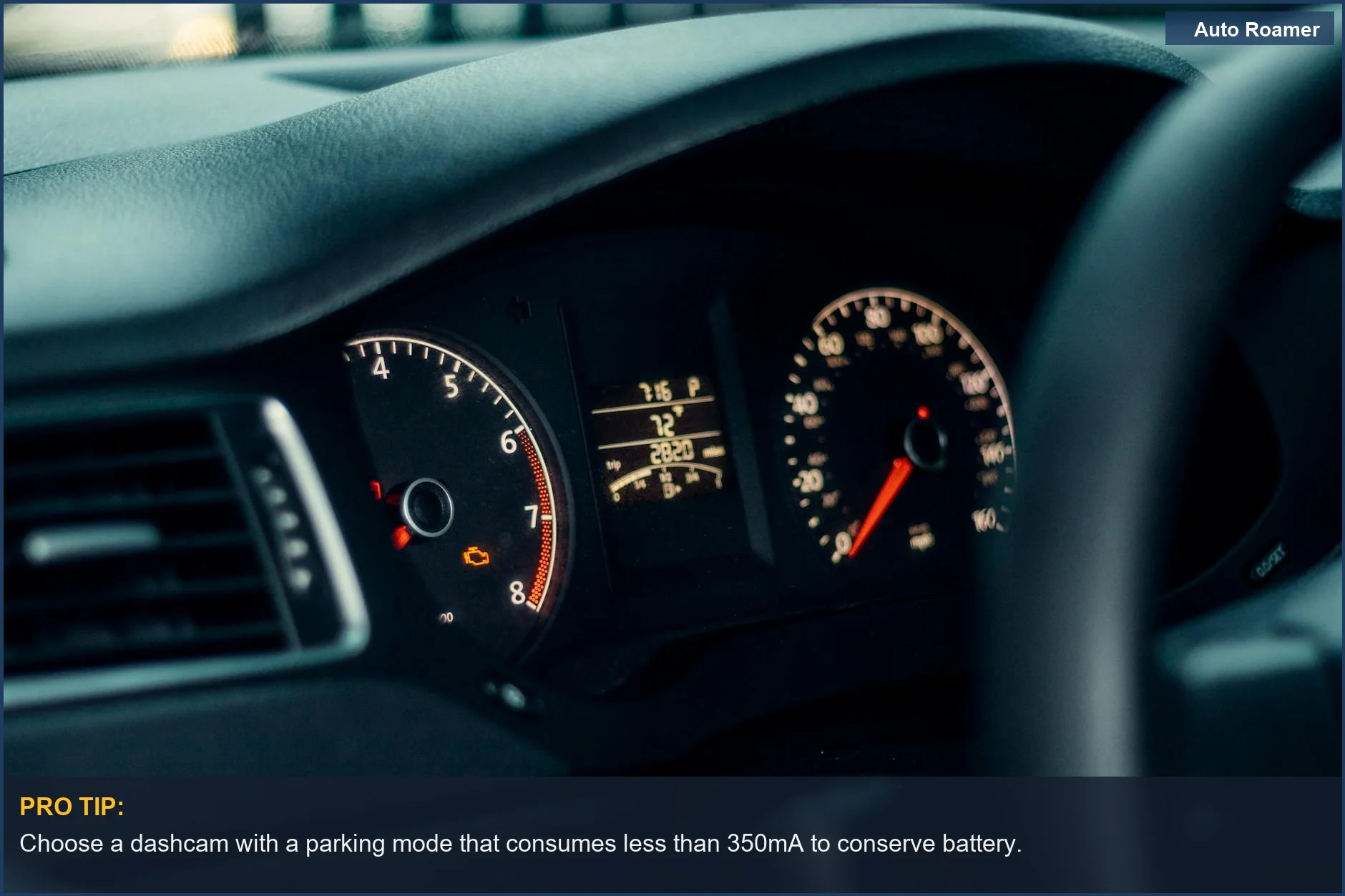
Mistakes That Cost People
| Mistake | Why It Fails | Diagnostic Tip |
|---|---|---|
| Direct wiring without LVC | Deep discharge, battery sulfation. No voltage threshold protection. | Measure battery voltage after parking overnight (should be >12.4V). |
| Using cheap fuse taps | Poor mechanical bond, high resistance, intermittent power. | Check for melted plastic around fuse box, dashcam resetting. |
| Ignoring parasitic draw specs | Assuming 'low power' is always sufficient. | Measure actual current draw with a multimeter. |
| Relying on internal dashcam battery | Limited capacity, short parking mode duration. Thermal degradation. | Dashcam only records for minutes, not hours, in parking mode. |
| Poor ground connection | Voltage drops, electrical noise, unreliable operation. | Intermittent dashcam function, fuzzy video. |
| Hardwiring to critical circuits | Risk of interfering with OEM systems, blowing essential fuses. | Other car functions (radio, windows) mysteriously fail. |
Key Takeaways
Mounting a dashcam is simple; wiring it correctly without compromising your car's electrical system is where people screw up. The physics are non-negotiable. Every electron pulled from your battery when the engine is off contributes to its eventual demise. Vancouver Dashcam states most dashcams consume 2-4 watts, but that's not always the full story.Frequently Asked Questions
What's the cost difference between DIYing a dashcam wiring fix versus taking it to the dealership?
Do I really need a $15 multimeter to check for parasitic draw, or can I just eyeball it?
What if I install a low-voltage cutoff, but my battery still dies after a few days?
Can a dashcam permanently damage my car's electrical system beyond just killing the battery?
I heard that dashcams with internal batteries don't drain the car battery at all. Is that true?
🏅 Looking for Gear Recommendations?
Check out our tested gear guides for products that work with this setup:
Sources
- Does a Dash Cam Drain Battery: How to Prevent It? - Redtiger
- Does a Dash Cam Drain a Battery? - optimabatteries
- Will a Battery Powered Dash Cam Drain My Car Battery? - Vantrue
- The Surprising Truth About Dash Cams and Your Car Battery Life
- Do Dashcams Drain Your Car Battery? What You Need to Know
- How much power do dash cams use? Any concerns? - Reddit
- Dashcam electrical impact on car battery? - Facebook
- does-a-dash-cam-drain-battery?srsltid=AfmBOoq3lzkQ9ClKcA9ClKc1hotHIMRBx85pQvPzGUJFOzhe1LnzGi6lfENHs
- Do Dashcams Drain Car Battery? Prevention - Techsbook
- Will My Dash Cam Kill My Car Battery? - DDPAI
- Will a Battery Powered Dash Cam Drain My Car Battery? - Vantrue
- Extend Your Car Battery Life with Low Power Dash Cameras