
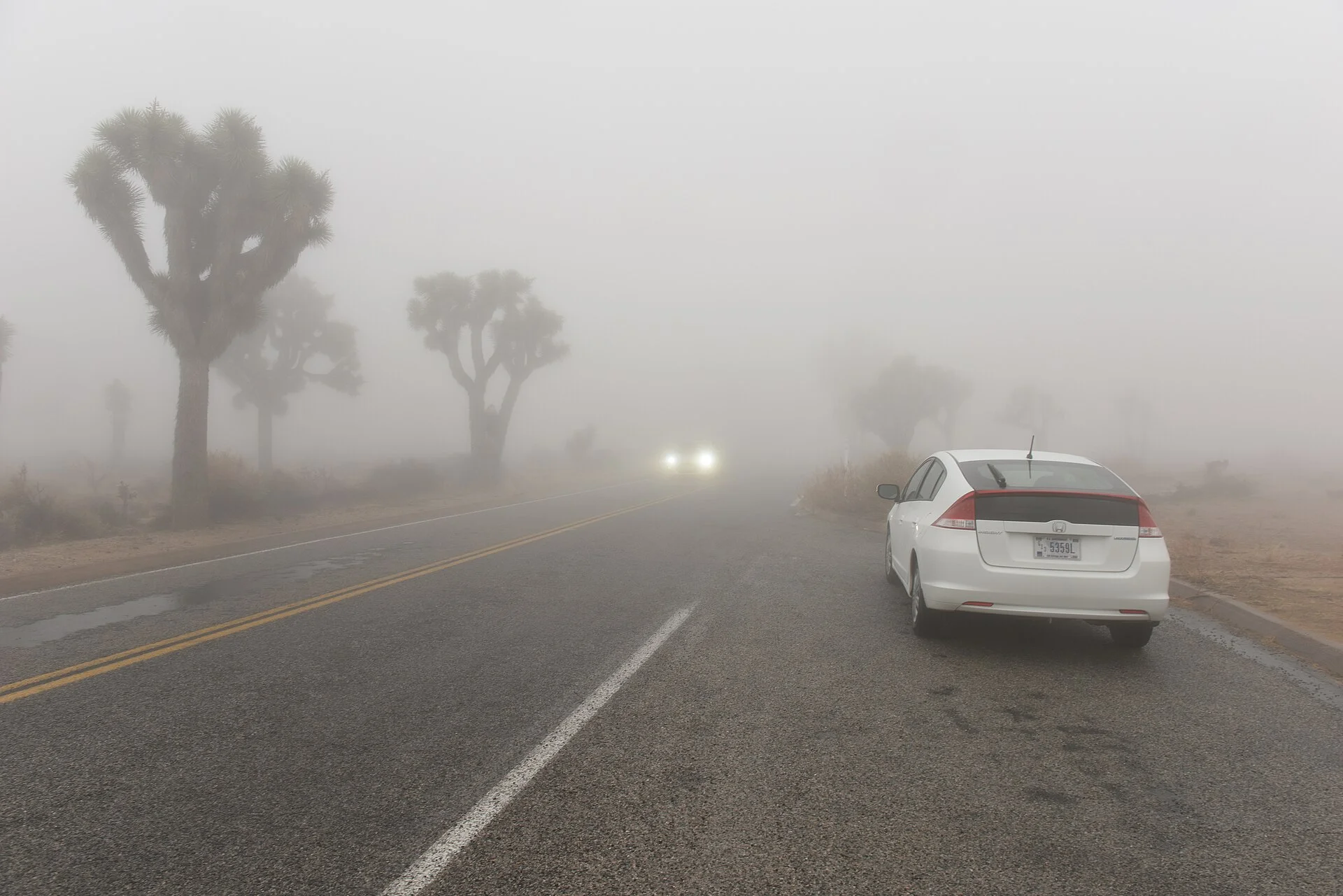
The Direct Answer: It Depends on Your State
Driving with your hazard lights on in fog is not settled by one national rule — it is settled by your state's own vehicle code, and those codes disagree sharply. Some states flatly forbid activating the four-way flashers on a moving vehicle no matter the weather. Others permit it broadly. A smaller group writes an explicit low-visibility or speed-tied exception into the statute itself, which is the closest thing to an actual "fog rule" that exists anywhere in U.S. traffic law.
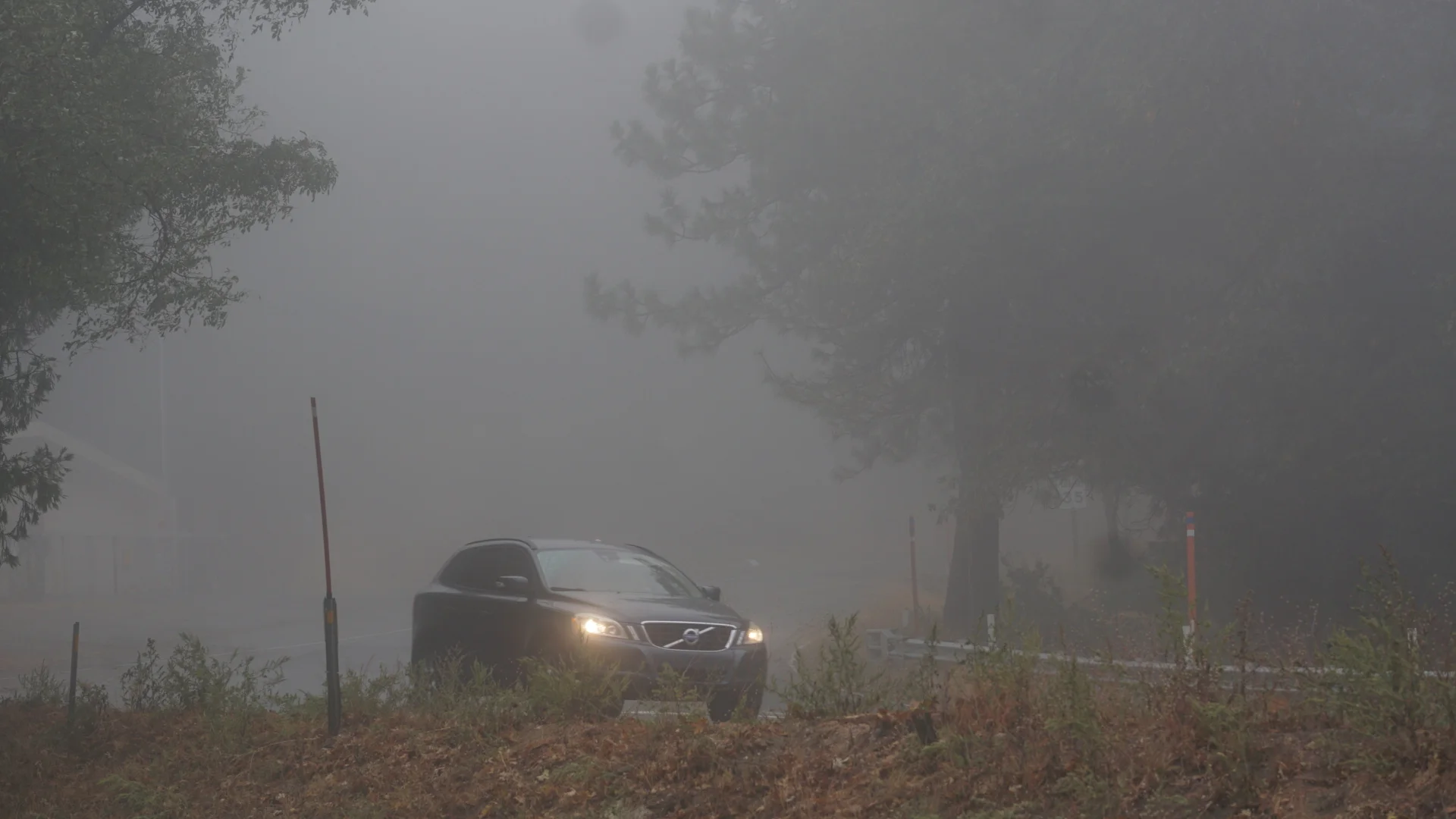
Fog raises this question more urgently than almost any other weather condition, because it is the scenario where drivers most want extra visibility and have the fewest good instincts for what to do about it. Rain at least keeps a car's silhouette visible through the water beading on the windshield; dense fog can erase a vehicle's outline within a few car lengths, and the reflex is to flip on every light available, hazards included. That reflex runs straight into a design fact: hazard lights were built, and are written into most state codes, as a signal for a stopped or disabled vehicle — not a moving one.
The distinction matters because fog is treated as a genuinely different trigger from rain in several statutes. A handful of jurisdictions that stay silent on hazards-in-rain name low visibility broadly enough to sweep fog in, or name fog specifically, when they carve out an exception — a related but separate question from the more commonly asked legality of hazard lights in the rain.
What follows is not a single yes-or-no, because none exists. It is a map of how the one variable that actually decides your answer — the statute of the state you're physically driving through — sorts into three groups: outright bans, broad permission, and narrow low-visibility or speed-based allowances. Layered on top of the legal question is a separate, and arguably more important, safety question: agencies from the National Weather Service to State Farm warn that hazards can be the wrong tool in fog even where they're legal, because of what they do to your turn signals at the exact moment you need them.
Read both halves before you reach for the switch next time visibility drops. The legal half tells you what you're allowed to do; the safety half tells you what actually keeps you from getting hit.
The One Deciding Variable: Your State's Statute
Every other detail in this article branches off a single fact: which state's vehicle code applies to you right now. There is no federal hazard-light law and no uniform model statute that all 50 states adopted — each legislature wrote its own rule, at a different time, with a different starting assumption about what hazard flashers are for.
Broadly, state statutes on moving hazard-light use fall into three buckets. The first is an outright ban: the code prohibits flashing lights on a moving vehicle except for a short list of named exceptions (emergency vehicles, school buses, funeral processions), and a hazard flasher used in fog simply isn't on that list. The second is broad permission: the statute allows simultaneous flashing signals to indicate a general "traffic hazard," a phrase broad enough that officers and courts have read it to cover a car moving well below the speed of surrounding traffic, fog-slowed or not. The third, and rarest, is an explicit conditional allowance — a statute that names a specific trigger, such as a minimum-speed threshold, a posted-speed floor, or the phrase "extremely low visibility," under which hazards are affirmatively legal while moving.
A fourth category deserves its own mention: some state codes are simply silent. They regulate hazard use for a stopped or disabled vehicle in detail and never address a moving one at all, leaving the question to officer discretion and local interpretation rather than a clear statutory answer, according to one legal explainer's review of state flasher codes (per LegalClarity's state-by-state review).
This is why a driver can cross a single state line, change nothing about the fog outside the windshield, and go from breaking the law to following it or vice versa. It is also why generic advice like "hazards are fine in bad weather" or "hazards are always illegal while moving" is wrong for a large share of drivers reading it — the honest answer requires checking the actual code, or at minimum the category, for the state the trip is happening in.
The sections below sort the states this research surfaced into those buckets. None of it is a substitute for the current text of your own state's code, since legislatures amend these provisions — Florida's own exception did not exist before 2021 — and a magazine article, however current, is a snapshot.
States That Ban Hazard Lights Outright
Several states treat hazard flashers on a moving vehicle as flatly illegal, full stop, with no fog or rain exception written in. Louisiana, Nebraska, and New Mexico are the ban states we could confirm directly against primary law — the state’s own vehicle-lighting statute, and for Nebraska a state supreme court ruling on top of it — rather than relying on a secondary state-by-state summary.
Nebraska's version of the ban is especially clear-cut: in State v. Warriner (267 Neb. 424, 2004), the Nebraska Supreme Court held that the state's general prohibition on flashing lights while driving (Neb. Rev. Stat. § 60-6,230) applies directly to hazard flashers, closing off the argument that hazards are somehow a different category of light than the statute meant to cover.
Louisiana and New Mexico both spell the restriction out directly in statute. Louisiana's code prohibits flashing lights on a vehicle except for authorized emergency vehicles, school buses, or a vehicle using them to indicate a turn or, more narrowly, the presence of a hazard requiring unusual care to approach or pass — not a blanket allowance for a car simply driving through fog (La. R.S. 32:327).
New Mexico's statute takes a similarly restrictive shape: flashing lights are prohibited on a vehicle except as expressly authorized, with the named exceptions running to emergency vehicles, school buses, and snow-removal or highway-marking equipment — a driver using hazards to cope with fog is not on that list (NM Stat § 66-3-835).
Notice what these statutes have in common: they are written as closed lists. The legislature named the specific situations where flashing lights are permitted, and everything else — including a moving car trying to be more visible in fog — falls outside the list by default. That drafting style is the structural reason these bans apply even to a driver acting in obvious good faith during genuinely bad weather; the statute doesn't carve out an intent-based exception, it carves out a use-based one.
If you regularly drive through fog in any of these states, the safest reading of the law is to treat hazards as reserved for the moment you are stopped, not the moments before you decide to stop.
A statute written as a closed list of exceptions doesn't bend for good intentions — if "fog" isn't on the list, hazards-while-moving isn't legal there, regardless of why you flipped the switch.
States That Allow or Require Hazards in Low Visibility
At the opposite end sits a group of states whose statutes affirmatively address low-visibility or slow-traffic situations, rather than staying silent on them or banning them outright. Florida is the clearest example: its code prohibits flashing lights generally, but carries an exception permitting them "during periods of extremely low visibility on roadways with a posted speed limit of 55 miles per hour or higher" (Fla. Stat. § 316.2397(7)(c)).
That Florida exception is worth dwelling on because it names weather conditions specifically rather than leaving "low visibility" undefined: qualifying conditions include heavy fog, rain, or smoke, and the allowance did not exist before July 1, 2021, when it took effect after the governor signed it into law on June 29, 2021 — misusing hazards outside those conditions remains a noncriminal traffic infraction carrying a $30 fine (per a legal summary of the 2021 amendment).
Pennsylvania takes a related but distinct approach, building the allowance around speed rather than a named weather condition — covered in full in the next section, since it doubles as the clearest example of the speed-threshold rule generally.
A separate group of states doesn't name fog or a speed number at all, but permits hazards to signal a general "traffic hazard" — a phrase broad enough to plausibly cover a vehicle moving well below the speed of surrounding traffic because of fog. Because that "traffic hazard" language is interpretive and worded differently from state to state, treat it as a reason to read your own state's statute, not as a blanket green light.
Other states permit hazard use while driving but almost always attach a condition — a speed floor, slow traffic, or a "hazard requiring unusual care" — rather than an unlimited green light. Pennsylvania, covered in the next section, is the clearest example we could verify against the statute itself.
The takeaway is not "these states are fog-friendly." It's that a permissive-sounding statute usually still has a trigger condition buried in it — slow traffic, a hazard requiring unusual care, or a specific speed number — and reading only the headline ("hazards are legal here") without the trigger is how drivers end up technically in violation despite feeling like they did the responsible thing.
The Speed-Threshold Rule: How Fast Is Too Fast for Hazards?
The most concrete pattern in the states that do permit moving hazard use is a speed number, not a weather word — and three states illustrate three different ways of writing that number into law.
Pennsylvania's code addresses hazard use directly in weather terms tied to speed. Outside business or residence districts, a driver whose vehicle is "unable to maintain a speed of at least 25 miles per hour because of weather, grade or other similar factors" is required to use the simultaneous flashing signals; the same duty applies when the vehicle can't maintain the minimum speed set for that roadway under a separate statutory provision (75 Pa.C.S. § 4305). Read closely, this isn't merely permission — Pennsylvania frames it as a requirement once fog (or any weather) has slowed a driver below that 25 mph floor.
Virginia takes a flat speed cap instead of a weather trigger. Its code states that hazard lights "shall not be flashed simultaneously while the vehicle is traveling faster than thirty miles per hour," with an exception for funeral processions, and that they may be flashed while a vehicle is "slowed or stopped at the scene of a traffic hazard" or "traveling at a speed of thirty miles per hour or less" (Va. Code § 46.2-1040). In practice, that means a Virginia driver crawling through fog at 25 mph is inside the law, while the same driver holding 45 mph with hazards flashing is not — regardless of how thick the fog looks.
Florida inverts the logic entirely by tying its allowance to a HIGH posted speed limit rather than a low actual one: the exception only applies on roadways posted at 55 mph or higher, meaning the same extremely-low-visibility fog on a 35 mph city street gets no such protection under that statute.
The pattern across all three: lawmakers keep reaching for a number — 25 mph, 30 mph, 55 mph — as the proxy for "this is a genuine emergency speed reduction, not routine caution." None of the three statutes uses "fog" alone as a sufficient trigger; each ties the exception to how fast you're actually able to go, or the class of road you're on. That's a meaningfully different question than "is it foggy," and it's the detail most drivers miss when they assume a state's low-visibility exception applies the moment they see mist on the windshield.
None of these statutes ask "is it foggy?" They ask "how fast are you actually moving, or what's this road posted for?" — fog is only ever the reason the speed dropped, never the trigger by itself.
Why Hazards Can Backfire in Fog, Even Where They're Legal
Even in a state where flashing hazards while driving through fog is unambiguously legal, safety guidance from multiple sources argues it's still the wrong move for most fog scenarios — because of what hazard lights do to the rest of your signaling.
The core mechanical problem is that hazards and turn signals typically share the same bulbs and circuit. With hazards flashing, a driver has no way to separately signal an upcoming turn or lane change; other drivers behind or beside you "also don't know where you may be going to," as one specialist put it in an analysis of the practice, meaning the exact maneuver most likely during a slow, cautious crawl through fog — a lane change to avoid a stalled car, a turn into a driveway to wait it out — becomes a maneuver you can no longer announce (per a Forbes analysis of hazard-light use in bad weather).
The second problem is what hazard flashers communicate to the drivers around you. A four-way flasher's default meaning, drilled into every driver from their first hours behind the wheel, is "this vehicle is stopped or disabled." A police department cited in that same analysis lists hazard lights as reducing visibility clarity and confusing other drivers about whether the flashing vehicle is stalled — precisely the wrong signal to broadcast in fog, where following drivers are already relying on brake lights and steady taillights to judge closing speed. The same source notes it becomes genuinely "challenging to know who is braking" once hazards are added into the mix of lights a following driver has to parse in low visibility.
A driving-safety guide from a national tire and auto-service chain states the guidance plainly rather than diplomatically: "Avoid using your hazard lights while moving — other drivers may think you've stopped," reserving hazard activation for the point you've actually pulled off the road (per the guide's fog-driving section).
Put together, the legality question and the safety question can point different directions in the same state. A driver in a Pennsylvania fog bank crawling below 25 mph may be following the letter of § 4305 by flashing hazards — and simultaneously giving up the one tool that would let them safely signal a lane change around a hazard they can't yet see. Legal and safe are not always the same instruction.
Fog Lights vs. Hazard Lights: Using the Right Tool
The reflex to reach for hazards in fog usually comes from a reasonable goal — "I want to be more visible and see better" — but hazard flashers were never engineered to do either of those things while a car is moving. There is a purpose-built tool for that job, and it's a different switch entirely: fog lights, used together with low beams.
Fog lights are designed to illuminate the road in low-visibility conditions such as rain, snow, thick fog, or dust, with a sharp, low cutoff engineered specifically to avoid reflecting light back off water droplets and causing glare — the opposite of what happens when a driver switches to high beams in fog, per a lighting manufacturer's explainer on how the fixtures work (see the breakdown of fog-light design). They emit a wide, short-range beam and are meant to be run in conjunction with headlights, not as a replacement for them.
The National Weather Service's own fog-driving guidance backs this pairing: drivers should use low-beam headlights, which also activates the taillights that make a vehicle visible to traffic behind it, and the guidance is explicit that high beams make things worse — "Never use your high-beam lights. Using high beam lights causes glare, making it more difficult for you to see what's ahead of you on the road" (per NWS fog-driving safety guidance). A separate roadside-assistance guide reinforces the same pairing, recommending drivers "drive with low beams and fog lights" specifically because "high beams/brights can worsen visibility because they reflect off the fog" (per that fog-driving guide).
- Low beams: keep on at all times in fog; they also power the taillights that make you visible from behind.
- Fog lights, if equipped: run alongside low beams, never as a substitute for them, and switch off once visibility returns to normal.
- High beams: avoid entirely in fog — the light reflects off suspended water droplets and reduces your own forward visibility.
- Hazard lights: reserved for a stopped or disabled vehicle, not a moving one, in the safety guidance above.
The functional difference comes down to what each light is actually built to do. Fog lights and low beams are visibility tools — aimed to cut through the specific optical problem fog creates. Hazard lights are a status signal, communicating "stopped" to other drivers, and flashing that signal on a moving car sends the wrong message regardless of how well-intentioned the driver is.
If fog forces you onto the shoulder, reflective triangles and flares do the job hazard lights were designed for — shop emergency roadside kits on Amazon.
What to Do When You Genuinely Can't See
There's a real scenario underneath all of this: fog so dense you can barely see the hood of your own car, where neither low beams nor fog lights are cutting it and the honest answer isn't a lighting fix at all. That's the moment the hazard-lights question changes entirely, because you're no longer deciding whether to flash them while driving — you're deciding to stop.
The National Weather Service's guidance is direct about this threshold: when visibility becomes extremely limited, "the best course of action is to first turn on your hazard lights, then simply pull into a safe location such as a parking lot of a local business and stop" (per NWS fog-driving guidance). Note the sequence — hazards go on as part of stopping, not as a substitute for it, which is the exact opposite of the moving-car use this article has spent most of its length examining.
If no parking lot or exit is available and you have to stop on the shoulder, the same guidance gets specific about what to do next: pull as far off the road as physically possible, then "turn off all lights except your hazard flashing lights, set the emergency brake, and take your foot off of the brake pedal to be sure the tail lights are not illuminated," so a following driver isn't confused by a brake light suggesting you're about to move.
A separate insurer's fog-safety guide offers the same bottom line in plainer language: if fog becomes extremely dense, "pull over into a parking area until the fog clears," treating that as the safer default over continuing to drive at any speed (per that guide's dense-fog section). The same source recommends building in far more following distance well before conditions get that bad — increasing your following gap "by at least 5 seconds instead of the normal 2 seconds" behind the car ahead, precisely because stopping distances in fog are unpredictable and rear-end pileups are the dominant fog-related crash pattern agencies warn about.
If you genuinely cannot exit or find a shoulder wide enough to stop safely, one auto-service chain's guidance for that specific bind is to slow further and use sound: "If you can't pull over, go slow and sound the horn occasionally," paired with driving so that your stopping distance never exceeds the distance you can actually see ahead of you — a simple, weather-agnostic rule that outperforms any lighting decision on its own.
The right moment for hazard lights in fog isn't "visibility got bad." It's "I have stopped, or I am in the act of stopping." Everything before that point is a low-beams-and-fog-lights problem, not a hazards problem.
Know Before You Drive: The Verdict
Circle back to the question this article opened with: is it legal to drive with your hazard lights on in fog? The honest answer is still that it depends entirely on your state — a real cluster of states ban it outright with no fog exception, a separate cluster permits it broadly, and a handful, Florida and Pennsylvania chief among them, tie the allowance to a specific speed threshold or an explicitly named low-visibility condition rather than to fog alone.
If there's one habit worth building from all of this, it's checking the actual trigger language in your state's statute rather than the vibe of the rule. "Hazards are legal here" is rarely the whole sentence — it's usually "hazards are legal here below 25 mph," or "below 30 mph," or "on a road posted 55 or higher, during extremely low visibility." Knowing which number applies to you is the difference between technically compliant and technically cited.
The bigger verdict, though, sits above the legal patchwork: even where hazards-while-moving are fully legal, the safety case against them in fog is consistent across every source in this research. Hazard flashers disable your ability to signal a turn or lane change at the exact moment fog makes that signal most necessary, and they broadcast "stopped" to drivers who need to correctly judge that you're still moving. Low beams and, if equipped, fog lights are the tools actually engineered to help you see and be seen while the car is in motion — hazards are the tool for the moment after you've decided to stop.
So the practical rule that survives every state's different statute: drive fog on low beams (with fog lights if you have them), build in extra following distance, and treat the hazard switch as reserved for the moment you're pulling over or have already stopped — not as a substitute for slowing down and seeing where you're going. If the fog is bad enough that you're reaching for the hazard switch while still moving, that's usually the sign it's bad enough to stop instead.
Statutes get amended — Florida's own low-visibility exception is only a few years old — so treat any state-specific number here as a starting point, and check your current state code before you rely on it in an actual fog bank.