Family Travel

When to Trade in a High Mileage Family Car (2026 Complete Guide)

Jake - The Dirtbag Engineer
13 min read
Prices verified March 2026
Includes Video

The dealer wants another $1200 for a timing belt job on your 2013 Honda Odyssey, and you're wondering if it's finally time to ditch the minivan. I've seen too many people dump a perfectly good vehicle because some service writer convinced them it was a ticking time bomb.

The dealer wants another $1200 for a timing belt job on your 2013 Honda Odyssey, and you're wondering if it's finally time to ditch the minivan. I've seen too many people dump a perfectly good vehicle because some service writer convinced them it was a ticking time bomb. The real question isn't the mileage, it's the remaining service life of critical subsystems versus the repair cost.

A lot of factors influence trade-in value, but the biggest one is often ignored: your own wallet. Don't let a mechanic's labor rate dictate your financial decisions. The sweet spot for trading in a high-mileage family car isn't some magic number, it's a cold, hard calculation of future failure rates and your tolerance for wrenching. Market conditions play a role too, but physics always wins.
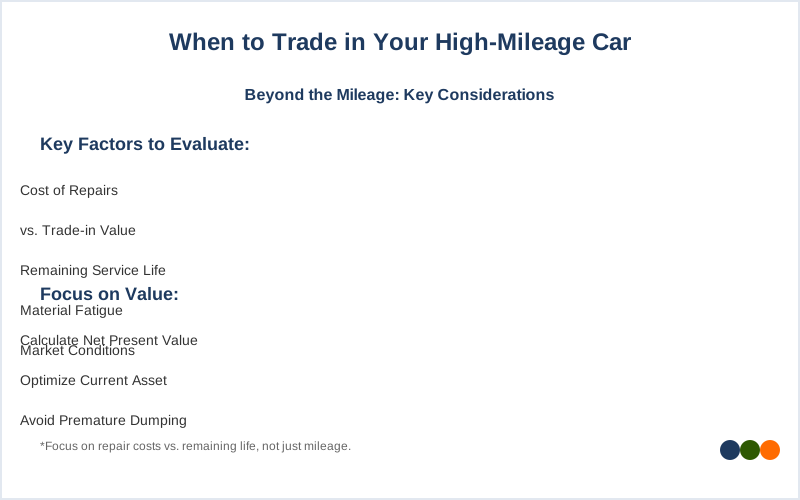
Infographic: When to trade high mileage family car.
Key specifications for when to trade in a high mileage family car

The Short Answer

Trading in a high-mileage family car isn't about hitting some arbitrary 100,000-mile mark. It's about performing a net present value analysis on the vehicle's remaining service life against the cost of impending mechanical failures. Your average dealer just wants to push new sheet metal, not help you optimize your current asset. Edmunds data shows used car values trend higher in the first two quarters, which is fine, but that's a market trend, not a mechanical one.

The underlying physics of a car's lifespan boils down to fatigue cycling and material degradation. Every time an engine heats up and cools down, components expand and contract. This thermal cycling introduces micro-fractures, reducing the material's shear strength over time. A 200,000-mile engine isn't inherently 'bad,' it's just closer to its ultimate fatigue limit on its connecting rods and crankshaft bearings. The question becomes: what's the projected cost of replacing these high-stress components versus the vehicle's current market value?

For most family cars, the cost-per-mile for maintenance starts to curve upwards dramatically around 150,000 miles. This isn't because the car suddenly 'breaks,' but because wear components like suspension bushings, wheel bearings, and accessory drive components are reaching their design life. The cumulative effect of minor vibrations and impacts causes these parts to lose their specified tolerances. That 0.5mm of play in a control arm bushing translates to increased load on other components, accelerating their failure.

The real trigger for a trade-in is when the annual cost of repairs, derived from projected failure rates of major systems, exceeds 25% of the vehicle's market value. This is where the emotional attachment needs to be overridden by cold, hard numbers. Consumer Reports often discusses keeping high-mileage cars, and they're right, if the maintenance is predictable and manageable.

But when the transmission starts to slip or the engine develops a persistent oil consumption issue due to worn piston rings, that's a different story. These aren't cheap fixes; they're major system overhauls. Your decision isn't about mileage; it's about the probability density function of expensive component failure.

I've seen too many people throw $3000 at a car worth $5000, only to have the next major component fail a month later. That's money down a rat hole. You're not fixing the underlying problem of an aging vehicle; you're just pushing the failure point to the next weakest link. It's a game of whack-a-mole where the moles are getting more expensive. Calculate your average annual repair cost for the past 2 years.

If that number is trending upwards sharply, you're entering the danger zone. That's your cue.

To further understand the implications of this decision, explore the hidden costs associated with trading in your vehicle.
Analyze your car's net present value before hitting 100,000 miles to avoid costly repairs.
Inside a sleek car, this modern dashboard symbolizes the advanced technology found in vehicles today. When considering when to trade in a high mileage family car, focus on declining service life. | Photo by Mike Bird

The Reality Check

The 'high mileage' label on a family car is less about the odometer reading and more about the degradation of specific subsystems. Dealers love to tell you a 120,000-mile car is 'done' to push a new sale. What they don't explain is the physics behind why certain components fail. It's not magic; it's predictable wear and tear. First impressions do matter for trade-in value, but a clean car won't fix a failing transmission.

Your decision should hinge on the actual condition of these high-cost items.

Consider a vehicle with 150,000 miles. The engine block itself is likely fine. The cylinder walls might have some ovality, increasing oil consumption, but it's often the ancillary components that drive repair costs. The water pump impeller can cavitate, leading to premature bearing failure. The alternator's rectifier diodes can fail due to thermal cycling, causing intermittent charging issues. These aren't 'engine problems,' they're accessory problems. The same goes for the chassis.

Suspension components are constantly under cyclic loading. Ball joints lose their grease, leading to increased friction and eventually catastrophic failure from metal-on-metal wear. Struts lose their damping fluid viscosity, allowing excessive body motion and accelerated tire wear. These are all quantifiable failure modes. Kelley Blue Book offers advice on keeping or trading in, but it often glosses over the dirty details of mechanical failure.

Here's a breakdown of common high-mileage failure points and their associated costs:

Component How It Fails Symptoms Fix Cost
Automatic Transmission Clutch pack friction material wear, solenoid failure, fluid viscosity breakdown from thermal cycling. Delayed shifts, slipping gears, harsh engagement, burnt fluid smell. $3000 - $6000
Engine Head Gasket Thermal expansion/contraction cycles cause gasket material fatigue, leading to coolant intrusion or oil leaks. Overheating, white exhaust smoke, coolant loss, oil in coolant. $1500 - $3500
Timing Belt/Chain Belt material degradation (cracking, stretching), chain stretch from wear on pins/bushings. Squealing (belt), rattling (chain), check engine light (timing error). $800 - $2000 (belt), $2000 - $4000 (chain)
Catalytic Converter Thermal shock, fuel contamination, or rich running conditions cause substrate melting or clogging, increasing back pressure. Reduced power, check engine light, rotten egg smell, failed emissions. $1000 - $2500
Suspension Struts/Shocks Internal fluid leakage, gas pressure loss, worn piston seals from cyclic compression/rebound. Excessive bouncing, harsh ride, uneven tire wear, fluid leaks on housing. $600 - $1200 (per axle)

These are the big-ticket items. A car with 180,000 miles on the original transmission is a gamble. The clutch packs inside have undergone millions of engagement cycles, and the friction material is thinning. The fluid's viscosity has broken down, reducing its lubricity and heat transfer capabilities. You can change the fluid, but it won't magically restore worn clutch material. It's like replacing the oil in an engine with a spun bearing; it's too late.

The mechanical stress has already done its work. Don't be fooled by 'miracle additives.'

Ensuring your floor mats are safe is just one part of maintaining your vehicle; consider evaluating used family vehicles for other hidden risks.
Understand component degradation, not just mileage; look for specific subsystem failures beyond 100,000 miles.
A car's speedometer and dashboard indicators reveal its true condition. Deciding when to trade in a high mileage family car involves understanding component wear, not just the odometer. | Photo by Mike Bird

How to Handle This

When you've decided the old warhorse is done, the next step is to get a realistic valuation. Don't just pull up to the dealer and let them lowball you. That's a rookie mistake that costs people thousands. Lithia suggests selling before 100k miles, which is fine if you're chasing top dollar, but not everyone wants to play that game.

  1. Perform a DIY Pre-Inspection: Get under the car. Look for fluid leaks - oil pan, transmission pan, power steering pump, brake lines. Check for torn CV boots. Grab each wheel at 12 and 6 o'clock, then 3 and 9 o'clock. Any play? That's worn ball joints or tie rod ends. Look at the tires for uneven wear patterns, indicating alignment issues or worn suspension components. Note every ding, scratch, and cracked lens.

This isn't about fixing it all, it's about knowing what they'll ding you for.

  1. Get a KBB Instant Cash Offer: Go to Kelley Blue Book and fill out their form. Be brutally honest about the condition. This gives you a baseline, often called the 'Black Book' value by dealers. This number is usually conservative, but it's a starting point. Don't expect to get this exact amount; it's a guide.

  2. Check Local Dealer Trade-In Offers Online: Many dealerships now offer instant online trade-in tools. Use them. Enter your vehicle's VIN and condition. Compare these offers to your KBB value. This takes 15 minutes and can save you hours of haggling. Remember, they're often trying to buy your car cheap to flip it for profit. Your goal is to narrow that margin.

  3. Consider Selling Privately (If You Have the Patience): For a car with 150,000+ miles, private sale can net you 10-20% more than a trade-in. But it also means dealing with tire-kickers, test drives, and title transfers. If your vehicle has a known issue, like a minor oil leak, disclose it. Don't waste your time trying to hide it; it'll come out during their inspection. KBB also notes that some dealerships accept over 150,000 miles, but they'll pay accordingly.

  4. Clean it Up, But Don't Over-Detail: Vacuum the interior. Wipe down surfaces. Wash the exterior. A $5 car wash and 20 minutes with a shop vac is enough. Don't spend $200 on a professional detail. That money is rarely recouped on a high-mileage trade. Focus on removing obvious trash and grime. You're not selling a show car, you're selling a functional vehicle.

The goal is to avoid giving them an obvious reason to drop the offer by $500 for a 'detail fee.'
While evaluating modifications, it's also wise to stay informed about any relevant recall notices that may affect your purchase.
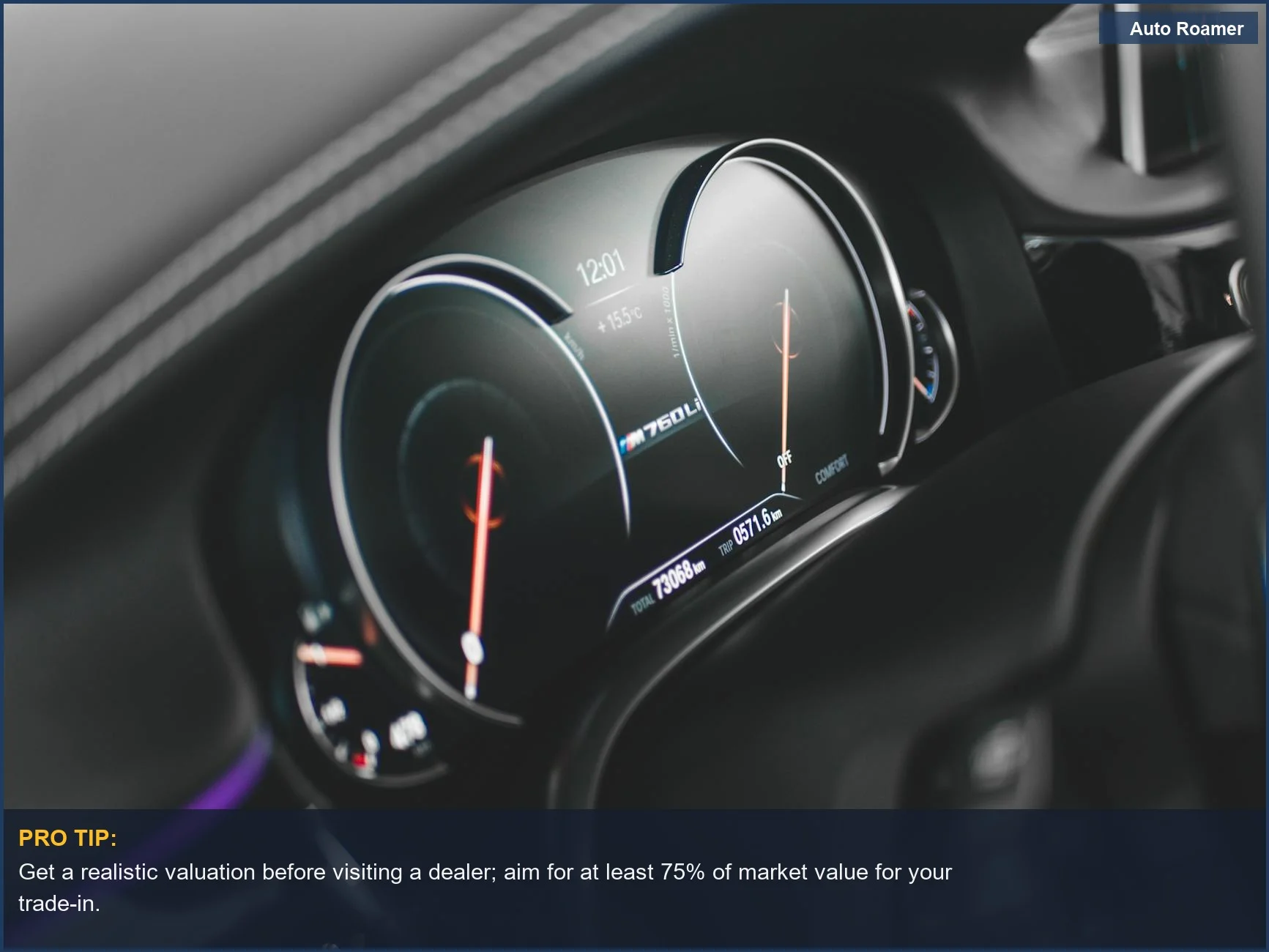
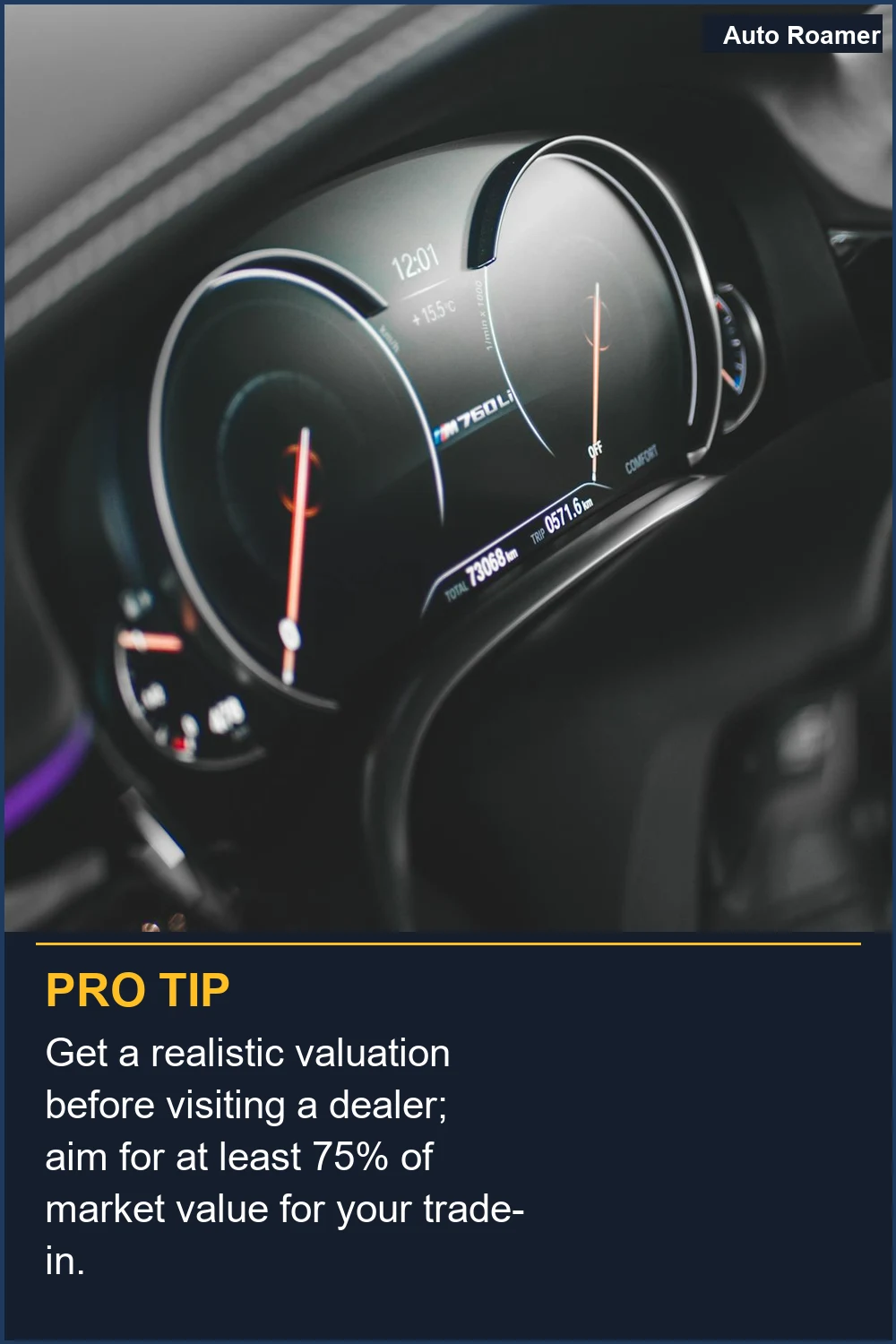
Get a realistic valuation before visiting a dealer; aim for at least 75% of market value for your trade-in.
This modern dashboard showcases a car's performance metrics. When ready to trade in your high mileage family car, research its value to avoid a lowball offer from dealers. | Photo by Vlad

What This Looks Like in Practice

I've seen all kinds of scenarios with high-mileage family cars. It's never a one-size-fits-all answer. The decision always comes down to the balance of mechanical integrity, cost-per-mile, and your tolerance for risk. Here are a few real-world examples I've encountered:
  • Scenario 1: The 2010 Toyota Sienna, 210,000 miles. Original owner. Meticulous maintenance records - every oil change, every fluid flush. Suspension replaced at 180k, timing belt done at 100k. Engine burned 0.5 quarts of oil per 3000 miles. Trade-in value: $3,500. Owner kept it, figuring the $1500 annual repair budget was cheaper than a new car payment. This is a solid decision based on known, manageable issues.

  • Scenario 2: The 2014 Ford Explorer, 130,000 miles. No maintenance records past 60k. Transmission started slipping between 2nd and 3rd gear. Check engine light for catalytic converter efficiency. Dealer offered $2,000 trade-in. Repair estimates: $4,000 for transmission, $1,200 for catalytic converter. Owner traded it in. The cost of repair far exceeded the vehicle's value, and the unknown maintenance history meant more issues were likely lurking. This is a clear case of diminishing returns.

Reddit discussions often highlight these situations.

  • Scenario 3: The 2016 Subaru Outback, 95,000 miles. Head gasket seeping oil externally. CV axles starting to click on turns. Trade-in offer: $8,000. Repair estimate: $2,500 for head gaskets, $600 for CV axles. Owner decided to fix it and keep it. The vehicle was still within a reasonable mileage range, and the repairs, while significant, were known and would provide another 50,000+ miles of service. This decision was based on a calculated repair-to-value ratio.

  • Scenario 4: The 2012 Honda CR-V, 160,000 miles. Rust starting to perforate the rocker panels. A/C compressor making bearing noise. Power steering pump weeping. Dealer offered $2,500. Owner sold it privately for $3,800, disclosing the issues. The rust was a structural integrity concern, and multiple minor failures indicated the vehicle was reaching its end-of-life cycle. The private sale maximized the return despite the issues. Understanding high mileage cars is crucial for both buyers and sellers.

  • Scenario 5: The 2017 Chevrolet Tahoe, 110,000 miles. AFM lifter failure causing a misfire. Check engine light. Dealer offered $10,000. Repair for lifters: $3,500. Owner traded it. The AFM issue is a known design flaw, and even with repair, the long-term reliability of that engine design is questionable. Sometimes, cutting your losses on a known engineering defect is the smart move.

To ensure your family car is safe, it's also wise to look into its accident history.
Balance mechanical integrity, cost-per-mile, and risk tolerance when deciding to trade your car before 150,000 miles.
A detailed view of a car's luxury dashboard. The decision on when to trade in a high mileage family car depends on factors like mechanical health and cost-per-mile analysis. | Photo by revac film's&photography

Mistakes That Cost People

People make some dumb mistakes when deciding to trade in a high-mileage car, mostly driven by emotion or bad advice. Here's what I see costing people money:

Mistake Why it's wrong (Physics/Engineering) Cost to You
Waiting for a 'catastrophic' failure. Ignoring early symptoms like a small fluid leak or odd noise. These are precursors to major component failure (e.g., a weeping water pump bearing that seizes and shreds the belt). Small fix becomes $1000+ tow and repair bill, zero trade value.
Over-investing in cosmetic repairs. Dealers don't care about your new floor mats. They look at structural integrity and drivetrain. A $300 paint correction on a car with a slipping transmission is wasted effort. $300-$500 wasted on detail, minimal increase in trade-in offer.
Not getting multiple offers. Relying on one dealer's offer is like asking a fox to guard the henhouse. Their offer is designed to maximize their profit, not your return. $500-$2000 in lost trade-in value.
Hiding known mechanical issues. Dealers have diagnostic tools and trained techs. They'll find the check engine light code, the rust, the worn suspension. Trying to hide it just makes you look dishonest and they'll lowball you further. Reduced trust, lower offer, potential legal issues.
Trading in with negative equity without a plan. Rolling negative equity into a new loan means you're paying interest on a car you no longer own. This creates a financial vortex that's hard to escape. Hundreds to thousands of dollars in unnecessary interest payments. This is a common discussion point on personal finance forums.
Ignoring seasonal market trends. Demand for vehicles fluctuates. Selling a convertible in January or a 4x4 in July often results in lower offers due to reduced buyer interest. $200-$500 in lost value.

Don't be the guy who puts $1500 into a new set of tires and brakes right before trading it in. Those are wear items. The dealer will factor them into their reconditioning cost anyway, but they won't give you dollar-for-dollar credit. You're just doing their work for them. Focus on the big-ticket items. If the engine is knocking, don't buy new wipers. That's just stupid.

Understanding the potential repair costs can help you make a more informed decision about trading in your vehicle.
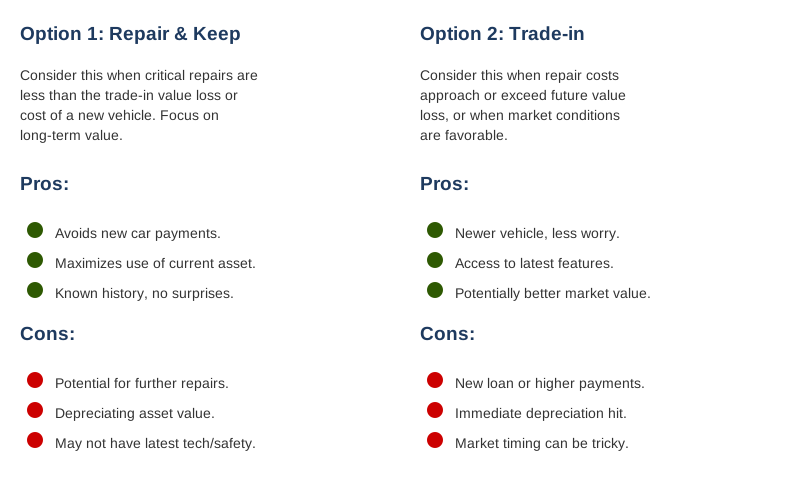
Pros/cons of trading high-mileage family car.
Product comparison for when to trade in a high mileage family car

Key Takeaways

Deciding when to trade in a high-mileage family car isn't about arbitrary numbers; it's a strategic decision based on mechanical integrity, financial outlay, and market timing. Don't let emotion or slick sales tactics dictate your move.

  • Understand the 'Why': Focus on the underlying physics of component failure - thermal cycling, fatigue, loss of tolerance. This dictates true remaining service life, not just the odometer. Modern cars can last well beyond 100,000 miles with proper care.
  • Calculate Cost-Per-Mile: Track your annual repair costs. When they consistently exceed 25% of the car's market value, you're likely in the red. This is your personal redline.
  • Prioritize Major Systems: Small dings and scratches are irrelevant.

Focus on the engine, transmission, and structural components. These are the deal-breakers for trade-ins. * Get Multiple Offers: Never take the first offer. Use online tools and visit several dealerships. Knowledge is power, especially when dealing with salespeople. * Clean, Don't Detail: A basic wash and vacuum is enough. Don't waste money on extensive cosmetic work that won't be recouped. You're selling a used vehicle, not a show car. * Know Your Car's Flaws: Be honest about known issues.

Trying to hide them only damages your credibility and will result in a lower offer once discovered. They have diagnostic equipment you don't. Your car's value depends on many factors, but transparency helps. * Timing Matters (Slightly): Spring and early summer typically see higher demand for used cars. If you can wait, a few months might net you a couple hundred dollars more. Market conditions do influence trade-in value, but not as much as mechanical condition.

Ultimately, it's about making a financially sound decision based on cold, hard data, not the dealer's sales pitch.

Understanding the potential cost of car repairs can help inform your trade-in decision.

Frequently Asked Questions

My mechanic quoted $800 to replace a worn control arm. Can I do it myself cheaper?
Absolutely. A new control arm assembly for a common family car like a Honda CR-V might cost $75-$150 for an aftermarket part. The shop's $800 quote includes about 2 hours of labor at $120/hour, plus markup. If you have basic hand tools, a jack, and jack stands, you can typically swap one in 90 minutes. You'll need an alignment afterward, which is another $100-$150. Total DIY: $250-$400. Mechanic: $800. Seems like a no-brainer to me.
Do I really need to check for parasitic draw with a multimeter if my battery keeps dying?
Yes, you absolutely need a multimeter. Your battery isn't just 'bad' because it's old; it's likely being drained by some phantom load. A $15 multimeter set to amperage is the only way to find a 50mA draw that's killing your 60Ah battery in 30 days. Without it, you're just guessing, and guessing costs money in replacement batteries. That 0.05 amp draw is a constant energy drain, slowly degrading your battery's internal chemistry through repeated deep discharge cycles. It's physics.
What if I fix a major issue like the transmission, and then something else expensive breaks right after?
That's the classic 'whack-a-mole' scenario. If you just dropped $4000 on a rebuilt transmission for a car worth $6000, and then the head gasket blows, you're in a deep financial hole. This indicates you didn't properly assess the vehicle's overall remaining service life. A major repair on an aging platform often just shifts the stress to the next weakest component. You put a new heart in a body with failing kidneys. Should've traded it when the first major system showed signs of terminal fatigue.
Can ignoring a small oil leak permanently damage my engine?
A 'small' oil leak isn't just messy; it's a symptom. If it's a valve cover gasket, no, not immediately. But if it's from the rear main seal, it can contaminate the clutch on a manual transmission, or worse, if the oil level drops too low, you'll starve the main bearings. That's metal-on-metal contact, rapidly increasing friction, generating localized thermal spikes, and leading to catastrophic engine failure due to bearing seizure. So, yes, it can permanently damage your engine by violating the fundamental principle of hydrodynamic lubrication.
My dealer said my 100,000-mile car is 'worthless' for trade-in. Is that true?
Worthless? No. That's a sales tactic to get you to accept a lower offer and buy a new car. A 100,000-mile car is not 'worthless' if it's been maintained. It's just past the point where the dealer can easily certify it and resell it with a warranty. They'll wholesale it or send it to auction. They're trying to buy it for as little as possible to maximize their profit on the next step. Don't fall for that garbage. Your car has intrinsic value based on its mass, materials, and functional capability. It's never 'worthless'.

Sources

Related Articles