
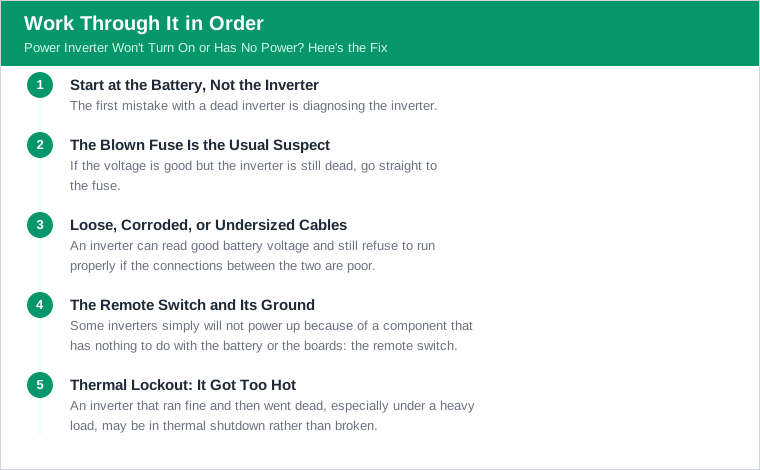
Start at the Battery, Not the Inverter
The first mistake with a dead inverter is diagnosing the inverter. Nine times out of ten the problem is on the DC side, and the fastest way to prove it is a voltmeter at the input terminals. Measure DC voltage directly at the inverter's input terminals - under no load first, then under load - to catch voltage drop from the cables and connections. Reading the battery itself is not enough, because the loss you are hunting often happens between the battery and the inverter.
Know the thresholds before you read the meter. Most 12V inverters shut down or refuse to start when input drops to about 10.5V DC, the low-voltage disconnect, and a low-voltage alarm often sounds first near 10.7-11.0V. If your terminals read below that, the inverter is doing exactly what it should - refusing to run on a battery that is too flat to support it. On a 24V system the equivalent low-voltage shutdown is about 21V DC.
The two-reading method is what separates a weak battery from a wiring loss. If the terminals read a healthy resting voltage with no load but collapse toward 10.5V the moment the inverter tries to draw, the battery may be fine while the cables or connections are strangling it under current. If they read low even at rest, the battery is the problem. Either way, you have learned more in thirty seconds with a digital multimeter than an hour of swapping parts would tell you. Start here every time.
The Blown Fuse Is the Usual Suspect
If the voltage is good but the inverter is still dead, go straight to the fuse. A blown inline DC fuse or a tripped breaker is one of the most common reasons an inverter won't power on - inspect it and replace it. Almost every correctly installed inverter has a fuse or breaker close to the battery on the positive cable, and that fuse is designed to be the first thing to fail so the wiring and the inverter survive.
The trap is that a blown fuse can look perfectly fine. Many high-amperage fuses hide their element inside an opaque body, so a visual check tells you nothing. The reliable test is continuity: pull the fuse and check it with a multimeter, or bridge the holder briefly to confirm power passes. A holder with a loose or corroded connection can also act like an open fuse even when the element is intact, so inspect the contact surfaces while you are in there.
Do not just replace a blown fuse and walk away, though. A fuse that blew did so for a reason - a surge, a short, a reversed connection, or a load beyond what the inverter can carry. Replace it with the correct rating (never a larger one to make the problem go away), then watch whether it holds. A fuse that blows again immediately points to a short or reverse-polarity event; one that held for months and finally gave up may just have fatigued. Sizing that fuse correctly is its own subject, and the next section covers the math.

Sizing That Fuse Right
A wrong-sized fuse causes both of the failures people blame on the inverter: too small and it blows under normal load, too large and it fails to protect the wiring. There is a simple rule. Inverter DC fuse sizing: continuous watts divided by battery voltage, times 1.25, equals the minimum fuse amps. The 1.25 (125%) multiplier covers inverter inefficiency and brief surges so the fuse does not blow on every startup.
Run the numbers on a common case. For a 1000W inverter on 12V: 1000 divided by 12, times 1.25, is about 104A - so you would use a 110A or 125A fuse. Undersize that to an 80A fuse and it will nuisance-blow the first time the inverter pulls its full rating; oversize it well beyond the rated figure and the cable could overheat before the fuse ever notices. The fuse protects the wire, so it has to be matched to both the load and the cable gauge.
This matters for a no-power complaint because a marginally undersized fuse produces an intermittent, maddening fault: the inverter runs light loads fine, then dies the instant you plug in something bigger, and by the time you look the fuse has blown and reset expectations. If your inverter keeps killing its fuse under normal use, do the math above before assuming the unit is faulty. A correctly sized fuse that still blows is telling you about a real short or overload; an undersized one is just telling you it was the wrong fuse.
Reverse Polarity Kills It Instantly
Of all the ways to kill an inverter, reversing the DC connections is the fastest and the most permanent. Reverse polarity - swapping the positive and negative - typically blows the inverter's internal fuse instantly and can permanently damage it. Always confirm polarity before connecting. There is no warning and no second chance; the damage is done in the moment the terminals touch the wrong posts.
This is a real risk in the field because DC cables are not always obviously marked, and a rushed connection in poor light is easy to get backwards. Red-to-positive and black-to-negative is the convention, but a previously modified harness or an aftermarket lead can defeat that assumption. Before you tighten anything, verify with a meter which terminal is actually positive rather than trusting the color of the insulation.
If an inverter went dead right after a reconnection, or after someone else touched the wiring, reverse polarity jumps to the top of the suspect list. The internal fuse may have taken the hit and protected the electronics - in which case a repair is possible - or the boards may be gone. Either way, the lesson is to prevent it: confirm polarity every single time, and consider that many quality installs add a reverse-polarity-protected connection precisely because this failure is so common and so unforgiving. A one-second check saves the whole unit.
Loose, Corroded, or Undersized Cables
An inverter can read good battery voltage and still refuse to run properly if the connections between the two are poor. Loose or corroded battery terminals cause voltage drop that starves the inverter - clean and tighten all connections. Every loose bolt and every film of corrosion is added resistance, and under the heavy current an inverter draws, that resistance turns into a voltage drop the inverter sees as a low battery.
The symptom pattern is distinctive. A starved inverter often powers up on no load, because a trickle of current passes a bad joint fine, then shuts down the instant a real load hits and the voltage collapses across the resistance. People read that as a failing inverter or a dying battery when the real fault is a green, crusty terminal or a bolt finger-tight instead of torqued. Pull each connection apart, clean the mating surfaces bright, and re-tighten firmly.
Cable size and length matter just as much as cleanliness. Undersized or overly long DC cables cause enough voltage drop under load to trip the low-voltage shutdown even when the battery is healthy. An inverter wants short, thick cable straight to the battery; a thin or long run acts like a permanent bad connection, dropping voltage every time the load rises. If an inverter behaves on a short bench lead but dies on its installed cable, the cable is the fault. Fix the connections and the wire before you condemn the box.

The Remote Switch and Its Ground
Some inverters simply will not power up because of a component that has nothing to do with the battery or the boards: the remote switch. A hardwired remote on/off switch, or its ground wire, if disconnected or faulty, will keep the inverter from powering up. If your inverter uses a remote panel and it shows no life at all, the signal path to that switch is worth checking before anything drastic.
The remote works by completing a small control circuit, and it depends on a good ground as much as a good signal wire. A remote switch with a broken lead, a corroded connector, or a ground that has worked loose leaves the inverter waiting for a turn-on command that never arrives. From the front it looks stone dead, but the power section is fine - it is simply never being told to start.
Diagnose it by isolating the switch. Check that the remote is actually in the on position, that its cable is seated at both ends, and that its ground connection is clean and tight. Many inverters can be tested by jumpering the remote terminals directly per the manual, which bypasses the switch entirely; if the inverter springs to life when jumpered, the switch or its wiring is your fault, not the inverter. It is a five-minute check that saves people from returning a perfectly good unit over a two-dollar switch.
Thermal Lockout: It Got Too Hot
An inverter that ran fine and then went dead, especially under a heavy load, may be in thermal shutdown rather than broken. Over-temperature lockout happens when the cooling fans fail or the vents clog with dust and the inverter protects itself by shutting down. Give it at least 6-12 inches of clearance on all sides. Heat is the enemy of every power electronic, and an inverter buried in a tight space or fed by a dead fan will cook itself into a self-protective coma.
The clue is timing and temperature. A thermal lockout does not happen at power-on; it happens after the inverter has been working, and the unit is usually hot to the touch when it quits. Let it cool and it comes back to life, which is the tell that separates thermal shutdown from a hard failure. If an inverter dies after twenty minutes of running a big load and revives once it cools, it is overheating, not failing.
The fixes are about airflow. Confirm the cooling fan actually spins when the inverter is loaded - a seized fan is a common culprit. Blow the dust out of the vents and heatsink, because a clogged unit traps its own heat. And give it room: an inverter shoved against a wall or into a sealed cabinet has no way to shed heat and will lock out under loads it could handle in open air. Relocate it, ventilate the space, and the phantom failures stop.

Know the Current It Pulls
Understanding how much current an inverter draws explains most of the failures above and prevents the next one. A rough rule: a 12V inverter draws roughly 1A per 100W of load from the battery, so a 1000W load pulls about 80-100A. That is an enormous current - the kind that finds every weak connection, undersized cable, and marginal fuse in the system and turns it into a fault.
Those numbers are why inverter problems are almost always DC-side problems. Pulling 80-100A through a thin lead or a loose terminal drops serious voltage, trips the low-voltage cutoff, and blows undersized fuses - all of which read as no power at the outlet. The inverter is not weak; the supply chain feeding it cannot deliver the current cleanly. Sizing the cable, the fuse, and the connections for that real current is what makes an install reliable.
There is a quieter cost too. No-load standby draw is typically about 0.5-1A - a few watts up to 10W or more - which quietly drains the battery if the inverter is left on. An inverter switched on and forgotten will flatten a battery over a few days entirely on its own, and then, of course, it will not turn on the next time because the battery has fallen below 10.5V. If your inverter is dead every time you come back to it after leaving it on, standby drain plus low-voltage cutoff is the loop you are stuck in. Switch it off when it is not working.
Cigarette Socket vs Hardwire
A huge share of no-power complaints come from asking a cigarette-lighter socket to do a job it was never built for. Cigarette-lighter and 12V accessory sockets are limited to about 10-15A - roughly 120-180W - so only small inverters (about 150-300W or less) should use them. Larger inverters must be hardwired directly to the battery. The socket's own fuse is the bottleneck, and it gives up long before the inverter does.
The math makes the mismatch obvious. A 300W cigarette-plug inverter pulls about 25A, which far exceeds a socket's rating and blows the socket fuse. From the driver's seat it looks like the inverter died, but what actually failed is the vehicle's accessory-circuit fuse, upstream and out of sight. People replace that fuse, run the inverter again, blow it again, and conclude the inverter is faulty - when the real problem is that the plug can never carry the current.
The rule is to match the connection to the load. Keep small inverters - phone and laptop chargers, a fan, a few hundred watts at most - on the socket, and hardwire anything bigger straight to the battery with properly sized cable and its own fuse. If a socket-powered inverter keeps killing fuses, do not size up the socket fuse; move the inverter to a hardwired feed. That single change resolves a whole category of intermittent no-power failures, and it is safer, because oversizing an accessory-socket fuse to chase the problem is how wiring overheats.

Test It Clean, Then Decide
Once the DC side is ruled out, a clean bench test tells you whether the inverter itself is truly dead. To test a suspected dead inverter, disconnect all loads, power it on, and measure AC output - no or low AC voltage with good DC input indicates an internal fault. Removing every AC device isolates the inverter from any downstream short or overload, so you are testing the unit alone rather than the whole system.
If the inverter produces correct AC output with nothing plugged in, the inverter is fine and the fault is a load, a cable, or a connection you have not found yet. If it shows no output despite healthy DC voltage at its terminals, a good fuse, correct polarity, and cool temperatures, then the internal fault is real and it is time for warranty service or replacement. That is the honest end of the road - but you should only reach it after everything upstream is clean.
One last variable can masquerade as a failure: waveform. Pure-sine-wave inverters output clean AC for sensitive electronics, while modified-sine inverters are cheaper but can cause buzzing, overheating, or a flat refusal-to-run in some devices. A device that will not power from a modified-sine inverter is not always proof the inverter is broken - some electronics simply reject the rougher waveform. If one appliance refuses but others work, suspect the waveform match before the inverter. Rule that out, and a dead outlet with good DC input genuinely points to the unit at last.