
Physics of Securing Roof Cargo for Highway Speeds (2026 Complete Guide)
The dealer wanted $250 for a roof rack installation on my buddy's Tacoma, claiming it was 'complex' due to aerodynamic considerations. It's four bolts. The real complexity isn't the install, it's making sure your cargo doesn't become a 70 MPH projectile.
The dealer wanted $250 for a roof rack installation on my buddy's Tacoma, claiming it was 'complex' due to aerodynamic considerations. It's four bolts. The real complexity isn't the install, it's making sure your cargo doesn't become a 70 MPH projectile. I've seen enough shattered rear windows to know that. Rack Attack points out the air dynamics over an open bed, but that's nothing compared to a poorly secured kayak.
The Short Answer
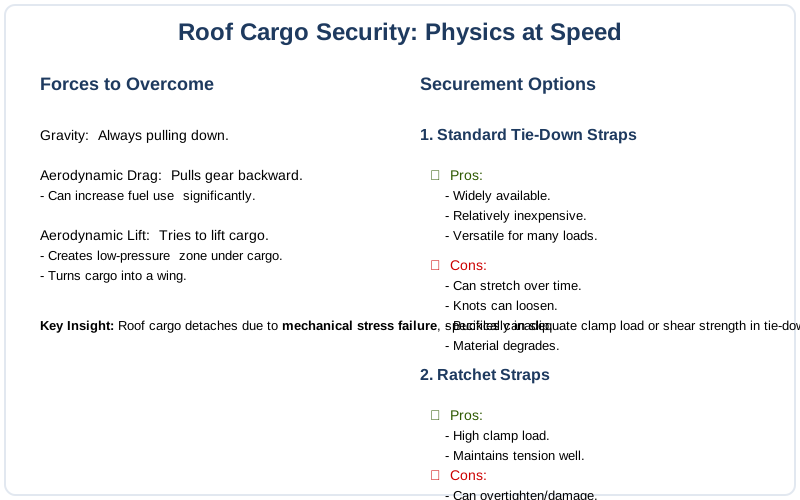
When you strap something to your roof, you're fighting three primary forces: gravity, drag, and lift. Gravity is easy; it's always pulling down. The real problem starts at 60 MPH.
Aerodynamic drag attempts to rip your gear straight backward. For an empty roof rack, this can increase fuel consumption by 5-15%, and a loaded rack can push that to 27.3% according to Tooenjoy. That's a lot of force trying to pull your stuff off the car.
Then there's aerodynamic lift. Airflow under a flat object, like a surfboard or a sheet of plywood, creates a low-pressure zone above it, essentially trying to turn your cargo into an airplane wing. If your tie-downs don't apply sufficient downward force, that lift will overcome the static friction.
The critical failure mode here is usually the tie-down itself, or the connection to the roof rack. Straps stretch, knots loosen, and cheap buckles slip. The material property of the strap or rope determines its tensile strength and its ability to maintain tension under dynamic loading.
Friction is your friend. The coefficient of friction between your cargo and the roof rack, or between the cargo and the vehicle roof if using soft racks, is paramount. A slippery surface requires significantly more clamp load to resist shear forces from acceleration and braking.
Mechanical stress on the roof rack mounting points is also a concern. High-frequency vibrations from wind buffeting and road imperfections can lead to fatigue failure in mounting bolts or the rack's structural members over time. This isn't usually a sudden event, but a slow degradation.
It's not just about the weight of the cargo, but its geometry and surface area. A flat, wide object presents a much larger surface for aerodynamic forces to act upon than a compact, dense one. This is basic fluid dynamics at play.
The center of gravity also shifts. Raising the vehicle's center of gravity with roof cargo impacts handling, especially in corners or crosswinds. Waag4x4 explains how this increases rollover risk. Your truck suddenly feels like a boat.
The Reality Check
Most vehicle manufacturers specify a dynamic load limit for roof racks. My 2018 Outback owner's manual says 150 lbs. The 2026 Kia Tasman, for example, lists a 100 kg (220 lbs) limit for driving, but up to 400 kg (880 lbs) when parked. That's a 4x difference in Kia's own documentation. You'd think the roof structure itself could handle the static load, but the dynamic forces are what kill it.
This isn't about the roof structure's static yield strength; it's about the cyclical stress on the mounting points, the fatigue limit of the materials, and the increased inertial mass during vehicle maneuvers. A sudden stop or swerve multiplies the perceived weight of your cargo significantly.
Overhang limits are another factor. Australian rules dictate a 1.2m front and rear overhang without a flag. Ignoring this creates a massive lever arm, amplifying lift and drag forces on the cargo's extremities. Drive.com.au covers these regulations. Brilliant engineering, really.
Soft racks, while cheap, suffer from poor load distribution and can introduce high-frequency vibration directly to the roof sheet metal, leading to paint abrasion or even stress cracks. Their straps running through the door seals also compromise sound insulation and weather sealing. They're fine for a quick trip, not for 800 miles at 75 MPH.
| Component | How It Fails | Symptoms | Fix Cost |
|---|---|---|---|
| Tie-down Strap | Material fatigue, UV degradation, buckle slippage (creep), abrasion | Cargo shifting, loose strap, high-frequency vibration noise from cargo | $15 - $50 (new straps) |
| Roof Rack Mount | Bolt shear, thread stripping, fatigue cracking of rack frame or vehicle roof attachment point | Rack wobble, abnormal noise, visible gap at mount, rust | $150 - $800 (rack repair/replacement) |
| Cargo Box Hinge/Latch | Plastic embrittlement (thermal cycling), latch mechanism wear, impact damage | Box lid flapping, water intrusion, cargo ejection | $50 - $300 (parts/repair kit) |
| Soft Rack Foam | Compression set, waterlogging, UV degradation, abrasion on paint | Cargo sag, paint damage, increased noise, mold growth | $30 - $60 (new pads) |
Ratchet straps are often preferred over cam buckles for heavier loads because they can apply higher, more consistent clamp load. The mechanical advantage of a ratchet means you can achieve a higher PSI on the cargo surface, increasing friction. The downside is overtightening, which can deform or crack delicate cargo like surfboards, as Outside Online warns. I've seen rails cracked from too much enthusiasm. Everything has a yield strength.
How to Handle This
-
Inspect Your Rack and Mounts (0 minutes): Before anything touches the roof, check your rack system. Grab each crossbar and try to rock it. Any play in the mounting feet? Loose bolts? Torque them to spec. A 10mm socket is usually all you need. Don't assume the dealer did it right.
-
Position Cargo for Aerodynamics (2 minutes): Place the heaviest items toward the center of the vehicle and as low as possible. Orient long, flat items like kayaks or lumber parallel to the direction of travel to minimize drag and lift. This reduces the frontal area presented to the airflow.
-
Use Quality Straps and Multiple Anchor Points (5 minutes): Don't cheap out on straps. Look for 1-inch wide nylon or polyester webbing with a minimum working load limit of 200 lbs per strap. Use at least two straps over the top, cinched down, and consider bow/stern lines for long loads. Outside Online suggests 15-foot heavy duty utility straps.
-
Achieve Adequate Clamp Load (3 minutes): Cinch straps until there's no perceptible movement when you push or pull on the cargo. The goal is to maximize friction between the cargo and the rack. If using ratchet straps, apply enough force to compress the cargo slightly, but avoid deforming it.
-
Check for Strap Vibration and Abrasion (1 minute): Flapping straps at highway speeds aren't just annoying; they're losing tension through high-frequency oscillation and can abrade your cargo or paint. Twist excess strap to prevent this. Pad sharp edges of your cargo where straps cross them to prevent cutting.
-
The Shake Test (30 seconds): After loading, vigorously shake the cargo by hand. If it wiggles more than 0.5 inches in any direction, your clamp load is insufficient. Re-tension or add more straps. This is a critical check for dynamic stability.
-
Road Test and Re-check (10 minutes): Drive a few miles, including some turns and a short highway burst. Pull over and re-check strap tension. Thermal cycling and vibration can cause straps to loosen, especially new ones. This initial re-check is non-negotiable for long trips. The Zebra recommends securing both widthwise and lengthwise.
What This Looks Like in Practice
-
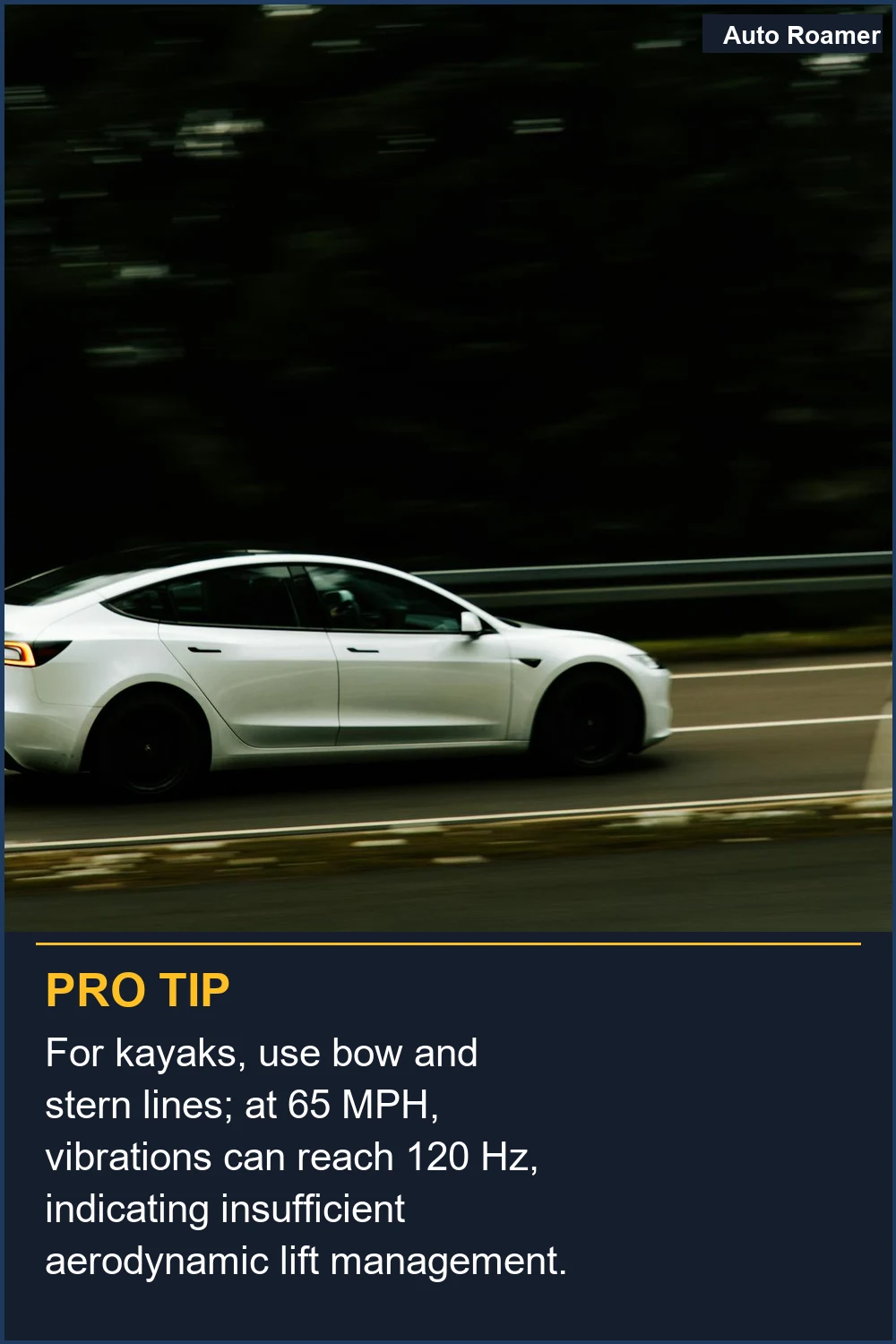
Kayak on a 2017 Subaru Outback (800 miles): Two cam-buckle straps over the hull, bow and stern lines to tow hooks. At 65 MPH, the bow line started to vibrate at 120 Hz, causing a low-frequency hum in the cabin. The aerodynamic lift on the bow was pulling the strap taut, indicating insufficient downward force or improper angle. A quick re-tension fixed it.
-
Lumber on a 2019 Ford F-150 with a bed rack (50 miles): Eight 2x4s, 16 feet long, secured with two ratchet straps. The overhang was 4 feet past the tailgate. No flag. A sudden crosswind gust at 55 MPH created a significant yaw moment, causing the truck to sway 1.5 degrees. The lumber acted as a large sail, stressing the rack's shear pins. Could have ended badly.
-
Roof Box on a 2020 Honda CR-V (300 miles): Thule Force XT L box, mounted via clamp mechanism. After 150 miles, the front clamp on the passenger side had loosened by 2 full turns due to road vibration. This allowed 0.75 inches of lateral play. If ignored, the box could have detached from the crossbar mounts.
-
Surfboard on a 2015 Toyota RAV4 with soft racks (20 miles): Single surfboard, two straps through the doors. At 45 MPH, the straps started to hum at 80 Hz, indicating aerodynamic flutter. The board had about 1 inch of vertical play, causing the paint to abrade where the board rested on the foam pads. Not ideal for paint integrity.
-
Camping gear in a cargo basket on a 2021 Jeep Wrangler (400 miles, off-road section): Duffle bags and plastic bins, secured with a cargo net. After 2 hours of washboard gravel roads, the net's elastic cords had stretched by 15%, and one of the plastic hooks had fatigued and broken off. This allowed a duffle bag to shift 6 inches laterally. Cargo nets are for containment, not primary load securing. They only provide minimal clamp load.

Mistakes That Cost People
| Mistake | Why It Fails (Physics) | Consequence |
|---|---|---|
| Using only one strap | Insufficient redundant restraint. If one point of mechanical bond fails, zero restraint. | Cargo detachment, high potential for road hazard. |
| Over-tightening straps | Exceeds material yield strength of cargo, leading to deformation or fracture. Stress concentration. | Cracked kayaks, dented boards, damaged cargo. |
| Under-tightening straps | Inadequate clamp load, insufficient static friction to resist shear forces from acceleration/braking and lift. | Cargo shifting, vibration, eventual detachment. |
| Ignoring bow/stern lines for long loads | Allows yawing and pitching moments, increasing aerodynamic lift and drag, stressing primary straps. | Increased aerodynamic drag (up to 28% according to ScienceDirect), high dynamic forces on primary straps. |
| Using old, frayed straps | Reduced tensile strength due to UV degradation and abrasion. Material fatigue. | Sudden strap failure under load, cargo detachment. |
| Exceeding vehicle's dynamic load limit | Overstresses roof structure and rack mounts. Shifts center of gravity, impacting vehicle stability. | Structural damage to roof, compromised vehicle handling, increased rollover risk. |
| Not re-checking tension after initial miles | Thermal cycling, vibration, and cargo settling can reduce initial clamp load. | Progressive loosening of straps, leading to cargo movement and potential detachment. |
Key Takeaways
Securing roof cargo isn't about guesswork; it's applied physics. Ignore the forces of drag, lift, and mechanical stress, and you're gambling with other people's windshields. The critical points are always the interface between the cargo and the rack, and the rack and the vehicle.
- Dynamic vs. Static Load: Understand your vehicle's limits. A 100 kg dynamic limit isn't a suggestion, it's a structural engineering constraint. Tooenjoy highlights this difference.
- Aerodynamic Management: Position cargo to minimize frontal area and flat surfaces that can generate lift. This reduces the force vectors trying to rip your gear off.
- Mechanical Integrity: Use high-quality, un-frayed straps. Ensure sufficient clamp load to maximize friction. Always check for play and re-tension after a short drive.
The dealer won't do this for you. Chrysler's own video talks about freeing up interior space, but not the physics of keeping it there. Brilliant.
Frequently Asked Questions
Is buying cheap $20 straps from a big box store really that bad compared to $50 brand-name ones?
Do I actually need bow and stern lines for my kayak, or are two straps over the middle enough for a 30-mile drive?
What if my roof rack feels secure after I've strapped everything down, but I still hear wind noise at highway speeds?
Can repeatedly carrying heavy loads on my roof rack permanently damage my car's roof or suspension?
My buddy said he just throws a tarp over everything and ties it down; is that good enough for rain protection and aerodynamics?
Sources
- Fuel consumption impacts of auto roof racks - ScienceDirect.com
- the-modern-truck-owners-guide-to-tonneau-covers-overland-systems?srsltid=AfmBOopA4AusXk9blSjOtyTGzmlf3zw5hjSJGuopD42Hfdjbh96AI1O
- Roof Luggage Rack | 2026 Chrysler, Dodge, Jeep & Ram Vehicles
- How to carry luggage and other holiday loads on top of your car
- How a Loaded Roof Rack Affects Your Truck's Center of Gravity
- How to Roof Rack Anything - Gear
- Roof Rack Usage and Load Limits | 2026 Kia Tasman
- How Roof Racks Impact Car Performance | Quick Guide - Tooenjoy
- Roof loads done right: Surfboards, kayaks and Aussie rules - Drive